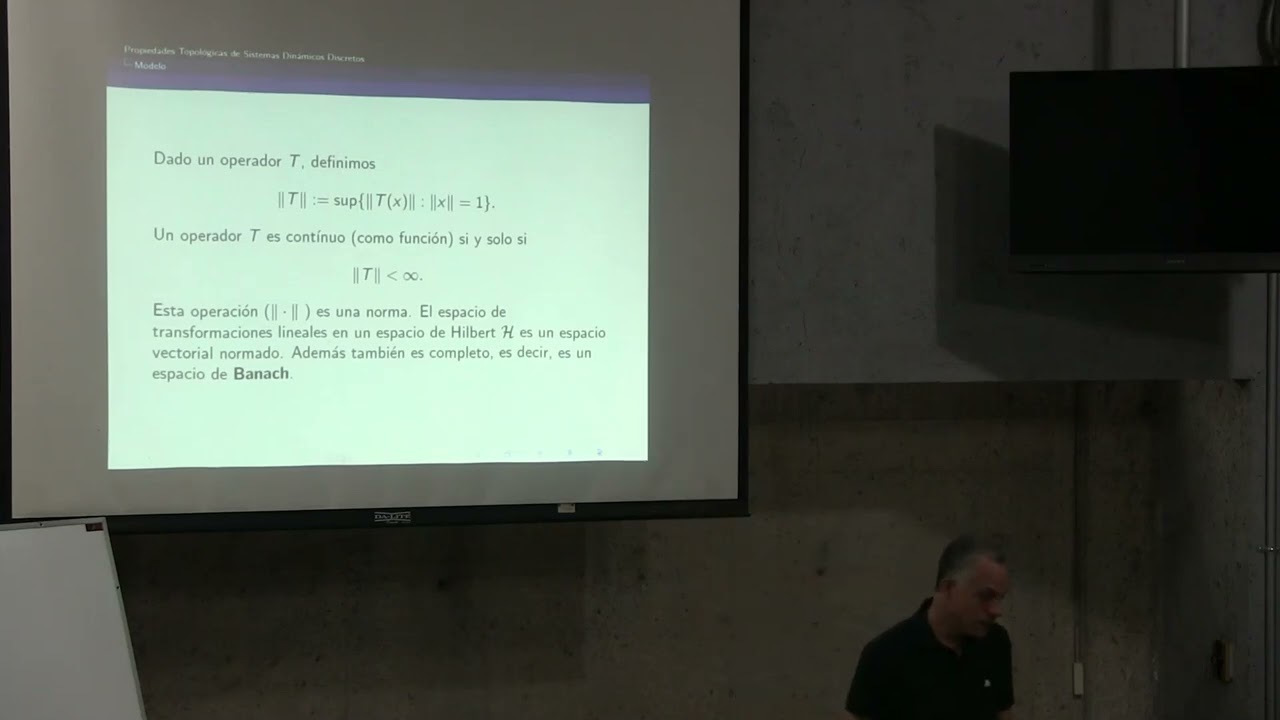
Propiedades Topológicas de Sistemas Dinámicos Discretos
Keywords
Summary
171 words
Critical Evaluation
Value of the Information & Strength of the Argument
The lecture provides valuable insights into the spectral theory of discrete operators and their topological implications. The argumentation is solid, building from basic definitions to the spectral resolution of the discrete Laplacian. The speaker effectively uses analogies with continuous systems and emphasizes the role of the Riemann surface and the torus in generating topological invariants. The connection to physical applications, such as topological insulators, adds practical relevance. The reasoning is clear and well-structured, though some steps are sketched rather than fully detailed.
Scientific Rigor, Source Quality, Title Accuracy
The scientific rigor is high; the speaker is a researcher at IIMAS and presents established mathematical concepts accurately. The sources are not explicitly cited in the video, but the content aligns with standard literature on spectral theory and topological insulators. The title accurately reflects the content, which focuses on topological properties of discrete dynamical systems. No comments were provided for analysis.
158 words
Title / Content Match
The title accurately reflects the content, which focuses on topological properties of discrete dynamical systems, specifically the discrete Laplacian and its spectral properties.
Quality & Reliability
8/10
The lecture is given by a researcher from IIMAS, UNAM, and presents rigorous mathematical content on discrete dynamical systems and topological properties. The speaker demonstrates deep knowledge and provides a clear, structured exposition. The content is consistent with established mathematical theory, though it is a seminar talk without peer review.
Key Moments
Markers derived by PSI from the transcript: the creator did not define chapters.
- Introduction to the Hilbert space ℓ²(ℤ, ℂⁿ) and definition of the discrete Laplacian.
- Discussion on the lack of a canonical first derivative on discrete sets and motivation for the discrete Laplacian.
- Introduction of the transfer matrix and reduction of the second-order difference equation to a first-order system.
- Use of the Riemann surface E = z + 1/z to characterize solutions and the emergence of plane waves.
- Application of the Fourier transform to diagonalize the discrete Laplacian, mapping to the torus.
- Computation of the spectrum as the interval [-2,2] and discussion of topological invariants.
- Connection to topological insulators and the 2016 Nobel Prize in Physics.
Contribution & Novelties
The lecture provides a clear pedagogical introduction to the spectral theory of the discrete Laplacian and its topological properties, bridging mathematical concepts with physical applications. The emphasis on the Riemann surface and the torus as sources of topological invariants is particularly insightful.
Pour aller plus loin :
- Spectral theory of operators — Provides background on spectral theory in infinite dimensions.
- Topological insulator — Explains the physical context and importance of topological invariants.
- Discrete Laplace operator — Details the discrete Laplacian and its properties.
83 words
Radar Profile
The radar profile shows high scores across all dimensions, indicating a technically rigorous and informative lecture with strong scientific quality. The balance between information quantity, quality, and technical depth is well maintained.