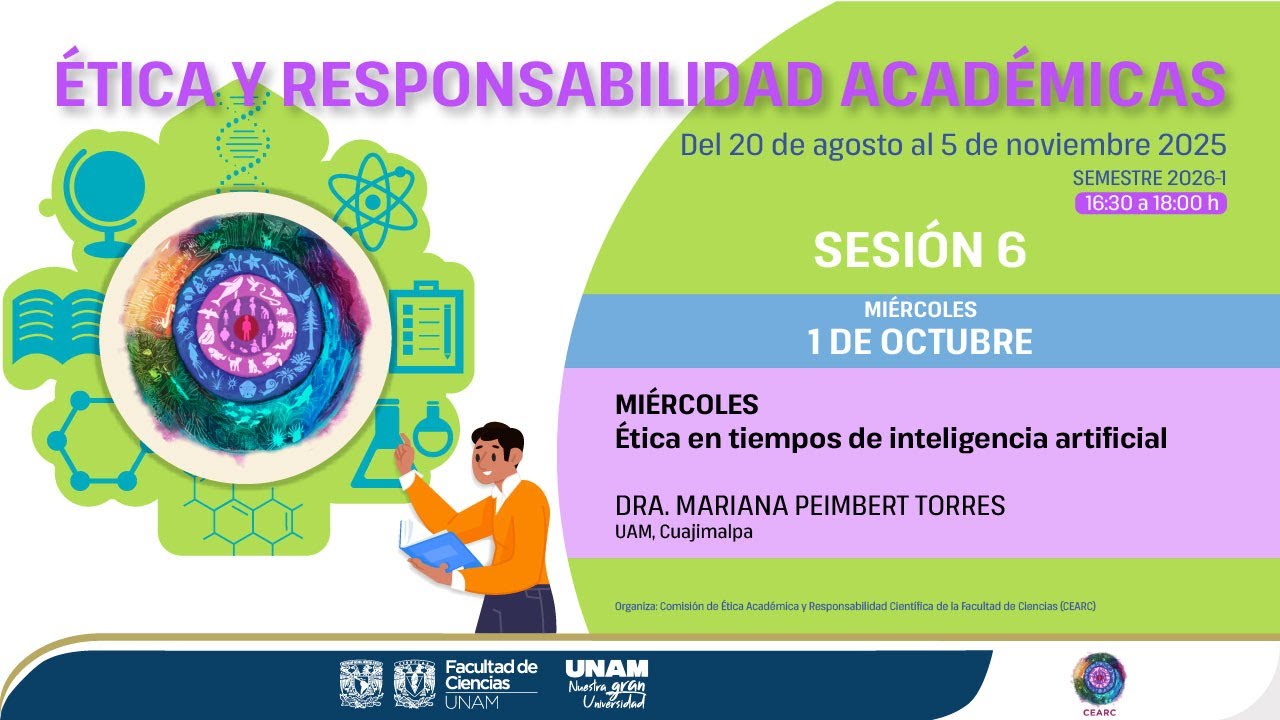
Ética en tiempos de inteligencia artificial
Keywords
Summary
180 words
Critical Evaluation
Value of the Information & Strength of the Argument
The talk provides valuable insights into the ethical challenges of AI, particularly in education and research. The speaker’s argumentation is solid, based on her personal experience and observations. She effectively illustrates points with relatable examples, such as the evolution of library research and the use of GPS. She acknowledges her non-expertise in AI and ethics, which adds credibility. However, the argumentation could be strengthened by more concrete data or case studies. The discussion of AI’s benefits and risks is balanced, avoiding extreme positions. She emphasizes the importance of critical thinking and responsible use, which is a valuable takeaway.
Scientific Rigor, Source Quality, Title Accuracy
The speaker demonstrates scientific rigor by clearly stating her background and limitations. She does not cite specific sources, but she references well-known AI applications like AlphaFold and ChatGPT. The title accurately reflects the content. The talk is more of an expert opinion than a rigorous scientific review, but it is well-structured and thoughtful. The lack of formal citations is a minor weakness, but the speaker’s expertise and balanced approach compensate.
183 words
Title / Content Match
The title accurately reflects the content, which focuses on ethical considerations of AI in academia and society.
Quality & Reliability
7/10
The speaker is a biologist and biochemist, not an AI or ethics specialist, but she provides a balanced, thoughtful perspective based on her experience as a researcher and educator. She clearly distinguishes her expertise and avoids overclaiming. The content is well-structured and grounded in practical examples, though it lacks deep technical detail and formal citations.
Key Moments
Markers derived by PSI from the transcript: the creator did not define chapters.
- Introduction and speaker's background
- Discussion on the shift in education from encyclopedic to problem-solving
- Explanation of AI as pattern recognition and examples like GPS and spam filters
- Why AI is booming now: data, hardware, and algorithms
- AI in biology: AlphaFold and species recognition
- Generative AI applications and risks like hallucination and bias
- Ethical considerations: data privacy, environmental impact, and digital divide
- Call for critical thinking and responsible use
Cited Sources
- AlphaFold — Mentioned as a revolutionary AI tool for protein structure prediction.
- ChatGPT — Mentioned as a generative AI for text.
Concurring Sources
- AI Ethics Guidelines — European Commission's guidelines on trustworthy AI, aligning with the talk's emphasis on ethics.
Contribution & Novelties
The talk offers a practical perspective from a scientist and educator on integrating AI ethically in academia. It emphasizes the shift from knowledge accumulation to asking relevant questions, a novel angle. The speaker’s balanced view, avoiding both techno-optimism and pessimism, is valuable.
Pour aller plus loin :
- AI Ethics — Provides an overview of ethical issues in AI.
- Algorithmic bias — Discusses how AI can perpetuate biases.
- Responsible AI — Framework for developing AI responsibly.
75 words
Radar Profile
The radar profile shows high scores in quality of information and fiabilité, reflecting the speaker's expertise and balanced approach. The lower score in technical level indicates the talk is accessible to a general audience. Overall, the talk is strong in providing ethical insights but less technical depth.
💬 No comments were provided for analysis.