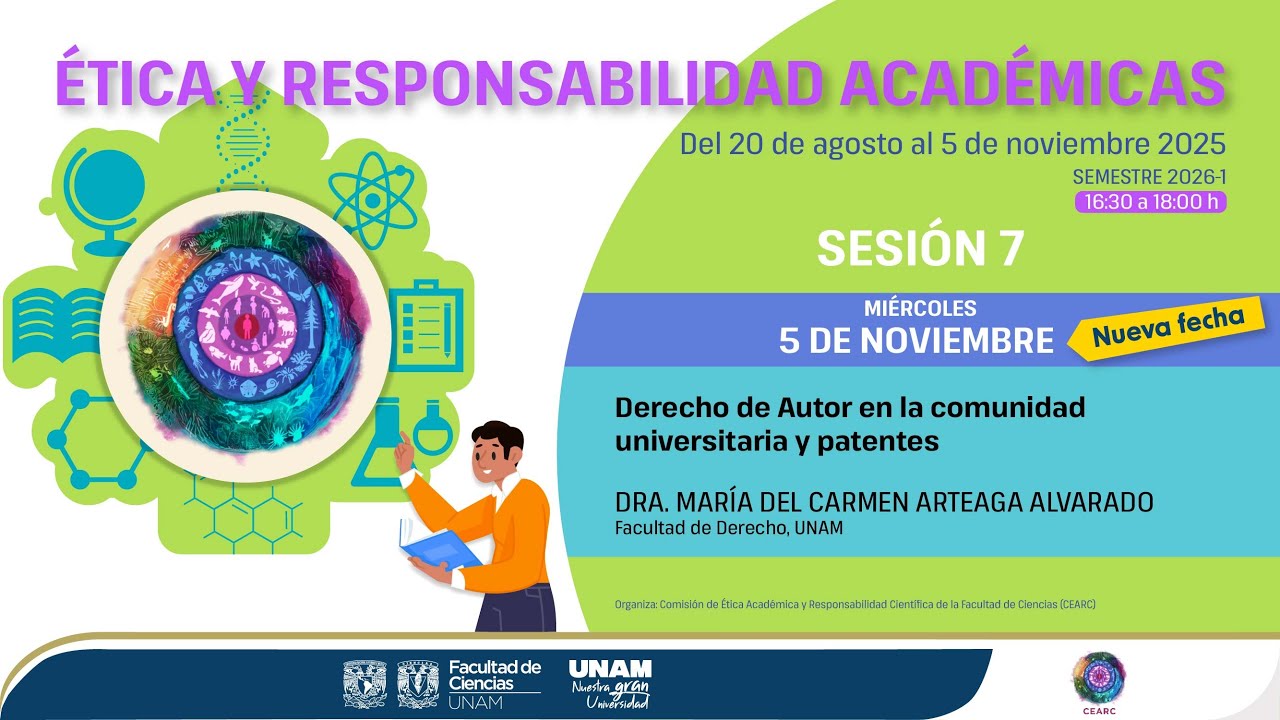
Derecho de autor en la comunidad universitaria y patentes
Keywords
Summary
196 words
Critical Evaluation
Value of the Information & Strength of the Argument
The value of the information is high for a general audience, as it clarifies common misconceptions about intellectual property, such as the difference between author and titular owner, and the automatic protection of works. The argumentation is solid, grounded in Mexican law and international treaties, and the speaker’s extensive experience lends credibility. She uses clear examples and analogies to explain complex legal concepts, making the content accessible. However, the talk is more descriptive than analytical, and it does not delve into critical debates or recent legal developments in depth.
Scientific Rigor, Source Quality, Title Accuracy
The scientific rigor is adequate for a conference aimed at a university community. The speaker cites Mexican laws (Ley Federal del Derecho de Autor, Ley de la Propiedad Industrial) and international treaties (Berne Convention) implicitly. She does not provide specific references or citations, but her expertise and the institutional context support the reliability. The title accurately reflects the content, which covers both copyright and patents in the university context. The talk is well-structured and logically organized, though it could benefit from more concrete examples and case studies.
191 words
Title / Content Match
The title accurately reflects the content, which covers copyright and patents in the university context.
Quality & Reliability
8/10
The speaker is a highly qualified legal expert with extensive experience in intellectual property, including roles at IMPI and Indautor. The content is well-structured, accurate, and based on Mexican law and international treaties. However, it is a general overview without deep technical detail, and some statements are simplified for a broad audience.
Key Moments
Markers derived by PSI from the transcript: the creator did not define chapters.
- Introduction and announcements about the conference series and a fan cinema contest.
- Speaker introduction and brief biography of Dr. Arteaga Alvarado.
- Definition of intellectual property and its branches: copyright, industrial property, and plant varieties.
- Explanation of copyright principles: automatic protection, originality, and the distinction between moral and economic rights.
- Discussion on the subject of copyright: author vs. titular owner, and the role of the university.
- Comparison between copyright and the Anglo-Saxon copyright system.
- Explanation of the object of copyright: works must be original and fixed in a material medium.
- Discussion on plagiarism and ethical considerations in academic settings.
- Overview of patents: requirements, duration, and the concept of public domain.
- Q&A session addressing questions about AI-generated works and practical steps for protection.
Cited Sources
- Ley Federal del Derecho de Autor (Mexico) — Mentioned as the legal basis for copyright in Mexico.
- Ley de la Propiedad Industrial (Mexico) — Mentioned as the legal basis for patents and industrial property.
Concurring Sources
- WIPO Guide to Intellectual Property — General reference on intellectual property concepts, consistent with the talk.
Contribution & Novelties
The talk provides a clear and accessible overview of intellectual property rights tailored to a university audience, emphasizing the distinction between author and titular owner, and the importance of ethical practices. It serves as a practical guide for academics and students on how to protect their creations and respect others’ rights.
Pour aller plus loin :
- Berne Convention — International treaty on copyright protection, foundational to the principles discussed.
- World Intellectual Property Organization (WIPO) — Global organization for intellectual property, with resources on copyright and patents.
- Mexican Institute of Industrial Property (IMPI) — Official Mexican authority for patents and trademarks, relevant for patent procedures.
- UNAM Intellectual Property Office — University office that manages intellectual property rights for the institution.
119 words
Radar Profile
The radar profile shows high scores in quality and reliability, reflecting the speaker's expertise and accurate legal information. The quantity of information is moderate, as the talk is a general overview. The technical level is moderate, suitable for a non-specialist audience, but not highly technical.
💬 No comments were provided for analysis.