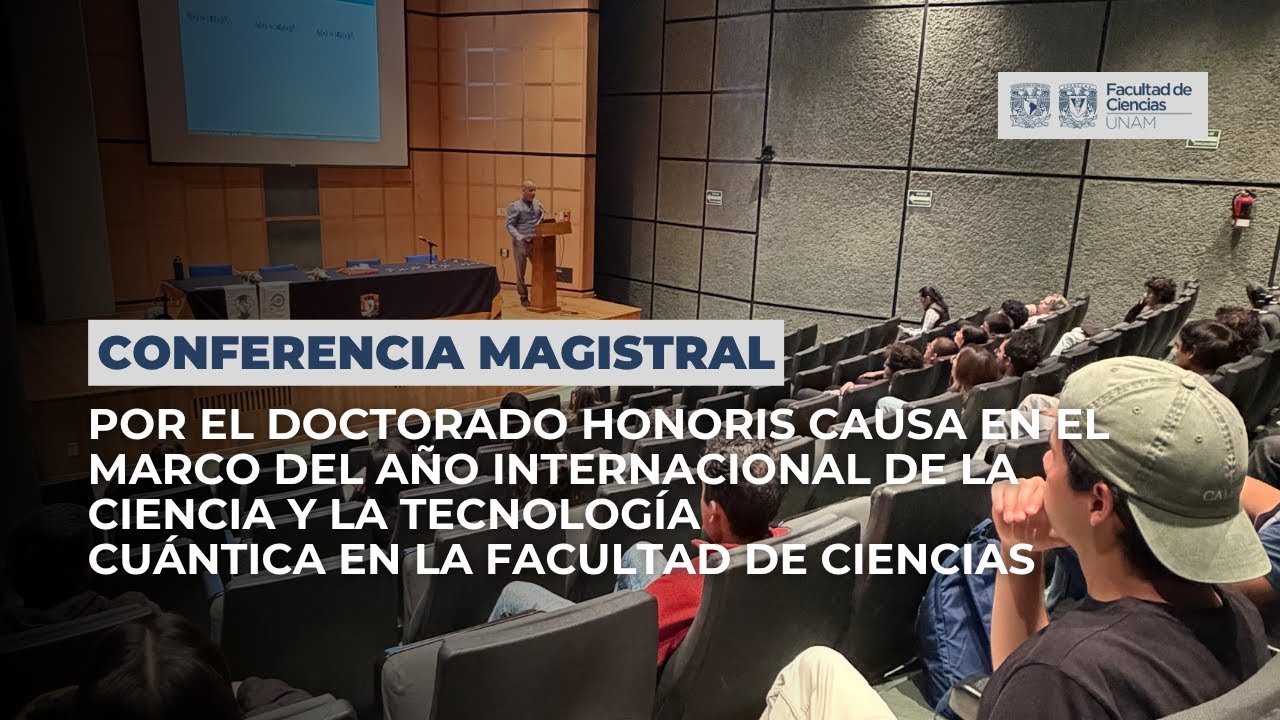
Cuantos de Ciencias - Conferencia magistral con el Dr. Pablo Barberis Blostein
Keywords
Summary
195 words
Critical Evaluation
Value of the Information & Strength of the Argument
The talk provides a clear and accessible introduction to quantum metrology, building from classical estimation theory to the quantum framework. The argumentation is solid, based on well-established theoretical results (Cramér-Rao bound, Fisher information) and illustrative examples. The speaker effectively motivates the importance of quantum entanglement for surpassing classical precision limits. However, the presentation is largely theoretical, with limited discussion of experimental implementations or practical challenges. The value lies in its pedagogical clarity and the demonstration of how quantum resources can enhance measurement precision.
Scientific Rigor, Source Quality, Title Accuracy
The scientific rigor is high, as the speaker relies on fundamental results in estimation theory and quantum mechanics. The sources are not explicitly cited in the talk, but the concepts are standard and well-documented in the literature. The title accurately reflects the content, focusing on the utility of quantum entanglement for frequency estimation. The talk is well-structured and the mathematical derivations are presented clearly, though some steps are simplified for the audience.
170 words
Title / Content Match
The title accurately reflects the content: a lecture on the utility of quantum entanglement for improving frequency estimation precision.
Quality & Reliability
8/10
The speaker is a researcher in quantum optics and quantum information, and the talk is based on established results (Cramér-Rao bound, Fisher information, maximum likelihood estimation). The presentation is rigorous and well-structured, though it is a conference talk rather than a peer-reviewed publication.
Key Moments
Markers derived by PSI from the transcript: the creator did not define chapters.
- Introduction to the lecture structure and the concept of indirect measurement.
- Example of estimating a parameter using a biased die, introducing estimators and maximum likelihood.
- Derivation of the Cramér-Rao bound and its implications for classical estimation.
- Transition to quantum metrology, defining the problem of estimating Hamiltonian parameters.
- Introduction of quantum Fisher information and the quantum Cramér-Rao bound.
- Discussion of entangled states and Heisenberg scaling, and brief overview of the speaker's research.
Contribution & Novelties
The talk provides a comprehensive overview of quantum metrology, emphasizing the role of entanglement in achieving precision beyond classical limits. It bridges classical estimation theory with quantum mechanics, making the topic accessible to a broad audience. The speaker’s research on open quantum systems adds a contemporary perspective, highlighting challenges in realistic implementations.
Pour aller plus loin :
- Quantum metrology — Overview of quantum-enhanced measurement techniques.
- Cramér–Rao bound — Fundamental limit in estimation theory.
- NOON state — Entangled state used in quantum interferometry.
82 words
Radar Profile
The radar profile shows high scores in information quantity, quality, and technical level, reflecting a dense and well-structured lecture. The global reliability is also high, indicating that the content is trustworthy and based on established science.