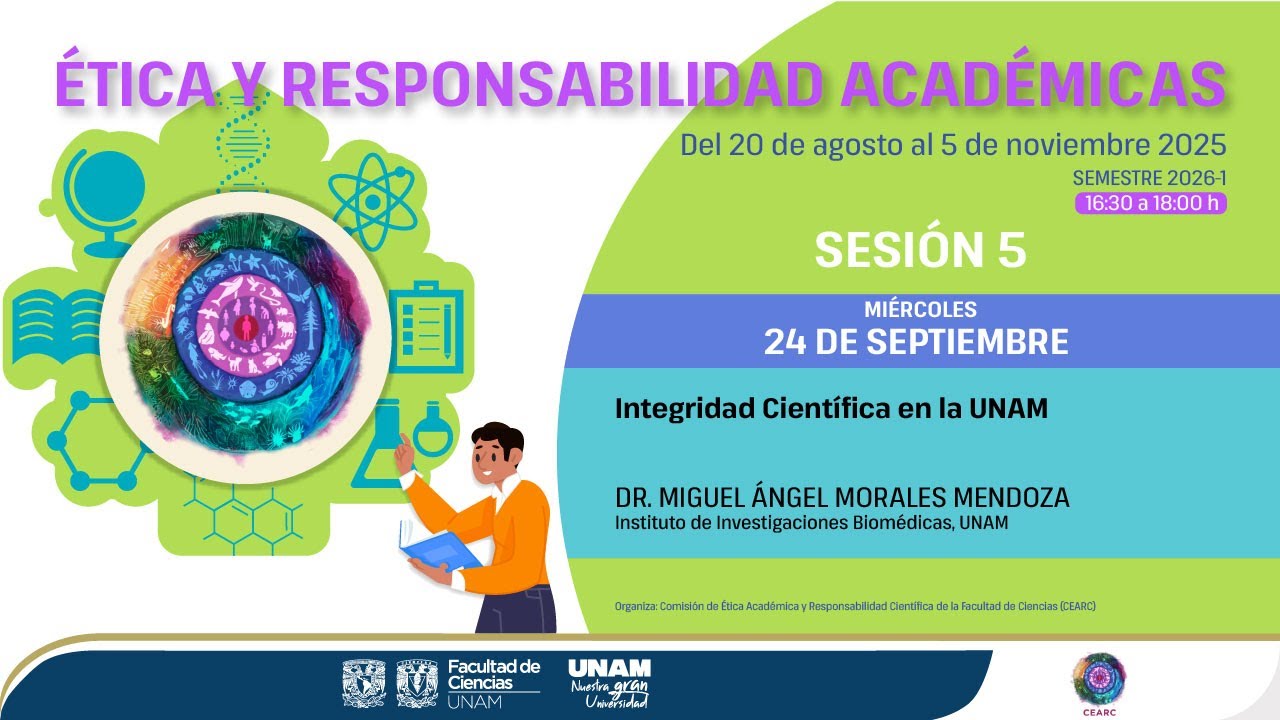
Integridad científica en la UNAM
Keywords
Summary
158 words
Critical Evaluation
Value of the Information & Strength of the Argument
The talk provides valuable insights into the practical implementation of scientific integrity at a major university, drawing on the speaker’s direct experience. The argumentation is coherent and grounded in real-world examples, such as the development of the ethics code and the discussion of fraud cases. However, the talk is largely based on personal experience and general knowledge, with limited systematic citation of specific studies or data. The speaker acknowledges his non-expert status, which adds authenticity but also limits the depth of theoretical analysis. The discussion of motivations for fraud and proposed solutions is reasonable but not deeply evidence-based.
Scientific Rigor, Source Quality, Title Accuracy
The talk demonstrates a good understanding of the institutional framework for research ethics at UNAM, referencing the university’s code of ethics and the historical documents like the Nuremberg Code and Declaration of Helsinki. The speaker cites his own work on the ethics code, which adds credibility. However, many claims are made without specific citations, and the talk relies heavily on anecdotal evidence. The title accurately reflects the content, focusing on scientific integrity within the UNAM context. The talk is well-structured and informative, but the lack of systematic referencing and the informal style reduce its scientific rigor.
209 words
Title / Content Match
The title accurately reflects the content, which focuses on scientific integrity within the UNAM context, including its ethical codes and practical issues.
Quality & Reliability
7/10
The speaker is a senior researcher with direct involvement in developing an ethics code at UNAM, providing firsthand experience. However, the talk is largely anecdotal and lacks systematic citation of sources, though it references key historical documents and institutional codes.
Key Moments
Markers derived by PSI from the transcript: the creator did not define chapters.
- Introduction and speaker's background
- Origin of the ethics code at IIB
- UNAM's ethical principles on integrity and honesty
- Historical context: Nuremberg Code and Declaration of Helsinki
- Motivations for scientific fraud
- Examples of data falsification and manipulation
- Consequences of fraud and the paracetamol example
- Measures to combat fraud: oversight and ethics committees
- Plagiarism detection software at UNAM
- Experience developing the ethics code and final remarks
Cited Sources
- Código de ética de la UNAM — Referenced as the university's ethical code containing principles on integrity and academic honesty.
- Nuremberg Code — Mentioned as the first international code defining ethical principles for research.
- Declaration of Helsinki — Referenced as a key document for medical research ethics.
Concurring Sources
- Código de ética de la UNAM — Aligns with the speaker's description of UNAM's ethical principles.
- Declaration of Helsinki — Supports the historical context of research ethics.
Dissenting Sources
- No specific discordant sources identified — The talk does not present controversial claims that would require discordant sources.
Contribution & Novelties
The talk provides a first-hand account of the development of an institutional ethics code at UNAM, offering practical insights into the challenges and processes involved. It emphasizes the importance of institutional mechanisms, such as ethics committees and plagiarism detection, in upholding scientific integrity. The discussion of the paracetamol-autism false claim illustrates the real-world impact of misinformation.
Pour aller plus loin :
- Office of Research Integrity — U.S. government body overseeing research integrity, relevant for policies and definitions.
- Committee on Publication Ethics (COPE) — Provides guidelines for ethical publishing, useful for understanding best practices.
- Retraction Watch — Tracks retractions of scientific papers, offering examples of misconduct cases.
106 words
Radar Profile
The radar profile shows balanced scores across information quantity, quality, technical level, and reliability, indicating a moderately informative and credible talk. The technical level is moderate, suitable for a general academic audience, while the reliability is supported by the speaker's direct experience.
💬 No comments were provided for analysis.