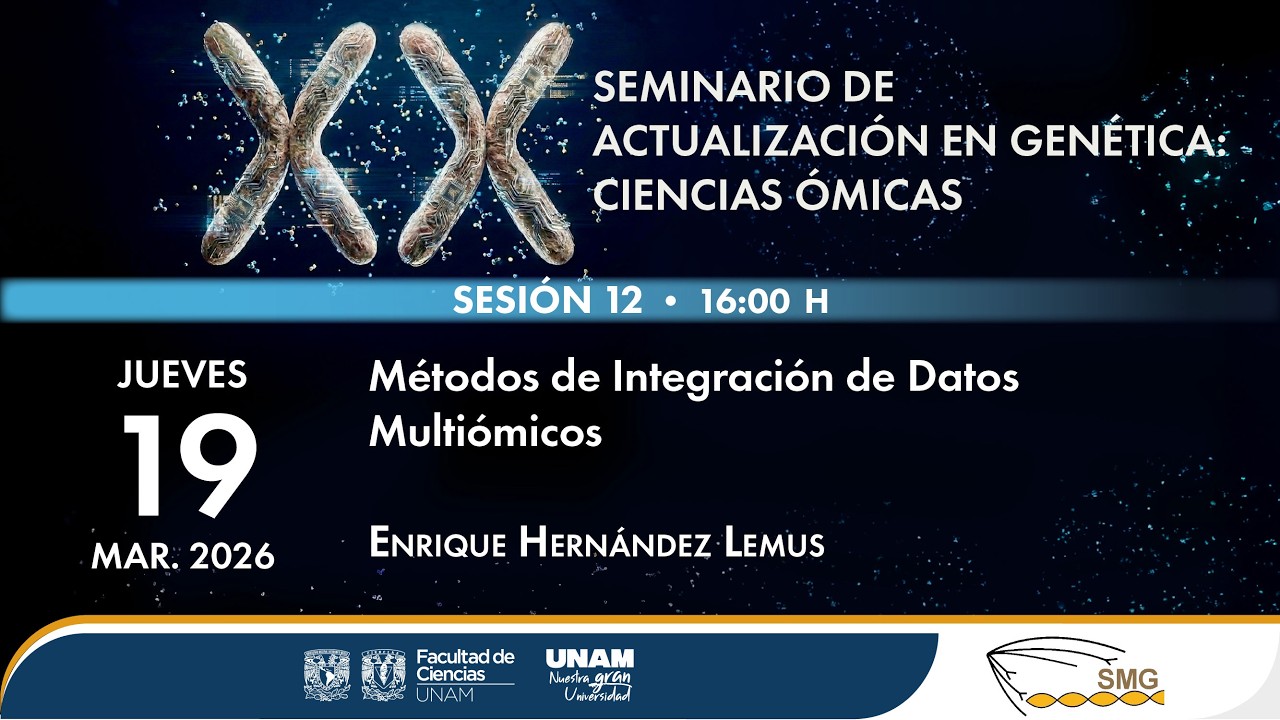
Métodos de integración de datos multiómicos
Keywords
Summary
154 words
Critical Evaluation
Value of the Information & Strength of the Argument
The presentation provides a comprehensive overview of multi-omics data integration, highlighting both the challenges and the available methods. The speaker’s argumentation is solid, grounded in his extensive experience in the field. He effectively uses analogies (e.g., paella, elephant in a dark room) to explain complex concepts. The talk is well-structured, progressing from biological complexity to integration strategies and specific methods. The value lies in its clear exposition of the key issues and the classification of integration approaches, which is useful for both newcomers and experienced researchers.
Scientific Rigor, Source Quality, Title Accuracy
The speaker is a recognized expert, and the content is consistent with current knowledge in the field. However, specific sources are not cited in the talk, and the description provides no references. The title accurately reflects the content. The presentation is a seminar, so it is not peer-reviewed, but the speaker’s credentials lend credibility. The talk is scientifically rigorous in its explanations, though it would benefit from explicit citations to the literature.
173 words
Title / Content Match
The title accurately reflects the content, which focuses on methods for integrating multi-omics data.
Quality & Reliability
8/10
The speaker is a highly qualified researcher with extensive experience in computational biology and genomics. The content is based on his expert knowledge and experience, but it is a seminar presentation rather than a peer-reviewed publication. The information is presented clearly and logically, with appropriate caveats about the complexity of multi-omics integration.
Key Moments
Markers derived by PSI from the transcript: the creator did not define chapters.
- Introduction to the complexity of biological systems and the need for multi-omics integration.
- Discussion of the challenges in integrating data from different omics technologies.
- Explanation of N-integration and P-integration strategies.
- Overview of early integration methods, including data normalization and regularization.
- Discussion of late integration approaches and their advantages.
- Presentation of specific computational methods such as matrix factorization and network-based integration.
- Consideration of biological context and validation strategies.
- Future directions, including integration of clinical and environmental data.
Contribution & Novelties
The talk provides a clear and comprehensive framework for understanding multi-omics data integration, distinguishing between N- and P-integration and early vs. late integration. It emphasizes the importance of considering biological complexity and the need for robust statistical methods. The speaker’s perspective as a physicist and computational biologist offers a unique angle.
Pour aller plus loin :
- Multi-omics integration in the age of single-cell biology — Relevant review on recent advances.
- MOFA+: a statistical framework for comprehensive integration of multi-modal single-cell data — Description of a popular integration method.
- The Human Cell Atlas — International initiative relevant to multi-omics integration.
99 words
Radar Profile
The radar profile shows high scores across all dimensions, indicating a well-balanced presentation with substantial information, high technical depth, and strong reliability. The speaker's expertise is evident, and the content is both informative and credible.