De Ondas Viajeras a Sistemas Dinámicos
Keywords
Summary
157 words
Critical Evaluation
Value of the Information & Strength of the Argument
The talk provides valuable historical and conceptual insights into the development of traveling wave theory, connecting it to dynamical systems. The argumentation is solid, building from historical examples to mathematical formulations. The speaker effectively uses analogies and examples to make complex ideas accessible. However, some parts are presented at a high level without full technical detail, which may leave advanced viewers wanting more depth.
Scientific Rigor, Source Quality, Title Accuracy
The presentation is scientifically rigorous, drawing on classical papers by Fisher and KPP, as well as the speaker’s own publications. The sources are credible and well-integrated. The title accurately reflects the content, which transitions from traveling waves to dynamical systems. The talk is well-structured and the historical narrative is engaging.
129 words
Title / Content Match
The title accurately reflects the content, which transitions from traveling waves in reaction-diffusion equations to their interpretation in dynamical systems.
Quality & Reliability
8/10
The speaker is a recognized academic with decades of research in the field, and the talk is based on his own published work and classical references. The presentation is rigorous and well-structured, though it is a seminar aimed at students, so some technical details are simplified.
Key Moments
Markers derived by PSI from the transcript: the creator did not define chapters.
- Introduction and overview of the talk's structure.
- Discussion of Robert Luther's 1906 work on chemical wave propagation.
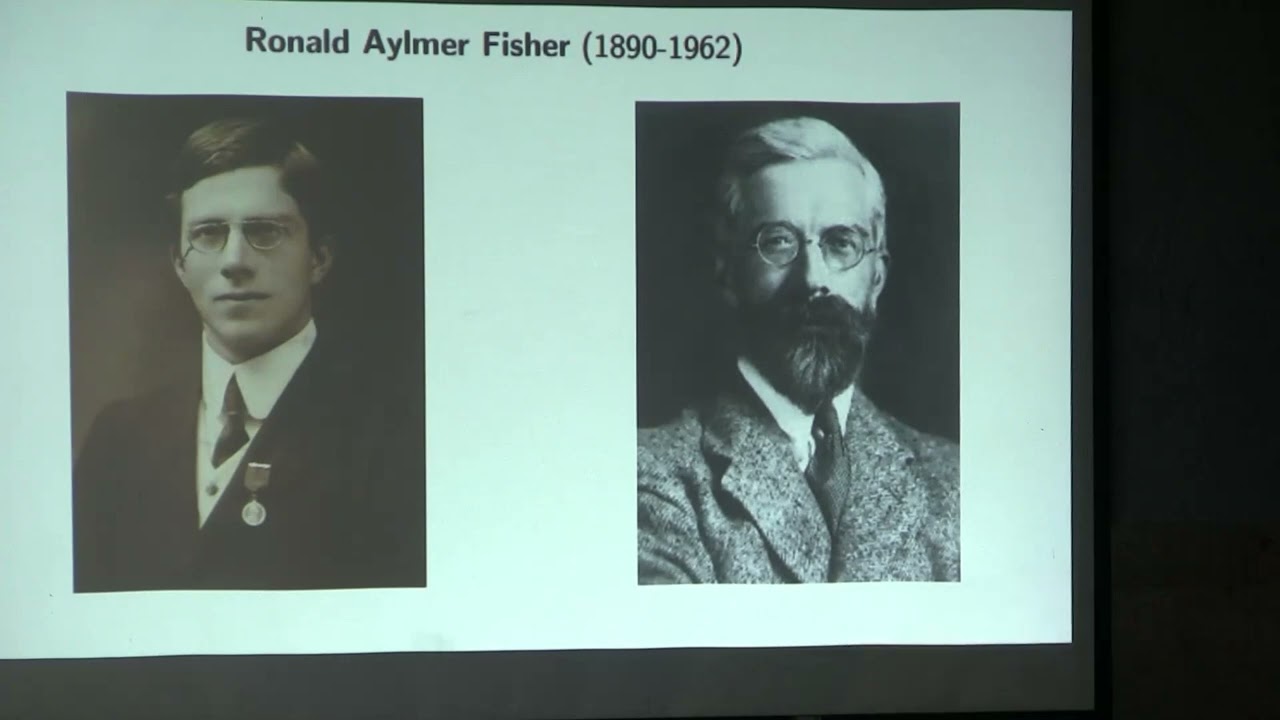
- Presentation of Ronald Fisher's 1937 model of gene spread and the derivation of the Fisher equation.
- Introduction of the Kolmogorov-Petrovskii-Piskunov (KPP) paper and its dynamical systems approach.
- Explanation of partial differential equation classification and the diffusion equation derivation.
- Definition of traveling waves and discussion of existence and convergence problems.
- Connection to dynamical systems and the speaker's own research contributions.
Cited Sources
- Propagation of chemical reactions in space (1906) — Robert Luther's work on chemical wave propagation, mentioned as the starting point.
- The wave of advance of advantageous genes (1937) — Ronald Fisher's paper on the spread of advantageous genes, which introduced the Fisher equation.
- A study of the diffusion equation with increase in the amount of substance, and its application to a biological problem (1937) — Kolmogorov, Petrovskii, and Piskunov's seminal paper that reformulated the problem using dynamical systems.
Concurring Sources
- Traveling wave solutions of reaction-diffusion equations — General theory of traveling waves in reaction-diffusion systems, consistent with the talk's content.
- Fisher's equation — Detailed information on the Fisher equation, which is central to the talk.
Contribution & Novelties
The talk provides a historical and conceptual synthesis of traveling waves in reaction-diffusion equations, linking them to dynamical systems theory. It offers a pedagogical perspective that is valuable for students and researchers new to the field. The speaker also shares personal insights and research experiences, adding a unique perspective.
Pour aller plus loin :
- Traveling wave — General concept of traveling waves in various contexts.
- Reaction–diffusion system — Mathematical models of pattern formation and wave propagation.
- Fisher’s equation — The specific equation introduced by Fisher.
- Kolmogorov–Petrovskii–Piskunov equation — The KPP equation and its significance.
94 words
Radar Profile
The radar profile shows high scores in information quantity, quality, and reliability, with a slightly lower technical level, reflecting the talk's aim to be accessible to students. The overall balance indicates a well-rounded and informative presentation.