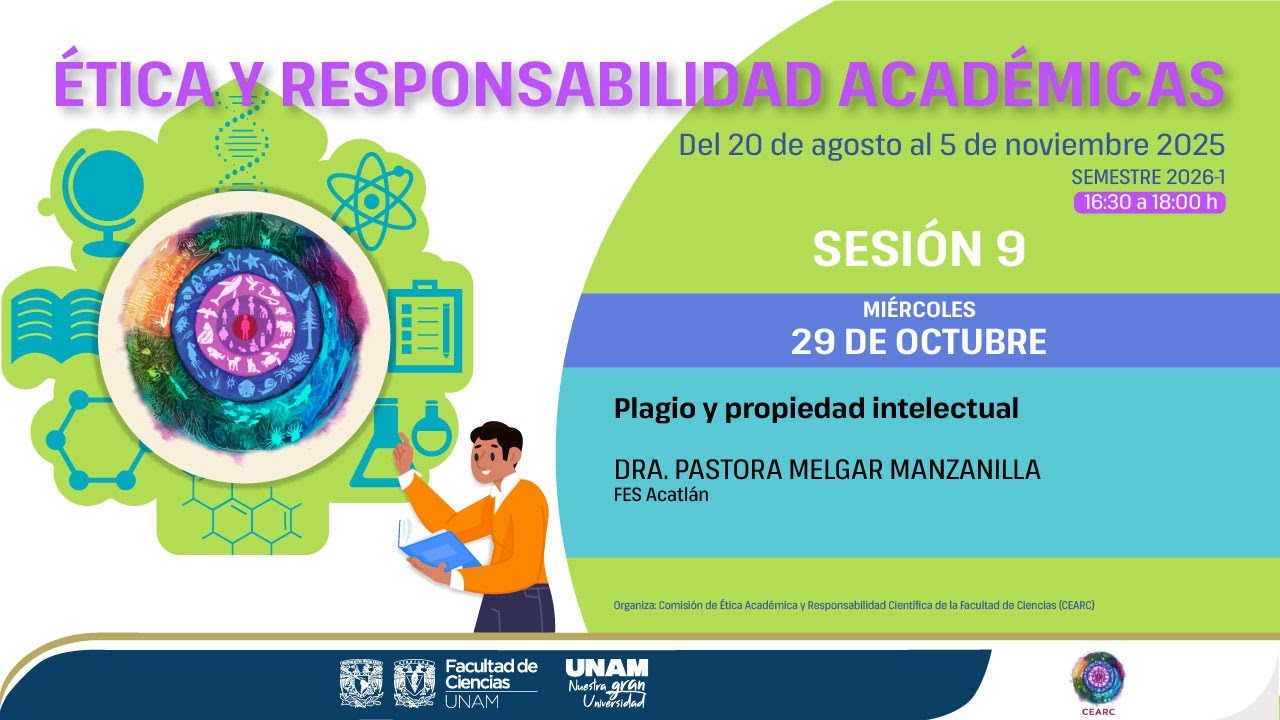
Plagio y propiedad intelectual
Keywords
Summary
214 words
Critical Evaluation
Value of the Information & Strength of the Argument
The presentation provides a comprehensive and systematic comparison between academic plagiarism and legal copyright infringement, which is valuable for understanding the nuances and overlaps. The argumentation is logically structured, moving from general concepts to specific legal provisions and their application to various plagiarism types. The speaker effectively uses legal references (e.g., Ley Federal de Derechos de Autor, Código Penal Federal) and institutional documents (Código de Ética de la UNAM) to support her points. However, the argumentation is largely descriptive and lacks critical analysis of potential tensions or criticisms of the legal framework. The value lies in its clarity and educational utility for an academic audience.
Scientific Rigor, Source Quality, Title Accuracy
The speaker demonstrates rigor by grounding her discussion in specific legal texts and institutional regulations, which are cited accurately. The sources are primarily legal and institutional, which is appropriate for the topic. The title accurately reflects the content, and the presentation stays on topic. The speaker’s expertise is evident, and she provides a balanced view of the two realms. However, the talk does not include external academic sources or empirical studies, which limits its scientific depth. The adequacy between title and content is high, as the talk directly addresses both plagiarism and intellectual property.
214 words
Title / Content Match
The title accurately reflects the content, which covers both plagiarism and intellectual property, focusing on their intersection in the academic context.
Quality & Reliability
8/10
The speaker is a legal scholar with expertise in academic integrity and intellectual property law, providing a structured and legally grounded presentation. The content is well-organized, citing specific Mexican laws and institutional regulations. However, it is primarily an expert lecture without empirical data or peer-reviewed sources, and some parts are general overviews.
Key Moments
Markers derived by PSI from the transcript: the creator did not define chapters.
- Introduction and presentation of the speaker by Dr. Ángeles.
- Speaker begins with an introduction to the two realms: academic and legal.
- Explanation of the constitutional basis for intellectual property (Article 28).
- Discussion of the dual nature of copyright: moral and economic rights.
- Overview of the three legal avenues: administrative, civil, and penal.
- Mapping of plagiarism types to legal infractions, starting with literal plagiarism.
- Continued mapping: mosaic, paraphrase, ideas, authorship, translation, self-plagiarism.
- Discussion of data fabrication, structure plagiarism, and AI-assisted plagiarism.
- Conclusion on academic responsibility and university autonomy in sanctioning plagiarism.
Cited Sources
- Ley Federal de Derechos de Autor — Cited as the primary legal framework for copyright in Mexico.
- Código Penal Federal — Cited for criminal offenses related to copyright infringement.
- Código de Ética de la UNAM — Cited as the institutional code defining plagiarism and academic integrity.
- Reglamento General de Exámenes de la UNAM — Cited as another institutional document defining plagiarism.
Concurring Sources
- Ley Federal de Derechos de Autor — The legal framework aligns with the speaker's explanations of copyright law.
- Código de Ética de la UNAM — The institutional code supports the definitions of plagiarism discussed.
Contribution & Novelties
The talk provides a clear and systematic comparison between academic plagiarism and legal copyright infringement, which is valuable for understanding the nuances and overlaps. It offers a practical mapping of various plagiarism types to specific legal provisions, which is not commonly found in such detail. The emphasis on the shared core value of recognizing the author’s intellectual effort is a useful conceptual contribution.
Pour aller plus loin :
- World Intellectual Property Organization (WIPO) — International perspective on intellectual property rights.
- Plagiarism.org — Resources on plagiarism definitions and prevention.
- UNAM’s Academic Integrity Program — Institutional resources on academic integrity.
98 words
Radar Profile
The radar profile shows high scores in quantity, quality, and reliability, with a slightly lower technical level, indicating a well-structured and informative talk that is accessible to a general academic audience.
💬 No comments were provided for analysis.