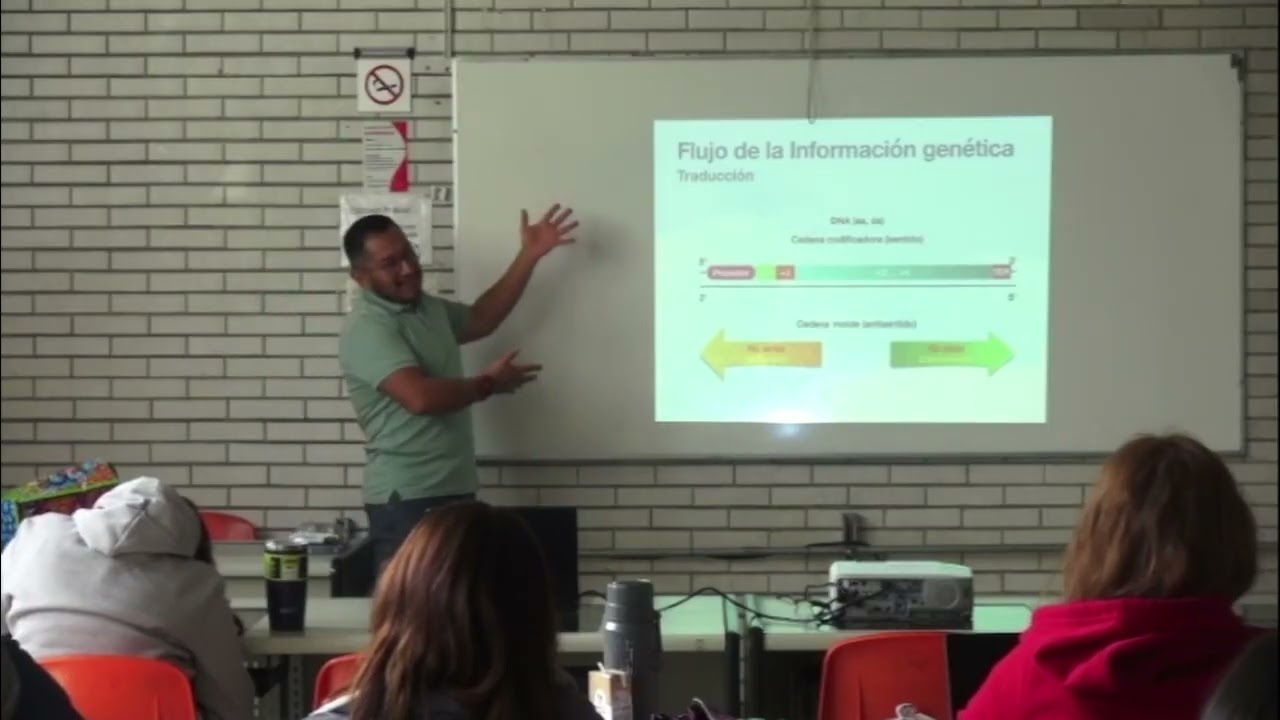
3. Desde el dogma central de la biología molecular hasta las mutaciones
Keywords
Summary
172 words
Critical Evaluation
Value of the Information & Strength of the Argument
The lecture provides a comprehensive and integrated view of the central dogma, going beyond the simplistic linear flow. It highlights exceptions and regulatory mechanisms, offering a nuanced understanding. The argumentation is solid, building from basic concepts to more complex integration. The use of analogies (e.g., accident scene for transcription initiation) aids comprehension. The instructors encourage critical thinking by questioning the universality of the central dogma and providing examples of deviations.
Scientific Rigor, Source Quality, Title Accuracy
The scientific rigor is high, as the content aligns with established molecular biology knowledge. The instructors reference the Protein Data Bank (PDB) for structural visualization, which is a reliable source. The title accurately reflects the content, covering the central dogma and extending to mutations. No external sources are cited beyond the PDB, but the lecture is based on well-established textbook knowledge. The teaching approach is interactive and encourages further exploration.
155 words
Title / Content Match
The title accurately reflects the content: it covers the central dogma and extends to mutations, as promised.
Quality & Reliability
8/10
The lecture is given by university professors, likely with expertise in molecular biology. It covers established concepts (central dogma, transcription, translation) and integrates them with critical thinking. The content is accurate and well-structured, though it is a lecture rather than a peer-reviewed source.
Key Moments
Markers derived by PSI from the transcript: the creator did not define chapters.
- Introduction to the central dogma and its limitations.
- Discussion of reverse transcription in HIV.
- Explanation of ribozymes and RNA catalysis.
- Definition of a gene and the importance of promoters.
- Structure of RNA polymerase and transcription initiation.
- Role of sigma factors and transcription factors.
- Promoter elements: -35 box, TATA box, and initiation region.
- Importance of 5' and 3' UTRs in translation.
- Codons and the genetic code.
- Activity: simulating protein synthesis.
Cited Sources
- Protein Data Bank (PDB) — The instructors recommend using the PDB to explore the 3D structure of RNA polymerase (PDB ID: 1I3Y).
Concurring Sources
- Molecular Biology of the Cell (Alberts et al.) — Standard textbook covering central dogma and gene expression.
Contribution & Novelties
The lecture provides an integrated perspective on the central dogma, emphasizing the dynamic and regulated nature of gene expression. It connects molecular processes to phenotypic outcomes, preparing students for understanding mutations. The use of analogies and interactive activities enhances learning.
Pour aller plus loin :
- Central dogma of molecular biology — Foundational concept.
- Reverse transcriptase — Enzyme enabling RNA to DNA.
- Ribozyme — RNA with catalytic activity.
- TATA box — Promoter element.
- Protein Data Bank — Resource for molecular structures.
80 words
Radar Profile
The radar profile shows high scores in information quality and reliability, with moderate technical level. This indicates a lecture that is scientifically sound and accessible to a biology audience, but not overly technical for advanced researchers.