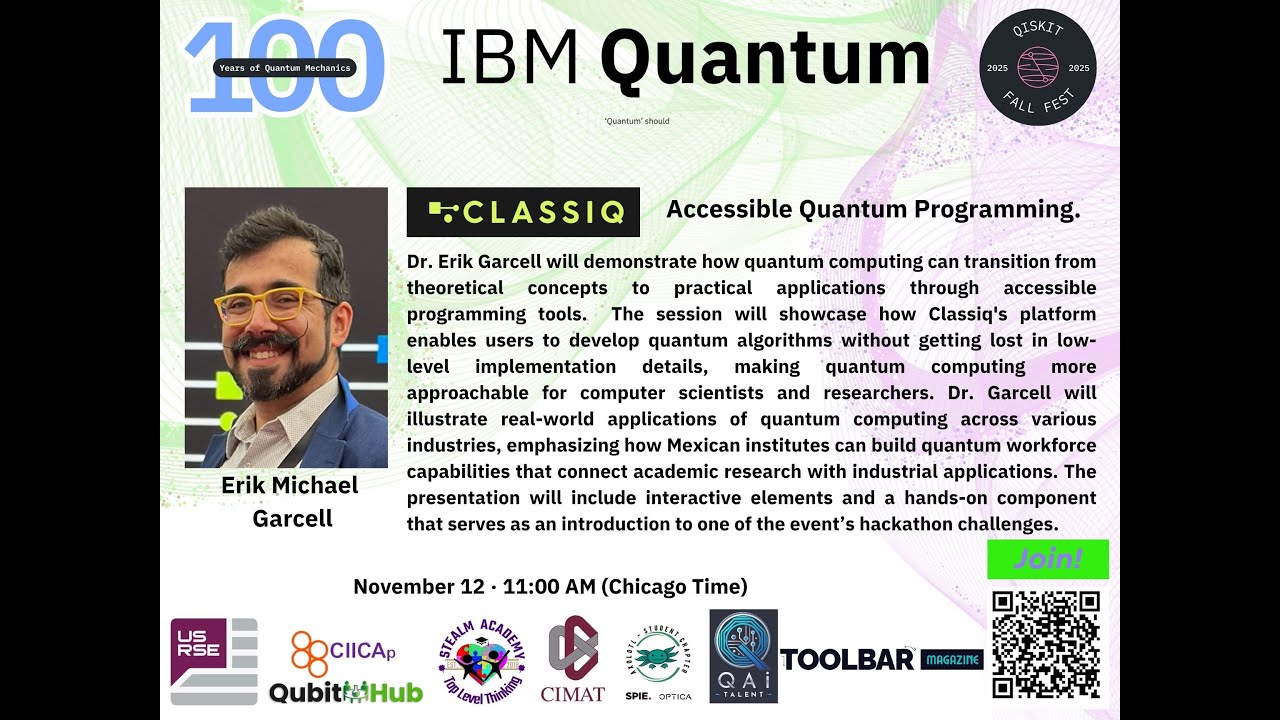
Dr. Erik Michael Garcell: Accessible Quantum Programming
Keywords
Summary
135 words
Critical Evaluation
Value of the Information & Strength of the Argument
The presentation provides valuable insights into the practical aspects of quantum programming, particularly the need for higher-level abstractions to make quantum computing accessible to a broader audience. Garcell effectively argues that low-level programming in QASM is analogous to assembly language, which is not scalable for complex applications. He supports his claims with references to an independent academic paper and industry collaborations, though the argumentation is somewhat promotional, focusing on Classiq’s advantages. The demonstration of code examples helps illustrate the benefits of the high-level language, but the presentation lacks a critical comparison with other high-level quantum programming frameworks.
Scientific Rigor, Source Quality, Title Accuracy
The presentation references an independent study from the University of Illinois Urbana-Champaign and mentions collaborations with major companies like BMW, Citi, and Rolls-Royce. However, specific sources are not cited in the video or description, and the claims are largely self-reported. The title accurately reflects the content, which is a tutorial on accessible quantum programming. The presentation is scientifically sound in its explanations of quantum concepts, but the promotional nature of the content and lack of independent verification reduce its overall rigor.
193 words
Title / Content Match
The title accurately reflects the content, which focuses on making quantum programming accessible through the Classiq platform.
Quality & Reliability
7/10
The presentation is a tutorial by a company representative, providing a clear overview of quantum computing concepts and a demonstration of their platform. It includes references to academic papers and industry collaborations, but lacks independent verification and contains promotional elements.
Key Moments
Markers derived by PSI from the transcript: the creator did not define chapters.
- Introduction to Classiq and its mission to lower the barrier to entry for quantum computing.
- Overview of Classiq's platform features and its integration with major cloud providers.
- Discussion of real-world applications of quantum computing in various industries.
- Explanation of quantum gates and circuits, with an example of a quantum circuit for a mathematical expression.
- Comparison of low-level QASM code with Classiq's high-level language, demonstrating code reduction.
- Q&A session: Garcell discusses his background and the intimidation factor of quantum computing.
- Q&A session: Garcell explains the intersection of AI and quantum computing.
Cited Sources
- Classiq GitHub Repository — Mentioned as the largest collection of quantum code examples on the internet.
Concurring Sources
- Classiq GitHub Repository — Provides code examples and resources for quantum programming with Classiq.
Contribution & Novelties
The presentation offers a practical introduction to quantum programming using Classiq’s high-level language, which is designed to make quantum computing more accessible to computer scientists. It provides a clear comparison between low-level QASM and high-level abstraction, highlighting the potential for reducing code complexity. The session also underscores the importance of building a quantum workforce and connecting academic research with industrial applications.
Pour aller plus loin :
- Quantum computing — Overview of quantum computing concepts.
- Qiskit — An open-source quantum computing framework for comparison.
- Quantum programming — Overview of quantum programming languages and paradigms.
93 words
Radar Profile
The radar profile shows a balanced distribution across the dimensions, with slightly higher scores in information quantity and quality, reflecting the tutorial's comprehensive coverage. The technical level is moderate, suitable for a general audience, while reliability is somewhat lower due to the promotional nature.