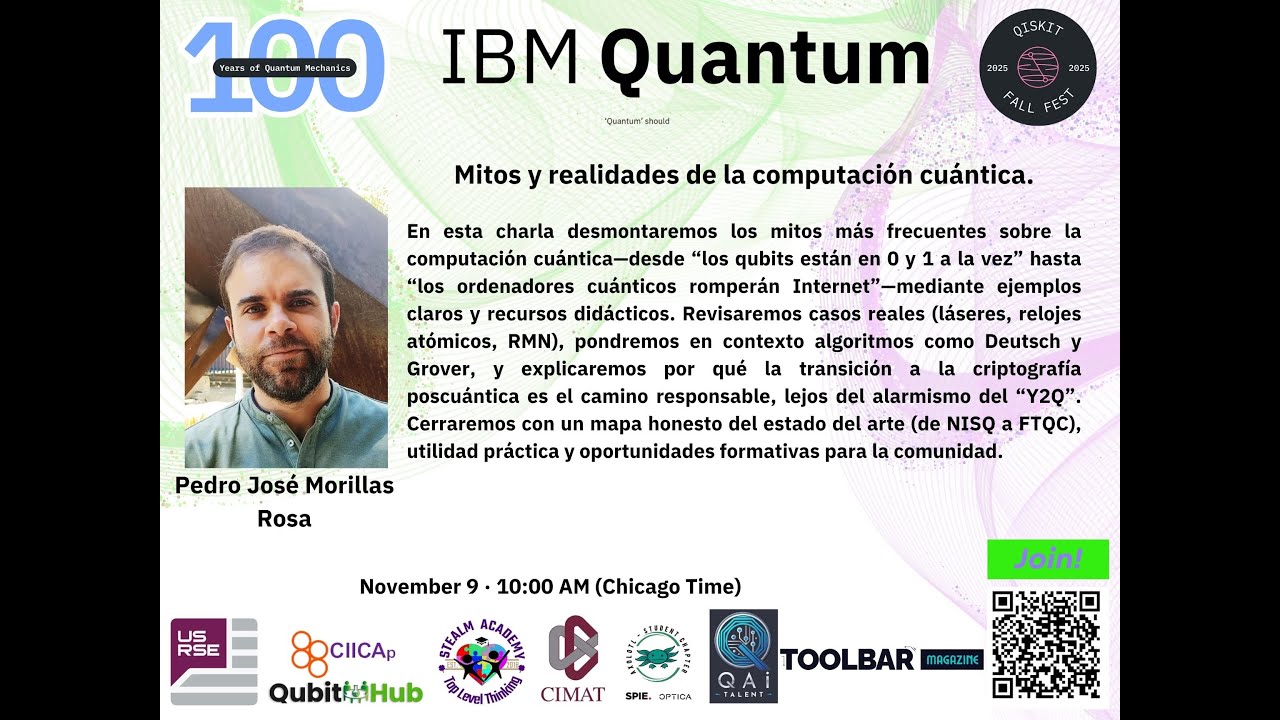
Mitos y realidades de la computación cuántica
Keywords
Summary
158 words
Critical Evaluation
Value of the Information & Strength of the Argument
The talk provides valuable clarifications of common misconceptions, using clear examples and analogies. The speaker’s argumentation is solid, grounded in established quantum mechanics principles and historical context. He effectively contrasts classical and quantum information processing, explaining the role of interference and probability amplitudes. The discussion of the Deutsch algorithm and the many-worlds interpretation is insightful, though he presents his own viewpoint as one among several. The emphasis on post-quantum cryptography as a responsible path is well-reasoned and practical.
Scientific Rigor, Source Quality, Title Accuracy
The speaker demonstrates scientific rigor by referencing reputable sources such as the book by Chris Ferrie, the writings of Scott Aaronson, and standard textbooks like Nielsen and Chuang. He also mentions historical papers and figures like Feynman and Deutsch. The title accurately reflects the content, and the talk maintains a high level of accuracy throughout. The speaker’s credentials and experience in quantum education lend credibility to the presentation.
161 words
Title / Content Match
The title accurately reflects the content, as the talk systematically debunks common myths about quantum computing while presenting the underlying realities.
Quality & Reliability
8/10
The speaker is a physicist and engineer with expertise in quantum computing education, and the talk is based on a well-regarded book by Chris Ferrie. The content is accurate and well-explained, though it is a popular science talk rather than a peer-reviewed presentation.
Key Moments
Markers derived by PSI from the transcript: the creator did not define chapters.
- Introduction: speaker introduces himself and the topic of myths and realities in quantum computing.
- Discussion of sensationalist media headlines and the need to debunk myths.
- Myth 1: 'Nobody understands quantum physics' - refuted by examples of quantum technologies (transistor, laser, atomic clock, MRI).
- Myth 2: 'Qubits are 0 and 1 at the same time' - explanation of superposition and probability amplitudes.
- Myth 3: 'Quantum computers test all solutions at once' - discussion of many-worlds interpretation and Deutsch algorithm.
- Myth 4: 'Quantum computers communicate instantly' - refutation and explanation of entanglement.
- Myth 5: 'Quantum computers will replace classical computers' - complementary role and practical limitations.
- Myth 6: 'Quantum computers will break the internet' - discussion of Shor's algorithm and post-quantum cryptography.
- Conclusion: honest assessment of current state (NISQ to FTQC) and educational opportunities.
Cited Sources
- What you should and shouldn't know about Quantum Computers — Book by Chris Ferrie, translated by the speaker, which inspired the talk.
- Quantum Information and Quantum Computation — Textbook by Nielsen and Chuang, referenced for circuit diagrams.
- Scott Aaronson's blog 'Shtetl-Optimized' — Blog mentioned as a resource for debunking quantum computing myths.
Concurring Sources
- Quantum Computing: Progress and Prospects — National Academies report on quantum computing, supporting the talk's assessment of the field's state.
Dissenting Sources
- Many-worlds interpretation — The speaker presents his own view that quantum computing does not require many worlds, but this is a matter of interpretation and some physicists disagree.
Contribution & Novelties
The talk provides a clear and accessible debunking of common quantum computing myths, synthesizing information from established sources. It offers a pedagogical perspective, aiming to make quantum concepts understandable to a broader audience. The speaker’s emphasis on post-quantum cryptography as a responsible path is particularly relevant.
Pour aller plus loin :
- Quantum computing — Overview of quantum computing concepts.
- Qubit — Detailed explanation of qubits and superposition.
- Deutsch–Jozsa algorithm — The algorithm discussed in the talk.
- Post-quantum cryptography — Cryptographic methods resistant to quantum attacks.
85 words
Radar Profile
The radar profile shows high scores in information quantity, quality, and reliability, with a moderate technical level. This indicates a well-balanced talk that is both informative and accessible, suitable for a general audience interested in quantum computing.
💬 Sur les 0 commentaires analysés, aucune tendance n'a pu être dégagée.