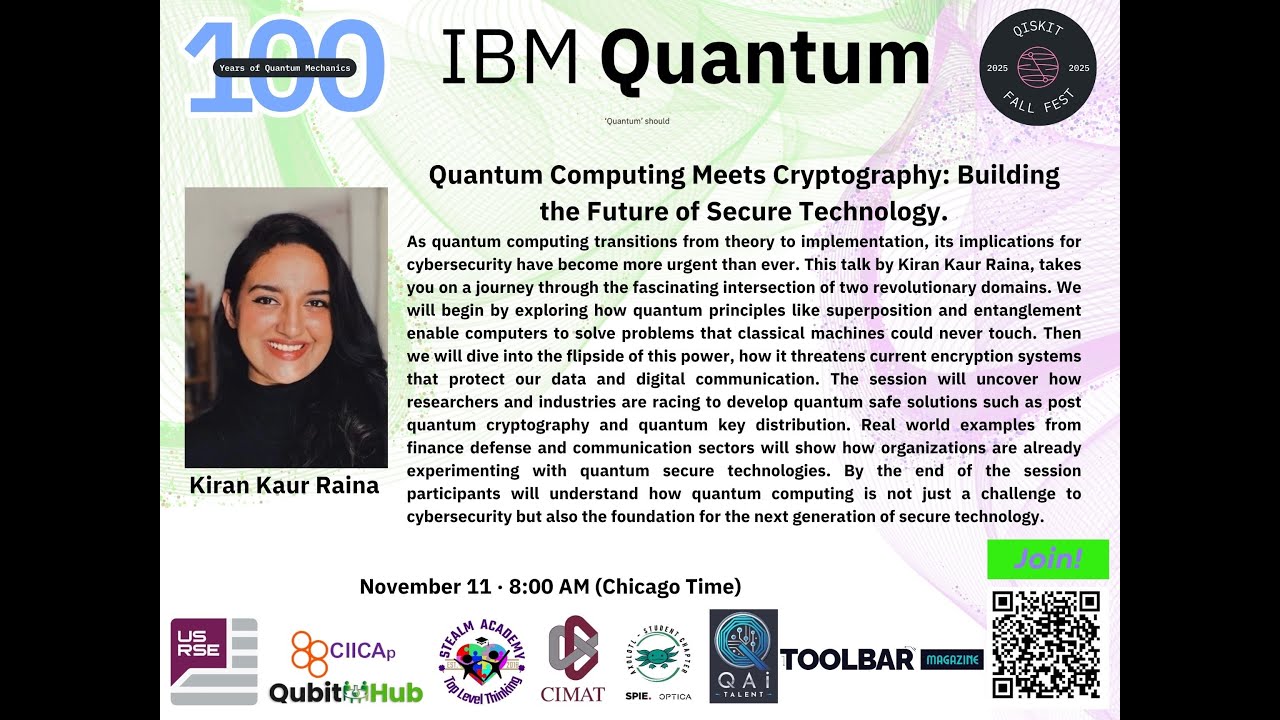
Quantum Computing Meets Cryptography - Building the Future of Secure Technology
Keywords
Summary
160 words
Critical Evaluation
Value of the Information & Strength of the Argument
The talk provides a high-level overview of quantum computing and cryptography, but the argumentation is largely descriptive rather than analytical. The speaker explains concepts clearly for a general audience, but does not delve into technical details or provide strong evidence for claims. The value lies in raising awareness about quantum threats and solutions, but the content is not novel and lacks depth. The argumentation is coherent but relies on common knowledge in the field, with no critical evaluation of the challenges or comparison of different approaches.
Scientific Rigor, Source Quality, Title Accuracy
The talk does not cite specific sources during the presentation, but the description mentions that slides will be shared, which may contain references. The speaker mentions NIST’s selection of PQC algorithms and companies like Google and Cloudflare, but without detailed citations. The title accurately reflects the content, which is a broad overview. The scientific rigor is moderate: the speaker is an undergraduate student and content creator, not a recognized expert, and the talk is more of an introductory lecture than a rigorous scientific presentation. The lack of citations and depth reduces the overall reliability.
195 words
Title / Content Match
The title accurately reflects the content, which covers the intersection of quantum computing and cryptography, including threats and solutions.
Quality & Reliability
6/10
The talk provides a broad overview of quantum computing and cryptography, but lacks depth and critical analysis. The speaker is an undergraduate student and content creator, not an established expert in the field. The presentation is largely introductory and relies on general knowledge, with no original research or detailed technical explanations. The information is generally accurate but simplified, and the speaker's enthusiasm is not backed by rigorous scientific discussion.
Key Moments
Markers derived by PSI from the transcript: the creator did not define chapters.
- Introduction to quantum computing: qubits, superposition, and entanglement.
- Explanation of classical cryptography (RSA, ECC) and the threat from Shor's algorithm.
- Discussion of Grover's algorithm and its impact on symmetric encryption.
- Introduction to Q-day and 'harvest now, decrypt later' attacks.
- Overview of post-quantum cryptography (PQC) and NIST-selected algorithms.
- Challenges in PQC adoption, including key sizes and infrastructure transition.
- Introduction to quantum key distribution (QKD) and protocols like BB84 and E91.
- Real-world applications of quantum-safe cryptography in finance, defense, and healthcare.
- Discussion of quantum blockchain and its potential.
- Future directions: quantum internet, quantum-safe IoT, and quantum homomorphic encryption.
- Career opportunities in quantum technology and list of companies.
- Q&A session begins.
Cited Sources
- NIST Post-Quantum Cryptography Standardization — Mentioned as the organization that selected algorithms like Kyber and Dilithium.
- Quantum Insider — Listed as the source for the top 25 quantum cryptography companies.
Concurring Sources
- NIST Post-Quantum Cryptography Standardization — The talk's mention of NIST-selected algorithms aligns with official NIST efforts.
Contribution & Novelties
The talk provides a broad overview of quantum computing and cryptography, but does not present new research or novel insights. Its value lies in synthesizing existing knowledge for a general audience, highlighting the urgency of quantum threats and the availability of solutions like PQC and QKD. The speaker’s perspective as a student and content creator may make the topic more accessible, but the content is not groundbreaking.
Pour aller plus loin :
- Shor’s algorithm - Wikipedia — Foundational algorithm for factoring integers, central to the quantum threat.
- Grover’s algorithm - Wikipedia — Quantum search algorithm that impacts symmetric key sizes.
- BB84 protocol - Wikipedia — First QKD protocol, mentioned in the talk.
- Post-quantum cryptography - NIST — Official NIST page for PQC standardization.
123 words
Radar Profile
The radar profile shows moderate scores across all dimensions, with slightly higher scores in quantity of information and lower in technical level. This indicates a broad but shallow overview, suitable for a general audience but lacking depth for experts.
💬 No comments were provided for analysis.