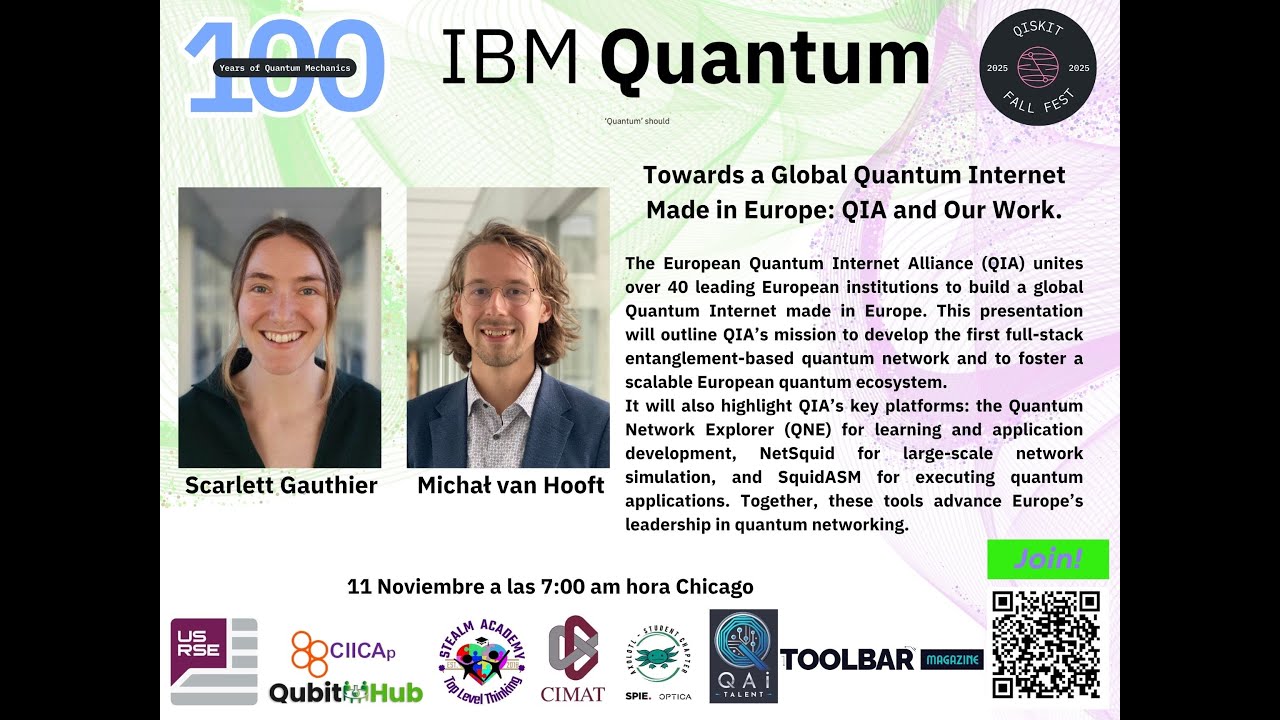
Scarlett Gauthier and Michał van Hooft: Towards a Global Quantum Internet Made in Europe
Keywords
Summary
194 words
Critical Evaluation
Value of the Information & Strength of the Argument
The talk provides valuable insights into the current state and future plans of the European Quantum Internet Alliance. It clearly explains the potential applications of a quantum internet, such as blind quantum computing and secure communication, and outlines the technical milestones needed to achieve them. The argumentation is coherent, building from basic quantum principles to the specific goals of the QIA and the simulation tools that support its development. The presentation is persuasive, emphasizing Europe’s leadership and the collaborative effort of multiple institutions. However, it is largely a project overview and does not delve into potential challenges or alternative approaches in depth, which limits its critical analysis.
Scientific Rigor, Source Quality, Title Accuracy
The talk is scientifically rigorous in its technical descriptions, and the presenters are credible as researchers from TU Delft. The sources cited are primarily the QIA’s own projects and tools, which are appropriate for the context. The title accurately reflects the content, focusing on the European initiative. The presentation does not cite external publications, but it references specific technologies and demonstrations that are part of the QIA’s work. The lack of external citations is acceptable for a project update, but it means the talk is not a comprehensive literature review.
212 words
Title / Content Match
The title accurately reflects the content, which focuses on the European Quantum Internet Alliance and its efforts towards a global quantum internet.
Quality & Reliability
7/10
The talk is given by researchers from TU Delft, a leading institution in quantum networking, and presents the Quantum Internet Alliance's goals and tools. The information is technical and specific, but it is primarily a project overview and demonstration of simulators, not peer-reviewed research. The claims are plausible and align with known developments in the field, but the talk is promotional in nature.
Key Moments
Markers derived by PSI from the transcript: the creator did not define chapters.
- Introduction and speaker introductions
- Overview of quantum technologies: qubits, superposition, no-cloning, entanglement
- Applications of quantum internet: secure computation, load balancing, quantum money
- Functional stages of quantum internet development
- Global efforts: Europe, US, China; ground-based and space-based
- Current state and next steps: metropolitan networks, long-term horizon
- Introduction to Quantum Internet Alliance: history, partners, goals
- Moonshot mission: full-stack prototype network, test programs
- Latest news: hardware improvements, QNodeOS, application challenge
- Michał van Hooft introduces simulation tools: NetSquid, NetBuilder, SquidASM, QNE
Cited Sources
- Quantum Internet Alliance — Mentioned as the main project and source of information
- NetSquid — Simulation tool presented by Michał van Hooft
- Quantum Network Explorer — Platform for learning and application development
Concurring Sources
- Quantum Internet Alliance — The official website confirms the project's goals and partners.
Contribution & Novelties
The talk provides an up-to-date overview of the Quantum Internet Alliance’s progress and introduces the simulation tools developed at TU Delft, which are valuable resources for researchers and developers. It highlights recent milestones such as rack-mounted quantum nodes and the QNodeOS operating system, offering a concrete picture of the current state of quantum networking in Europe.
Pour aller plus loin :
- Quantum Internet Alliance — Official website with detailed information on the project.
- NetSquid — Simulation platform for quantum networks, with documentation and tutorials.
- Quantum Network Explorer — Interactive platform for learning about quantum networks.
- Quantum key distribution — Related concept for secure communication.
- Blind quantum computing — Application mentioned in the talk.
113 words
Radar Profile
The radar profile shows balanced scores across all dimensions, with slightly higher scores in information quantity and technical level, reflecting the detailed technical content and the expertise of the speakers. The lower score in information quality is due to the promotional nature of the talk, which lacks critical analysis.
💬 No comments were provided for analysis.