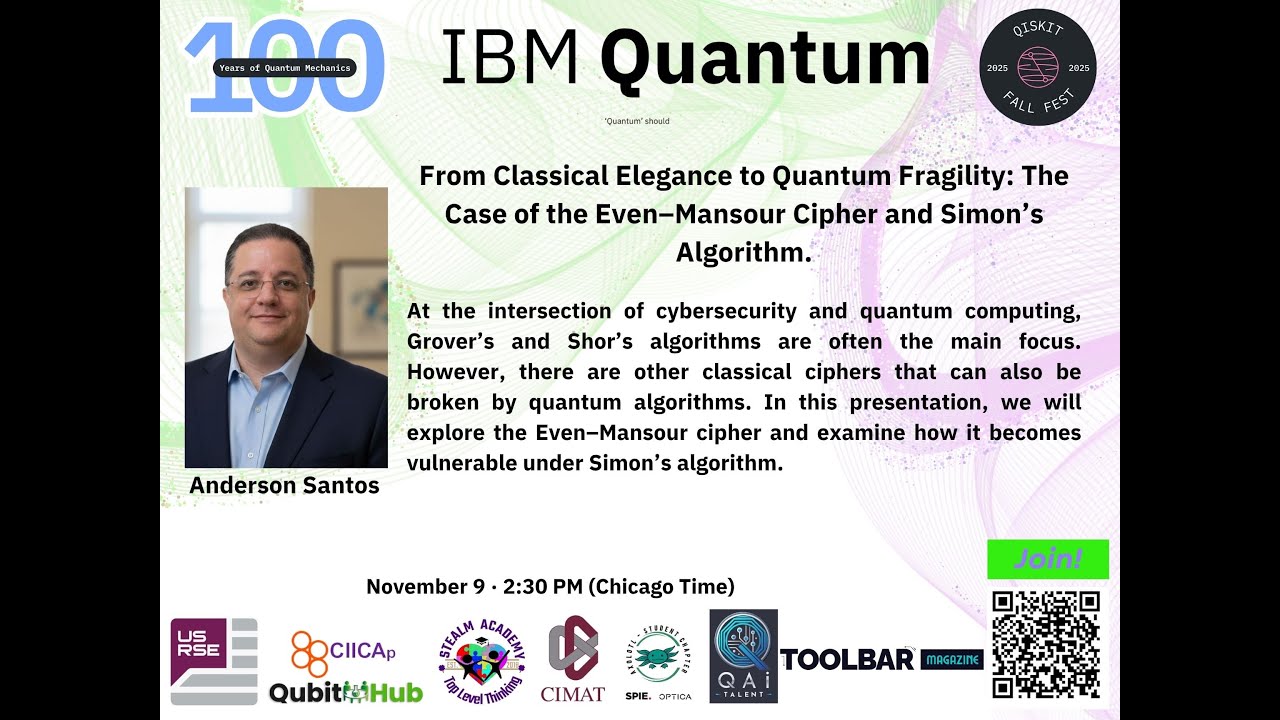
Dr. Anderson Santos: From Classical Elegance to Quantum Fragility
Keywords
Summary
141 words
Critical Evaluation
Value of the Information & Strength of the Argument
The presentation provides a clear and accessible explanation of how Simon’s algorithm can break the Even-Mansour cipher, a topic not commonly covered in mainstream discussions. The argumentation is logically structured: it establishes the context of quantum threats, introduces the cipher, demonstrates the attack, and discusses its implications. The speaker effectively uses mathematical notation and step-by-step reasoning to illustrate the attack, making it understandable for an audience with some background in cryptography. However, the talk is more of an overview than a deep dive, and some parts feel rushed. The value lies in highlighting a lesser-known quantum attack and encouraging further research into similar constructions.
Scientific Rigor, Source Quality, Title Accuracy
The speaker references several academic papers and standards, including the Even-Mansour cipher original paper, Simon’s algorithm, and NIST post-quantum standardization. He also mentions a Brazilian lightweight authentication algorithm that was broken, providing a concrete example. The sources are credible and relevant. The title accurately reflects the content, though it is somewhat metaphorical. The talk does not include a formal citation list, but the references mentioned are appropriate. The speaker’s expertise adds to the credibility, though the lack of detailed citations in the slides is a minor weakness.
206 words
Title / Content Match
The title is somewhat poetic but accurately reflects the content: it contrasts classical cryptographic elegance with quantum vulnerabilities.
Quality & Reliability
7/10
The speaker is a PhD in computer engineering with extensive experience in cybersecurity and quantum computing. The presentation is based on established research (Even-Mansour cipher, Simon's algorithm) and includes references to specific papers. However, the talk is a high-level overview and lacks detailed technical depth, and some statements are general.
Key Moments
Markers derived by PSI from the transcript: the creator did not define chapters.
- Introduction of the speaker and his background.
- Overview of Shor's and Grover's algorithms and their impact on cryptography.
- Introduction to the Even-Mansour cipher and its structure.
- Explanation of Simon's problem and algorithm.
- Demonstration of how Simon's algorithm breaks Even-Mansour.
- Discussion on the practical relevance and market usage of Even-Mansour.
- Post-quantum cryptography efforts and cryptoagility.
- Q&A session covering various topics including Brazil's quantum initiatives.
Cited Sources
- Even-Mansour cipher original paper — Referenced as the basis for the cipher's construction.
- Simon's algorithm paper — Referenced for the quantum algorithm used in the attack.
- NIST post-quantum cryptography standardization — Mentioned in the context of migration to quantum-resistant algorithms.
Concurring Sources
- Simon's algorithm — Confirms the algorithm's ability to find hidden periods efficiently.
- Even-Mansour cipher — Provides details on the cipher's construction and known attacks.
Contribution & Novelties
This presentation brings attention to a less-known quantum attack on a classical cipher, demonstrating that beyond Shor and Grover, other quantum algorithms can break specific constructions. It underscores the importance of considering a broader range of quantum threats in cryptographic design. The talk also highlights the Even-Mansour cipher’s simplicity and its potential vulnerability, which is not widely discussed in mainstream literature.
Pour aller plus loin :
- Simon’s problem — Provides background on the computational problem and its quantum solution.
- Even-Mansour cipher — Overview of the cipher’s structure and security.
- Post-quantum cryptography — Context on the broader field and standardization efforts.
100 words
Radar Profile
The radar profile shows balanced scores across all dimensions, with slightly lower technical depth and information quantity compared to quality and reliability. This suggests a presentation that is credible and well-structured but may not delve deeply into technical details, making it suitable for a general technical audience rather than experts.
💬 No comments were provided for analysis.