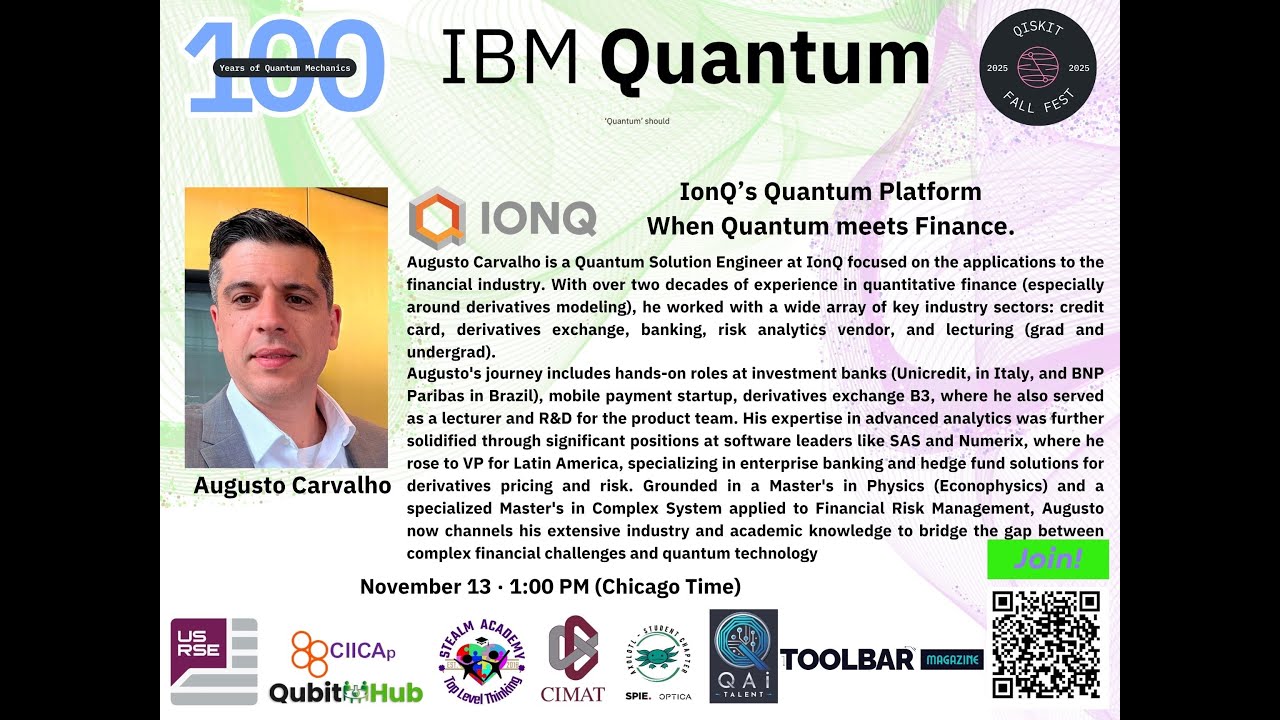
Augusto Carvalho: IonQ’s Quantum Platform When Quantum meets Finance
Keywords
Summary
171 words
Critical Evaluation
Value of the Information & Strength of the Argument
The talk provides valuable insights into the practical applications of quantum computing in finance, particularly the quantum copula approach, which is a novel and promising method for risk management. The argumentation is solid, grounded in the speaker’s extensive industry experience and IonQ’s research. However, the presentation is somewhat high-level and promotional, lacking deep technical details or rigorous comparisons with classical methods. The speaker effectively communicates the potential of quantum computing but does not fully address challenges such as error correction or the current limitations of quantum hardware.
Scientific Rigor, Source Quality, Title Accuracy
The talk is scientifically rigorous in its explanation of quantum computing concepts and financial applications, but it relies heavily on IonQ’s own research and claims. The speaker mentions a study on quantum copulas but does not provide specific references or external sources. The title accurately reflects the content, which is a presentation of IonQ’s platform and its financial applications. The talk is more of an expert opinion and industry overview than a peer-reviewed scientific presentation.
177 words
Title / Content Match
The title accurately reflects the content, which focuses on IonQ's quantum platform and its applications in finance.
Quality & Reliability
7/10
The speaker is a Quantum Solution Engineer at IonQ with extensive experience in quantitative finance. The content is based on his expertise and IonQ's research, but it is largely promotional and lacks detailed technical depth or peer-reviewed sources.
Key Moments
Markers derived by PSI from the transcript: the creator did not define chapters.
- Introduction: Why quantum now? Drivers include cybersecurity threats and approaching simulation threshold.
- IonQ's quantum platform: computing, networking, and sensing.
- Ion trap technology: advantages and scalability challenges.
- IonQ's roadmap: 64-200 qubits now, aiming for 2 million by 2030.
- Portfolio optimization: canonical quantum finance problem, combinatorial explosion.
- Quantum copulas: modeling asset correlations without parametric assumptions.
- Conclusion: Start building quantum expertise now; it takes two years.
Cited Sources
- IonQ website — Mentioned as source for roadmap and technology details.
Concurring Sources
- IonQ research publications — The speaker references IonQ's study on quantum copulas, which is likely published here.
Contribution & Novelties
The talk provides an industry perspective on quantum computing in finance, highlighting the quantum copula approach as a novel application. It emphasizes that some quantum algorithms are already feasible on current hardware, which is a significant claim. The speaker’s background in both physics and finance adds credibility.
Pour aller plus loin :
- Quantum computing — Overview of quantum computing concepts.
- Portfolio optimization — Classical formulation and challenges.
- Copula (probability theory) — Statistical method for modeling dependencies.
76 words
Radar Profile
The radar profile shows high scores in information quantity and quality, with moderate technical depth and reliability. The talk is informative and credible but not deeply technical or heavily sourced.