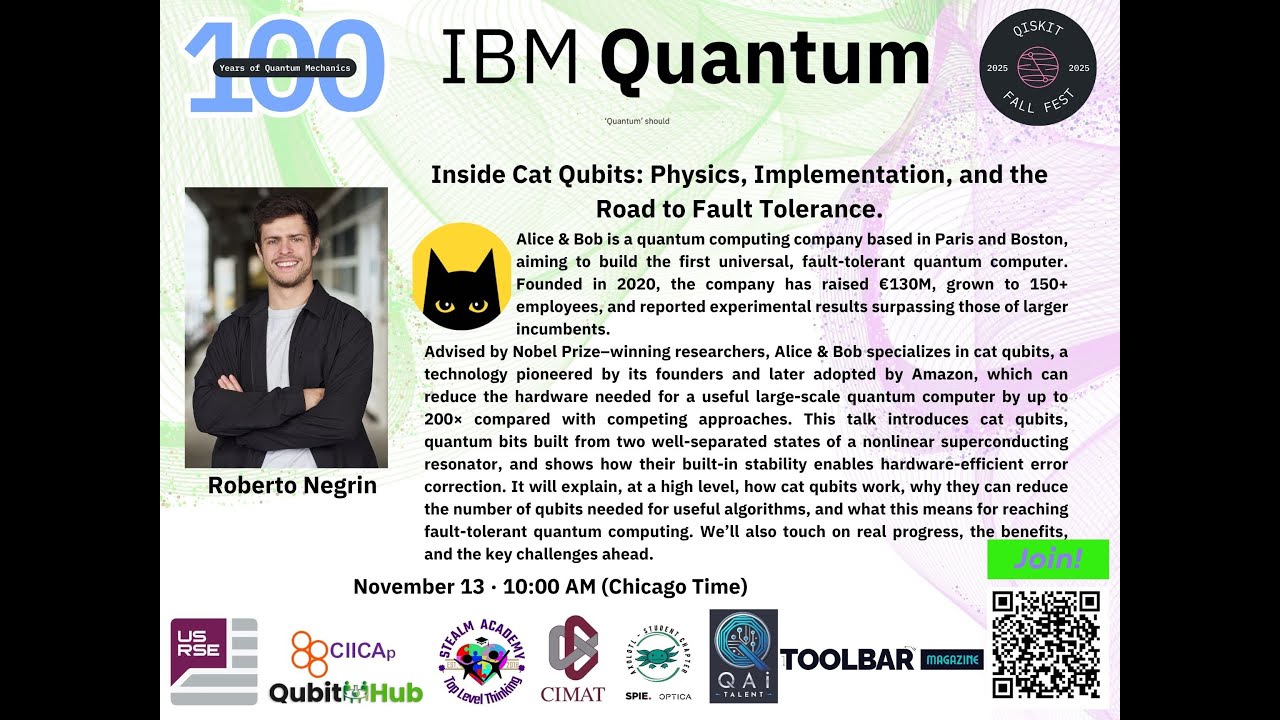
Dr. Roberto Negrin: Inside Cat Qubits - Physics, Implementation, and the Road to Fault Tolerance
Keywords
Summary
203 words
Critical Evaluation
Value of the Information & Strength of the Argument
The talk provides valuable insights into a specific quantum computing approach, explaining the physics behind cat qubits in an accessible yet technical manner. The argumentation is solid, grounded in the Hamiltonian of the system and supported by experimental data. The speaker effectively demonstrates the advantages of cat qubits, such as exponential bit-flip suppression and reduced qubit overhead for error correction. The live simulation adds practical value, illustrating the concepts in real-time. However, the presentation is somewhat promotional, emphasizing the company’s achievements without deeply discussing alternative approaches or potential drawbacks.
Scientific Rigor, Source Quality, Title Accuracy
The scientific rigor is generally high, with clear explanations of the underlying physics and references to experimental results. The speaker mentions a blog post for the latest bit-flip time result, but no formal paper is cited. The sources are primarily from the company’s own work, which may introduce bias. The title accurately reflects the content, covering both the physics and implementation aspects. The talk is well-structured and technically sound, though it could benefit from more external references and a critical comparison with other qubit technologies.
189 words
Title / Content Match
The title accurately reflects the content: the talk covers the physics, implementation, and fault-tolerance roadmap of cat qubits.
Quality & Reliability
8/10
The talk is given by a PhD student at Alice & Bob, a leading company in cat qubits, and includes technical details on the physics and implementation. The content is consistent with known principles of quantum error correction and superconducting circuits. However, some claims (e.g., bit-flip time of 1 hour) are not yet published in peer-reviewed literature, and the talk is promotional in nature.
Key Moments
Markers derived by PSI from the transcript: the creator did not define chapters.
- Introduction to Alice & Bob and the speaker's role.
- Explanation of cat qubits and the concept of error bias.
- Physical implementation: memory, buffer, and ATS.
- Hamiltonian and potential barrier explanation.
- Bias-preserving gates and CNOT gate.
- Introduction to simulation tools, focusing on dynamics.
- Live demo comparing transmon and cat qubit performance.
- Discussion of recent results and bit-flip time improvements.
- Roadmap to fault tolerance and qubit reduction.
Cited Sources
- Alice & Bob blog post on bit-flip time — Mentioned as the source for the latest bit-flip time result of 1 hour.
Concurring Sources
- Alice & Bob website — Company website with information on cat qubits and their technology.
Contribution & Novelties
The talk provides a clear and accessible explanation of cat qubits, a relatively novel approach in quantum computing. It highlights the key advantage of exponential bit-flip suppression and the resulting efficiency in error correction. The presentation also offers practical insights into the simulation tools used in research, particularly the ‘dynamics’ library, which may be of interest to practitioners.
Pour aller plus loin :
- Cat state (Wikipedia) — Background on the quantum superposition concept.
- Quantum error correction (Wikipedia) — Overview of error correction techniques.
- Superconducting quantum computing (Wikipedia) — Context on the hardware platform.
93 words
Radar Profile
The radar profile shows high scores in information quantity and quality, with a moderate technical level and reliability. This indicates a well-structured and informative talk, though the technical depth may be challenging for a general audience. The reliability score is slightly lower due to the promotional nature and lack of peer-reviewed references.