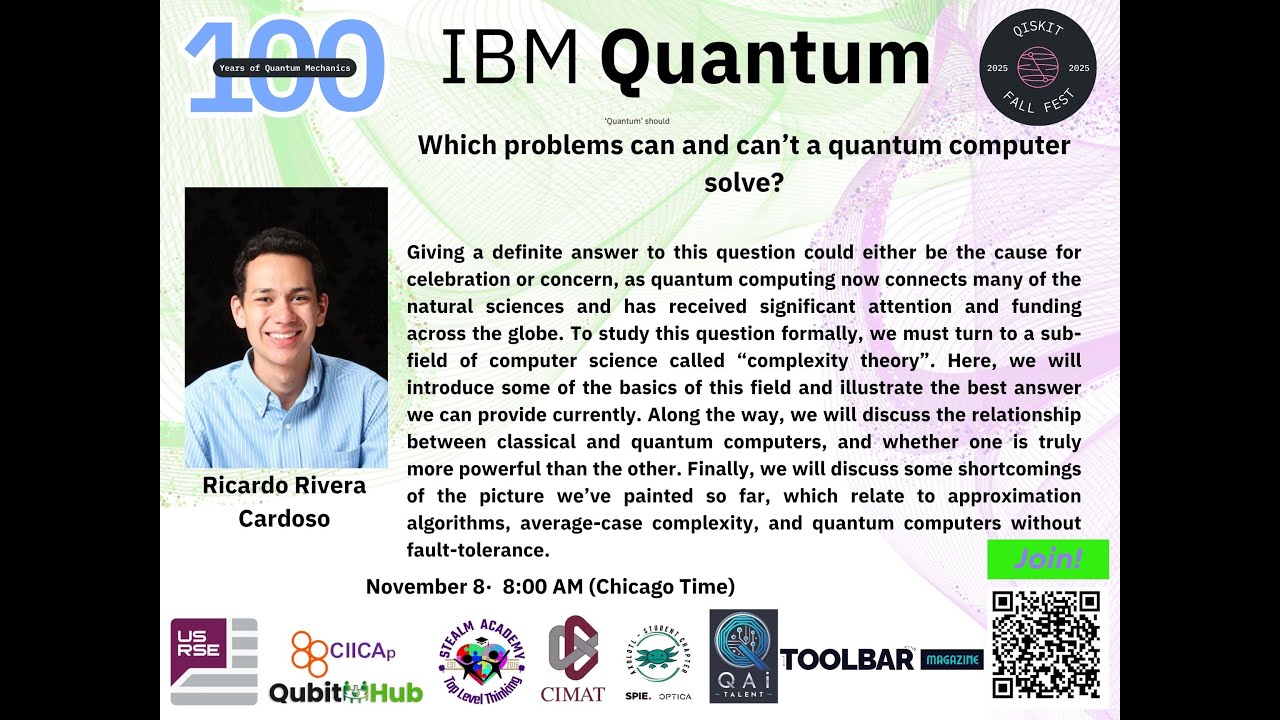
Dr. Ricardo Rivera Cardoso: Which problems can and can’t a quantum computer solve?
Keywords
Summary
168 words
Critical Evaluation
Value of the Information & Strength of the Argument
The talk provides a clear and rigorous introduction to complexity theory as applied to quantum computing. It effectively uses analogies (e.g., phone PIN, Sudoku) to explain abstract concepts. The argumentation is solid, building from basic definitions to the central question of P vs. NP and the potential of quantum computers. The speaker appropriately notes the limitations of the worst-case framework and the open questions in the field. The inclusion of personal anecdotes and internship experiences adds credibility and engagement.
88 words
Title / Content Match
The title accurately reflects the content, which addresses the capabilities and limitations of quantum computers in solving computational problems.
Quality & Reliability
8/10
The talk is scientifically accurate, well-structured, and grounded in complexity theory. The speaker, a PhD candidate in Hamiltonian complexity, demonstrates expertise. The content is up-to-date and appropriately caveated, acknowledging open questions and limitations.
Key Moments
Markers derived by PSI from the transcript: the creator did not define chapters.
- Introduction and speaker background
- Formalizing the question: efficiency and worst-case analysis
- Introduction to complexity classes and reductions
- Classical complexity: P and examples
- NP and the P vs NP question
- Quantum complexity: BQP and potential advantages
- Shor's algorithm and integer factorization
- Limitations: approximation, average-case, and fault-tolerance
- Conclusion and encouragement
Contribution & Novelties
The talk provides a clear and accessible explanation of complexity theory as it applies to quantum computing, emphasizing the importance of worst-case analysis and the open question of P vs NP. It effectively communicates the current understanding of quantum advantages and limitations. The speaker’s personal journey and industry experience add a unique perspective.
Pour aller plus loin :
- Complexity classes P and NP — Overview of the P vs NP problem.
- Shor’s algorithm — Quantum algorithm for integer factorization.
- Quantum complexity theory — Introduction to quantum complexity classes.
88 words
Radar Profile
The radar profile shows high scores in information quality and reliability, with slightly lower scores in technical depth and quantity, reflecting a well-balanced introductory talk that is scientifically sound but not extremely detailed.