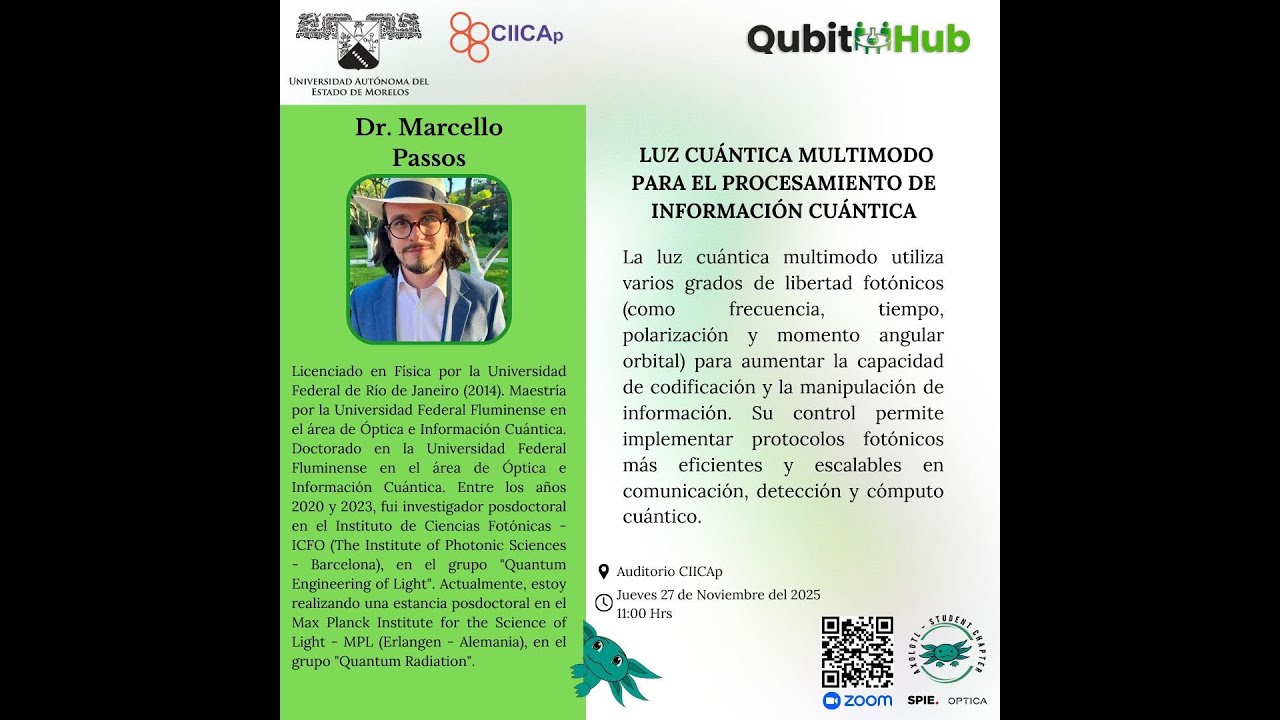
Multimode quantum light for quantum information processing
Keywords
Summary
210 words
Critical Evaluation
Value of the Information & Strength of the Argument
The talk provides a clear and accessible introduction to quantum optics, using intuitive analogies (e.g., pea, pizza) to explain complex concepts like quadratures and squeezing. The speaker effectively argues for the importance of high-gain SPDC for generating multimode squeezed states, contrasting it with low-gain photon-pair sources. He supports his points with historical context (first experiments) and current experimental capabilities, making a strong case for the practicality of these sources. The argumentation is coherent and well-structured, though some details are simplified for a student audience.
Scientific Rigor, Source Quality, Title Accuracy
The speaker demonstrates scientific rigor by referencing key historical papers (e.g., first theoretical proposal of squeezing, first experimental observation) and explaining the underlying physics. He clearly distinguishes between theoretical predictions and experimental results. The title accurately reflects the content, which focuses on multimode quantum light and its use in quantum information. The talk is based on the speaker’s own research and established literature, though it is not a formal review. No external sources are cited in the video description, but the speaker mentions specific works and groups.
186 words
Title / Content Match
The title accurately reflects the content, which focuses on generating and using multimode quantum light for quantum information processing.
Quality & Reliability
8/10
The speaker is a postdoctoral researcher at the Max Planck Institute for the Science of Light, with a PhD in quantum optics and several publications in the field. The talk covers established concepts and recent experimental results, but it is a seminar presentation rather than a peer-reviewed article, and some details are simplified for a student audience.
Key Moments
Markers derived by PSI from the transcript: the creator did not define chapters.
- Introduction to quantum technologies and the four pillars.
- Explanation of the harmonic oscillator and quantization of light.
- Introduction to squeezed states and vacuum fluctuations.
- Generation of squeezed states via SPDC, low vs high gain.
- Experimental setup at Max Planck, images of SPDC emission.
- Multimode nature of the generated light and challenges for detection.
- Applications in quantum information, cluster states, and metrology.
Cited Sources
- First theoretical proposal of squeezed states (1967) — Mentioned as the first theoretical work on generating squeezed light.
- Glauber's theory of parametric amplification — Cited as a foundational work in quantum optics.
- First experimental observation of SPDC (1970) — Shown as a historical milestone in the field.
- First measurement of squeezed states — Discussed in the context of homodyne detection.
Concurring Sources
- Quantum Information with Continuous Variables — A review article on continuous-variable quantum information, which aligns with the talk's focus.
Contribution & Novelties
The talk provides a clear pedagogical introduction to multimode quantum light, emphasizing the high-gain regime of SPDC for generating squeezed states. It highlights the experimental challenges and the potential for quantum information processing. The speaker’s own research at Max Planck is presented, offering insights into current state-of-the-art techniques.
Pour aller plus loin :
- Squeezed coherent state — Wikipedia article on squeezed states, providing mathematical details.
- Spontaneous parametric down-conversion — Wikipedia article on SPDC, explaining the process.
- Homodyne detection — Wikipedia article on homodyne detection, a key technique for measuring squeezed light.
91 words
Radar Profile
The radar profile shows high scores in information quantity, quality, and technical level, with a slightly lower score in global reliability due to the informal nature of a seminar talk. This indicates a well-informed and detailed presentation, but one that is not peer-reviewed.