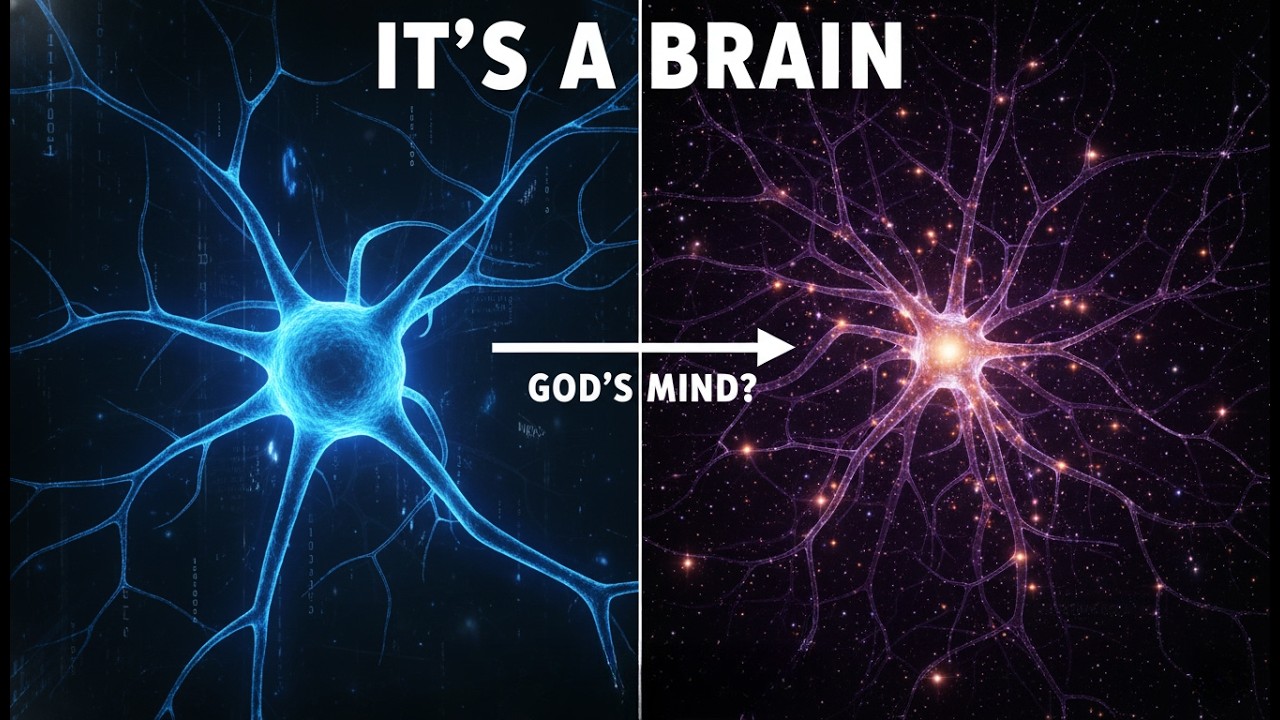
The Universe Is A Brain. Here Is The Proof.
Keywords
Summary
130 words
Critical Evaluation
The video presents a philosophical argument about divine self-awareness, but it is not scientifically rigorous. It relies on analogies (knife, eye, computer) and thought experiments rather than empirical data. The title is sensationalist and misleading, as it claims ‘proof’ but offers none. The content is speculative and draws on theology, philosophy, and pop science, but does not engage deeply with any discipline. The argument is structured logically, but the premises are questionable. For instance, the assumption that God is infinite and omniscient is taken from theology, not established. The video also conflates different concepts of consciousness and self-awareness. It mentions the Simulation Hypothesis and panpsychism but does not provide evidence for them. The sources cited are not scientific; they are philosophical or theological. The video’s value lies in raising interesting questions, but it does not provide answers or rigorous analysis. The production quality is decent, but the content is not suitable for an academic audience. The video’s length (90 minutes) is excessive for the content, which could be condensed. Overall, the video is more entertainment than education, and its scientific credibility is low.
183 words
Title / Content Match
The title is sensationalist and misleading; the video does not provide proof that the universe is a brain, but rather explores philosophical and theological questions about divine self-awareness.
Quality & Reliability
4/10
The video presents a speculative philosophical argument with limited scientific rigor, relying on analogies and thought experiments rather than empirical evidence. It cites no specific scientific studies or peer-reviewed sources, and the title's claim of 'proof' is misleading. The content is more philosophical than scientific, with some references to physics and AI used superficially.
Key Moments
Markers derived by PSI from the transcript: the creator did not define chapters.
- Introduction: The paradox of God's self-awareness is posed.
- Discussion of omniscience and the difference between knowledge and self-awareness.
- The problem of contrast: self-awareness requires boundaries.
- Theological attempts to solve the problem: Trinity and Brahman.
- Questioning whether God is truly infinite.
- Introduction of the Simulation Hypothesis as a possible explanation.
- Discussion of consciousness and AI, and whether machines can be self-aware.
- Exploration of panpsychism and the idea that consciousness is fundamental.
- The role of humans as mirrors for God's self-awareness.
- Conclusion: The universe as God's coping mechanism for loneliness.
Cited Sources
- No specific sources cited in the video description. — The video description contains no links or references to external sources.
Concurring Sources
- No concordant sources found. — No external sources were cited or found to support the video's claims.
Dissenting Sources
- No discordant sources found. — No external sources were cited or found to contradict the video's claims.
Contribution & Novelties
The video offers a novel synthesis of philosophical and theological ideas about divine self-awareness, but it does not present original research. Its main contribution is to popularize the question of whether an infinite being can know itself, drawing on concepts from Spinoza, the Simulation Hypothesis, and panpsychism.
Pour aller plus loin :
- Spinoza’s philosophy of God and nature — Relevant to the idea of God as the universe.
- Simulation Hypothesis — Discussed in the video as a possible explanation.
- Panpsychism — The view that consciousness is fundamental to reality.
89 words
Radar Profile
The radar profile shows low scores across all dimensions, indicating a video with limited scientific content, low reliability, and minimal technical depth. The video is primarily philosophical speculation without empirical support.
💬 No comments were provided for analysis.