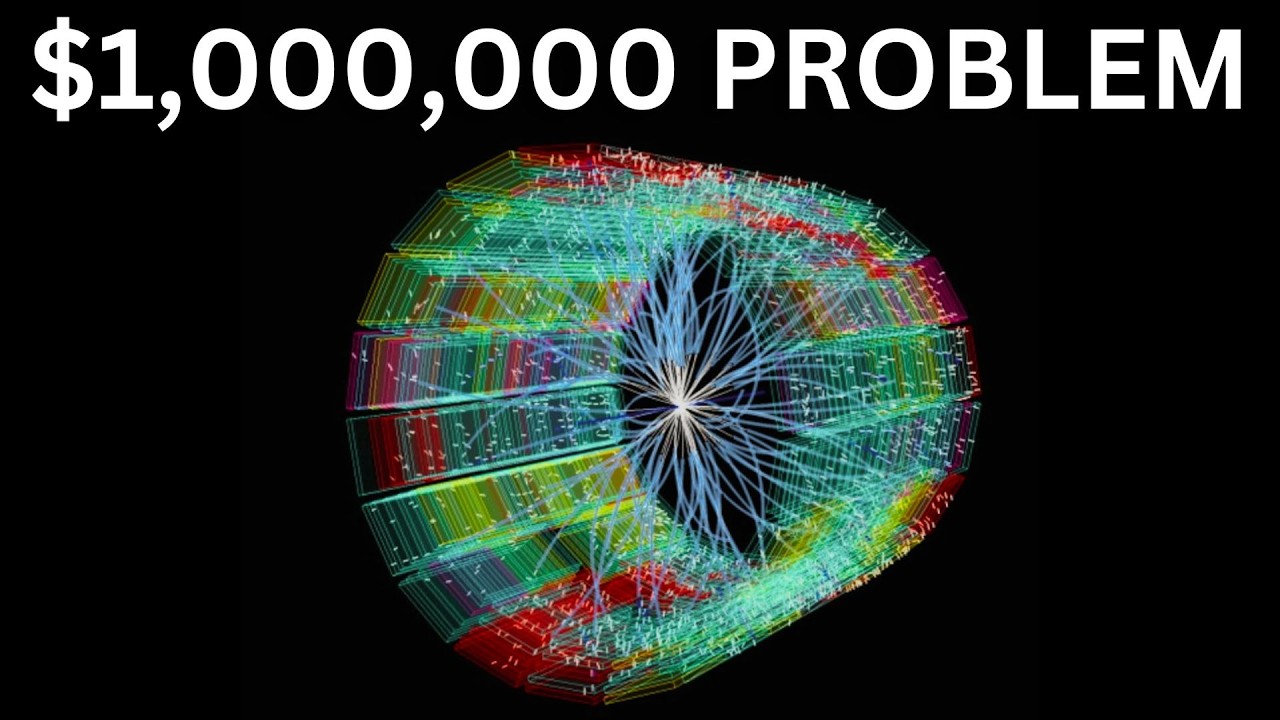
What Holds Quarks Together Inside Protons? | Science Documentary
Keywords
Summary
170 words
Critical Evaluation
The documentary provides a compelling and largely accurate historical narrative of the discovery of quarks and the strong force. It excels in making complex concepts accessible through vivid analogies and a clear chronological structure. The explanation of color charge and confinement is particularly well done, using the analogy of color mixing to illustrate how quarks combine to form color-neutral particles. However, there are several areas where the scientific rigor could be improved. The claim that the strong force is ‘10^39 times stronger than gravity’ is misleading without specifying the distance scale; at typical nuclear distances, the strong force is indeed much stronger, but the comparison is not straightforward. Additionally, the documentary does not mention the role of gluons, which are the force carriers of the strong interaction, and are essential to understanding how quarks interact. The description of the strong force as ’the most powerful force in the universe’ is also an oversimplification, as the strength of forces depends on energy scales. The documentary also omits any discussion of asymptotic freedom, a key property of QCD that explains why quarks behave as free particles at short distances. This omission is significant because it is central to understanding the nature of the strong force. Furthermore, the use of an AI voiceover of David Attenborough without clear disclosure is ethically questionable, as it may mislead viewers into thinking it is his actual narration. Despite these shortcomings, the documentary is a valuable educational resource for a general audience, providing a solid foundation for understanding one of the deepest mysteries in physics. The absence of citations to primary sources is a limitation, but the historical facts presented are generally accurate. Overall, the documentary succeeds in its goal of explaining the strong force and quark confinement in an engaging manner, but it could benefit from more precise scientific language and a discussion of the current state of research.
313 words
Title / Content Match
The title accurately reflects the central question addressed in the documentary, which is the nature of the strong force and quark confinement.
Quality & Reliability
7/10
The documentary provides a generally accurate historical and conceptual overview of the strong nuclear force and quark confinement, but it lacks citations to primary sources and contains some simplifications and potential inaccuracies (e.g., the claim that the strong force is 10^39 times stronger than gravity is misleading without specifying distance scales). The use of an AI voiceover of David Attenborough without clear disclosure may raise ethical concerns, but it does not affect the scientific content.
Key Moments
Markers derived by PSI from the transcript: the creator did not define chapters.
- Introduction to the mystery of what holds quarks together inside protons.
- Historical overview of atomic theory from Democritus to Dalton.
- Discovery of the electron and Rutherford's gold foil experiment.
- The particle zoo of the 1930s-50s and the need for order.
- Murray Gell-Mann's eightfold way and the prediction of the Omega Minus.
- Proposal of the quark model and initial skepticism.
- SLAC deep inelastic scattering experiments confirming quarks.
- Introduction of color charge to resolve the Pauli exclusion principle issue.
- Explanation of color confinement and why quarks are never seen alone.
- Discussion of the strong nuclear force and its role in binding quarks.
Contribution & Novelties
The documentary provides a clear and engaging historical narrative of the discovery of quarks and the strong force, making complex concepts accessible to a general audience. It effectively explains the concept of color charge and confinement, which are often difficult to grasp. The use of analogies and a chronological approach helps viewers understand the evolution of particle physics.
Pour aller plus loin :
- Quantum chromodynamics — Provides a detailed overview of the theory of the strong interaction.
- Asymptotic freedom — Explains the property of QCD that quarks become free at short distances.
- Gluon — The force carrier of the strong force, essential for understanding quark interactions.
- Deep inelastic scattering — The experimental technique that revealed the internal structure of protons.
120 words
Radar Profile
The radar profile shows a balanced performance across all dimensions, with slightly higher scores in quantity of information and technical level, indicating a content-rich documentary with a good depth of explanation. The lower score in reliability suggests that while the information is generally accurate, the lack of citations and some simplifications prevent it from being fully authoritative.