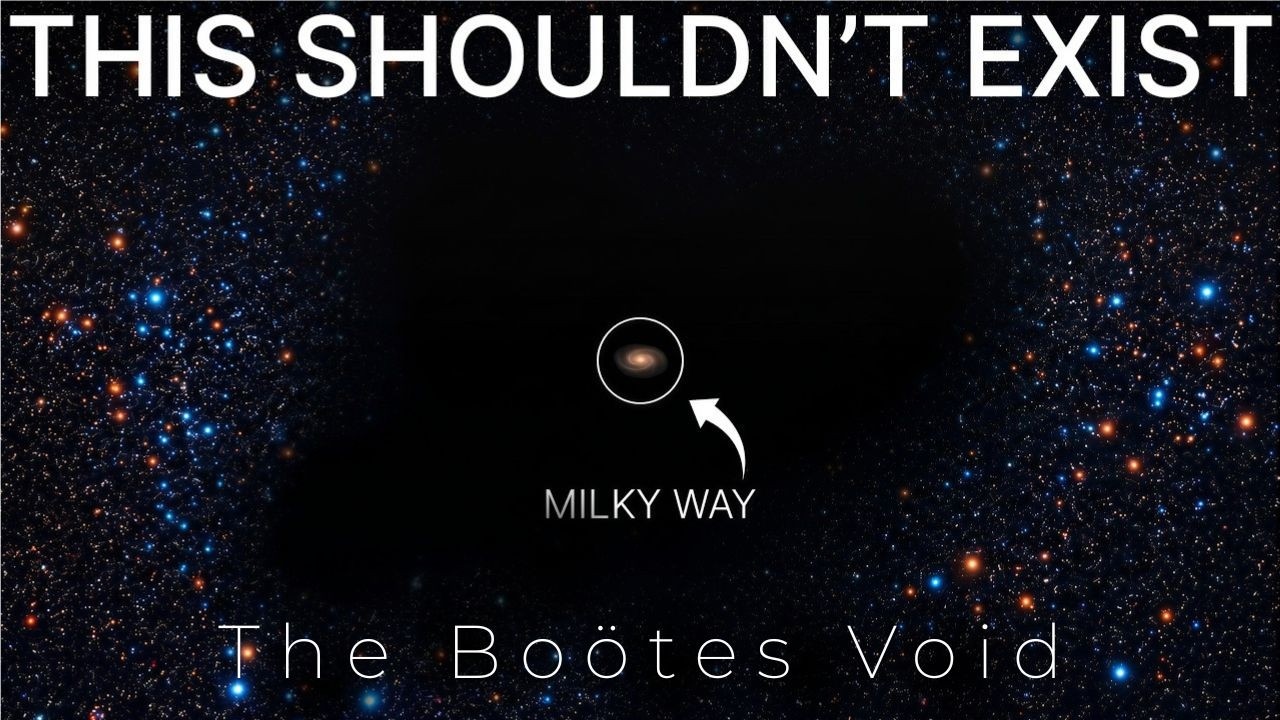
This Void Reveals Something Terrifying about The Universe and Dark Matter
Keywords
Summary
177 words
Critical Evaluation
The video provides a comprehensive and engaging overview of the Boötes Void, accurately conveying its significance in cosmology. It correctly describes the void’s discovery, its properties, and its role in understanding dark energy. The scientific content is generally sound, with correct references to redshift surveys, galaxy density measurements, and the cosmic web. However, the video lacks direct citations to primary sources, relying instead on general knowledge and the narrator’s explanations. This reduces its utility for viewers seeking verifiable references. The argumentation is coherent, but some speculative elements, such as the future of the universe and the possibility of changing dark energy, are presented without clearly distinguishing established science from hypothesis. The video’s strength lies in its ability to make complex concepts accessible, using analogies and thought experiments. The adéquation between title and content is good, though the title’s ‘Terrifying’ is sensationalist. Overall, the video is a valuable educational resource, but viewers should supplement it with primary literature for deeper understanding.
160 words
Title / Content Match
The title is somewhat sensationalist ('Terrifying') but accurately reflects the content's focus on the Boötes Void and its implications for dark matter and the universe's structure.
Quality & Reliability
7/10
The video presents accurate scientific facts about the Boötes Void, cosmic voids, and dark energy, referencing real studies and researchers. However, it lacks direct citations to primary sources and includes speculative elements (e.g., future of the universe) without clear distinction from established science.
Key Moments
Markers derived by PSI from the transcript: the creator did not define chapters.
- Introduction to the Boötes Void and its significance.
- Discovery of the void by Robert Kirshner in 1981.
- Explanation of the void's emptiness and galaxy density.
- Formation of voids from quantum fluctuations.
- How void galaxies differ from those in dense regions.
- Role of dark energy in void expansion.
- Scale comparisons and the Hercules-Corona Borealis Great Wall.
- Thought experiment: Milky Way inside the void.
- Debunking alien megastructure theories.
- Future of the universe and the void as a metaphor.
Cited Sources
- Astrophysical Journal (1987) - Kirshner et al. — Publication of the Boötes Void discovery.
- Hubble's 1924 discovery of galaxies — Mentioned in the thought experiment about the void's impact on cosmology.
Concurring Sources
- NASA - Dark Energy, Dark Matter — NASA's overview of dark energy and dark matter, consistent with the video's explanations.
Dissenting Sources
- Some studies suggest dark energy may be constant — The video hints at the possibility of dark energy changing, but many current models assume it is constant. This is an area of active research.
Contribution & Novelties
The video offers a compelling narrative that connects the Boötes Void to fundamental questions about dark energy and the universe’s fate. It provides a clear explanation of how voids form and why they are important laboratories for studying dark energy. The thought experiment about the Milky Way inside the void is a novel way to illustrate the impact of our cosmic location.
Pour aller plus loin :
- Cosmic void - Wikipedia — Overview of cosmic voids and their properties.
- Dark energy - Wikipedia — Explanation of dark energy and its role in cosmic expansion.
- Cosmic web - Wikipedia — Description of the large-scale structure of the universe.
107 words
Radar Profile
The radar profile shows high scores in quantity of information and fiabilité, with moderate technical level. This indicates a well-informed video that is accessible to a general audience but may lack depth for experts.
💬 No comments were provided for analysis.