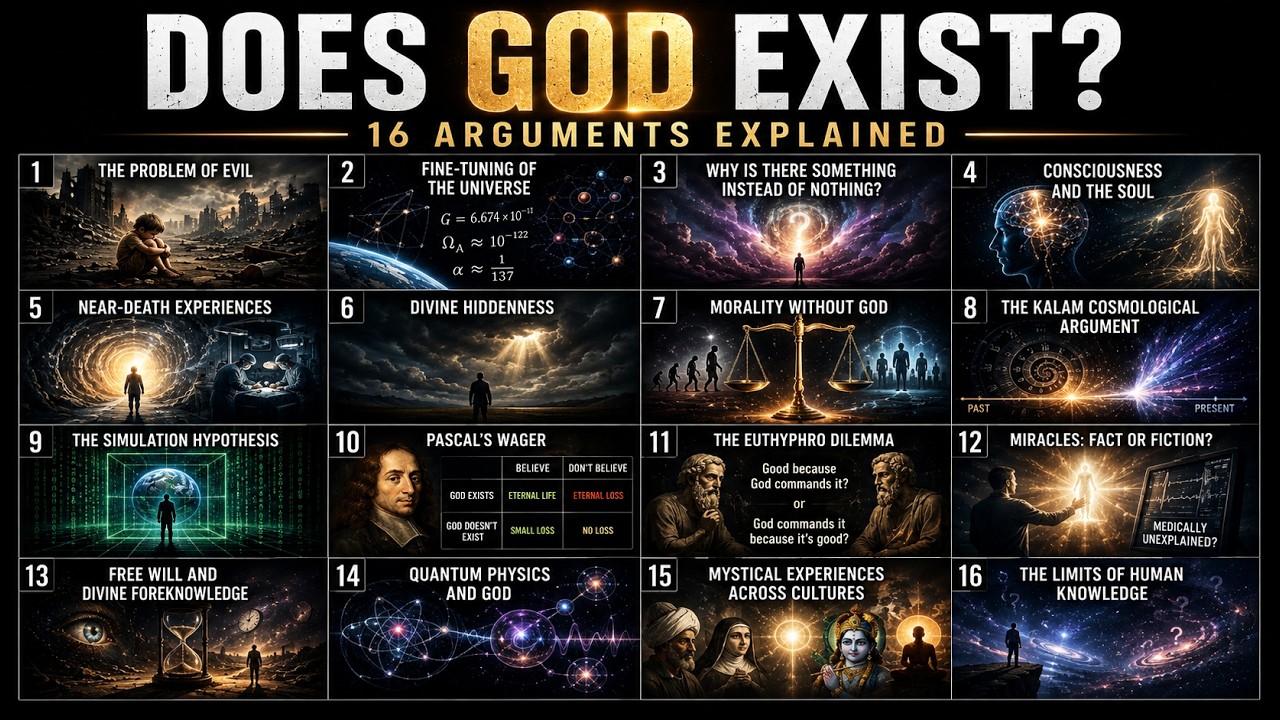
16 Reasons Science Rejects God—The Answer Is Terrifying. | FULL DOCUMENTARY
Keywords
Summary
122 words
Critical Evaluation
Value of the Information & Strength of the Argument
The documentary provides a valuable overview of the main arguments, presenting both theistic and atheistic perspectives fairly. It explains complex ideas clearly and uses examples to illustrate points. The argumentation is generally solid, though some arguments are simplified and could benefit from more nuance. The inclusion of counterarguments strengthens the overall credibility.
Scientific Rigor, Source Quality, Title Accuracy
The documentary references several philosophers and scientists, such as Epicurus, Dostoevsky, Plantinga, Hick, Penrose, Hoyle, Chalmers, Tononi, Moody, van Lommel, Schellenberg, Craig, Bostrom, and Pascal. However, it does not provide specific citations or links to primary sources. The title is somewhat sensationalist, but the content is more balanced than the title suggests. The documentary does not include a public comments section, so no analysis of viewer feedback is possible.
136 words
Title / Content Match
The title is somewhat sensationalist and may overstate the content, but it accurately reflects the documentary's focus on scientific and philosophical arguments against God.
Quality & Reliability
7/10
The documentary presents a balanced overview of major arguments for and against God's existence, citing philosophers and scientists. However, it lacks depth in some areas and does not provide direct citations for all claims.
Key Moments
Markers derived by PSI from the transcript: the creator did not define chapters.
- Introduction to the problem of evil and Epicurus' quote
- Discussion of the free will defense and natural evil
- Fine-tuning argument and the anthropic principle
- Cosmological argument and the Kalam version
- The hard problem of consciousness and the soul hypothesis
- Near-death experiences and scientific explanations
- Divine hiddenness and non-resistant non-belief
- The moral argument for God's existence
- Pascal's Wager and the many gods objection
- Simulation hypothesis and its implications
Cited Sources
- The Brothers Karamazov — Referenced in discussion of the problem of evil
- Life After Life — Referenced in discussion of near-death experiences
- The Lancet study on near-death experiences — Referenced in discussion of near-death experiences
Concurring Sources
- Stanford Encyclopedia of Philosophy: Problem of Evil — Provides scholarly analysis of the problem of evil.
- Stanford Encyclopedia of Philosophy: Fine-Tuning — Discusses the fine-tuning argument in detail.
Dissenting Sources
- The God Delusion by Richard Dawkins — Presents a more aggressive atheist perspective, contrasting with the documentary's balanced tone.
Contribution & Novelties
The documentary synthesizes a wide range of arguments in a single narrative, making it accessible to a general audience. It does not present new research but offers a comprehensive overview. For further exploration, consider the following:
- Problem of evil — Stanford Encyclopedia of Philosophy entry.
- Fine-tuning argument — Stanford Encyclopedia of Philosophy entry.
- Cosmological argument — Stanford Encyclopedia of Philosophy entry.
- Hard problem of consciousness — Stanford Encyclopedia of Philosophy entry.
- Simulation hypothesis — Wikipedia article.
76 words
Radar Profile
The radar profile shows high scores in quantity of information and quality, with moderate technical level and reliability. This indicates a comprehensive yet accessible documentary, suitable for a broad audience.