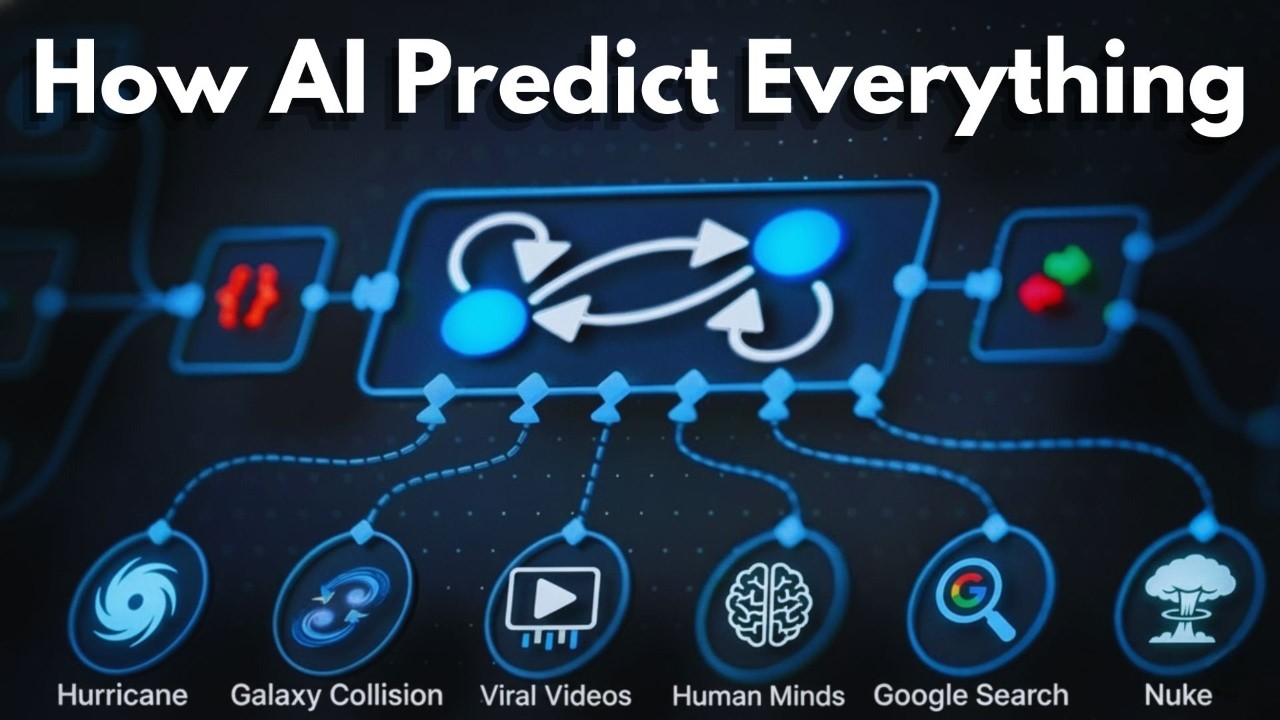
How Algorithm Predict Anything | Full Documentary 2026
Keywords
Summary
116 words
Critical Evaluation
The documentary offers a compelling narrative that connects historical mathematical concepts to contemporary AI applications, making it accessible to a general audience. However, its scientific rigor is limited by several factors. Firstly, it relies heavily on anecdotal examples and broad generalizations without providing concrete data or case studies. For instance, the claim that algorithms ‘shape what goes viral’ is presented as fact, but no empirical evidence is cited. Secondly, the documentary oversimplifies complex topics such as machine learning and neural networks, which may mislead viewers into thinking they understand these systems. Thirdly, it lacks citations to primary sources, making it difficult to verify the accuracy of historical claims or modern assertions. The narrative style, while engaging, often prioritizes dramatic effect over precision. For example, the statement that ‘your phone seems to know what you want before you do’ is a common trope that ignores the probabilistic nature of predictive algorithms. Additionally, the documentary does not address the limitations and biases inherent in algorithmic systems, which is a significant omission. The adéquation between title and content is moderate; the title suggests a focus on prediction mechanisms, but the documentary spends more time on history and societal impact. Overall, while the documentary serves as an engaging introduction, it falls short of being a rigorous scientific analysis. It would benefit from more technical depth, explicit sources, and a balanced discussion of both capabilities and limitations.
232 words
Title / Content Match
The title is somewhat misleading as the documentary focuses more on the history and societal impact of algorithms rather than a detailed explanation of how they predict anything.
Quality & Reliability
6/10
The documentary provides a broad historical overview of algorithms and their modern applications, but lacks depth in technical details and cites no specific sources. It mixes established facts with speculative claims about algorithmic influence, and the narrative style may oversimplify complex topics.
Key Moments
Markers derived by PSI from the transcript: the creator did not define chapters.
- Introduction to the concept of algorithms and their hidden influence on daily life.
- Discussion of ancient Babylonian algorithms and Euclid's algorithm.
- Al-Khwarizmi's contribution and the origin of the term 'algorithm'.
- Charles Babbage's Analytical Engine and Ada Lovelace's visionary insights.
- Alan Turing's theoretical framework and the Turing machine.
- The role of algorithms in WWII codebreaking and the birth of electronic computers.
- Modern applications: car engines, GPS, and the exponential growth of computing power.
- Conclusion: the societal impact of predictive algorithms and questions of control.
Contribution & Novelties
The documentary provides a broad historical perspective on algorithms, connecting ancient mathematical procedures to modern AI systems. It emphasizes the conceptual evolution from simple instructions to complex predictive models. However, it does not offer new scientific insights or original research.
Pour aller plus loin :
- Turing machine — Foundational concept in computation.
- Moore’s law — Observation about exponential growth in computing power.
- Recommendation system — Core technology behind predictive algorithms in media.
72 words
Radar Profile
The radar profile shows moderate scores in information quantity and quality, but lower technical depth and reliability. This indicates a documentary that is informative but lacks rigorous scientific detail and source verification.