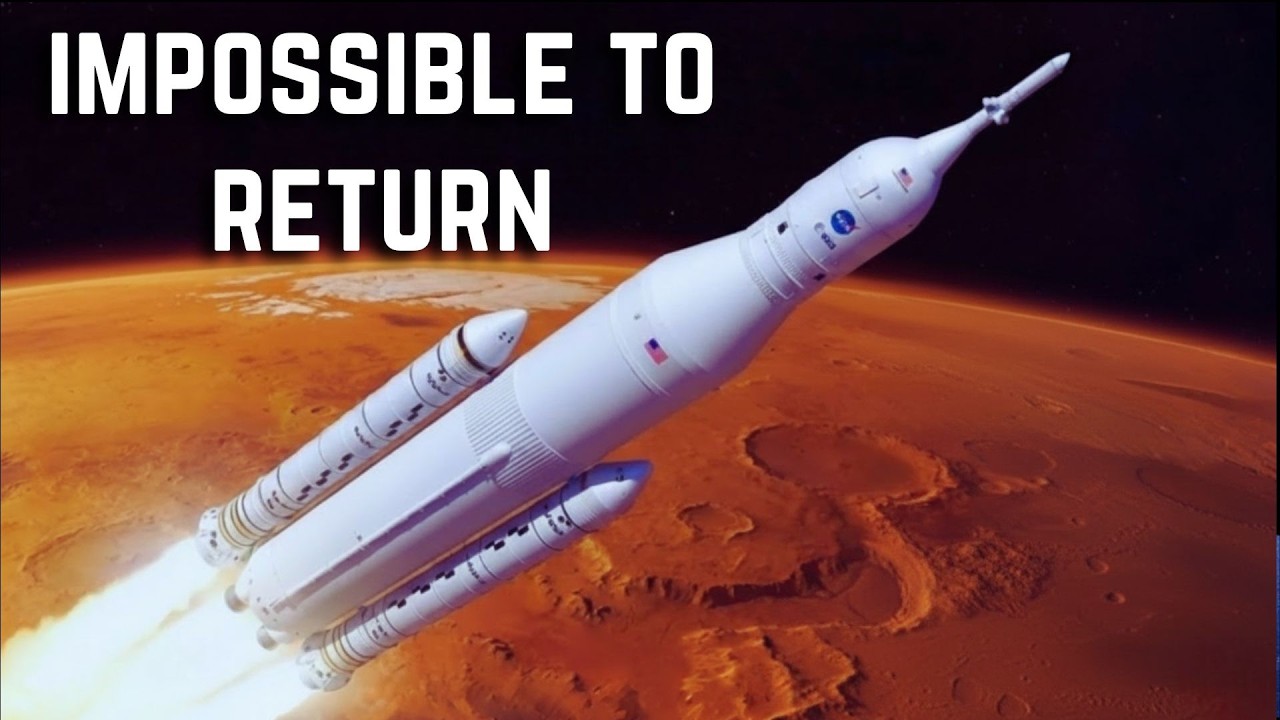
This One Problem Makes Returning from Mars Impossible | Full Documentary
Keywords
Summary
188 words
Critical Evaluation
The documentary provides a comprehensive and technically sound overview of the challenges of Mars return missions, focusing on the rocket equation and the tyranny of the propellant mass. It correctly identifies that the primary issue is not the delta-v required to leave Mars (which is lower than Earth’s) but the mass penalty of shipping fuel from Earth, making ISRU a necessity. The explanation of the rocket equation is clear and accessible, using the Saturn V as a concrete example. The discussion of pre-deployment and the harsh Martian environment adds practical depth. However, the documentary lacks specific citations to primary sources or peer-reviewed studies, relying on general knowledge and mentioning NASA and SpaceX without detailed references. The AI-generated narration, as disclosed, may raise concerns about authenticity, though the content itself appears accurate. The title’s use of ‘Impossible’ is somewhat sensational, but the content is balanced and does not claim impossibility, rather highlighting the difficulty. The documentary would benefit from more detailed technical data and expert interviews to strengthen its credibility. Overall, it is a valuable educational resource for a general audience interested in space exploration, but it does not break new ground for experts.
193 words
Title / Content Match
The title is somewhat sensationalist ('Impossible') but the content accurately addresses the core problem of fuel and return logistics, making it largely adequate.
Quality & Reliability
7/10
The documentary provides a well-structured and technically accurate overview of the challenges of Mars return missions, grounded in established physics (rocket equation) and engineering concepts. It cites NASA and SpaceX as key actors and mentions ISRU as a critical technology. However, it lacks specific citations to peer-reviewed sources or detailed technical reports, and the AI-generated narration (as disclosed) may reduce perceived authenticity. The content is generally reliable but not exhaustive.
Key Moments
Markers derived by PSI from the transcript: the creator did not define chapters.
- Introduction to the Moon missions and why they were feasible.
- Explanation of the distance and orbital mechanics of Mars missions.
- Introduction to the rocket equation and its implications.
- Comparison of delta-v requirements for Earth and Mars.
- Discussion of the mass penalty for shipping fuel from Earth.
- Introduction to in-situ resource utilization (ISRU).
- Challenges of building infrastructure on Mars.
- Effects of Martian environment on equipment and crew.
- Pre-deployment of ascent vehicles and autonomous systems.
- Conclusion summarizing the key challenges and current efforts.
Cited Sources
- NASA Mars Exploration Program — Mentioned as a key organization working on Mars missions and ISRU.
- SpaceX Mars & Beyond — Mentioned as a company developing technologies for Mars missions.
Concurring Sources
- NASA Mars Exploration Program — NASA's official Mars program aligns with the documentary's claims about ongoing research and ISRU development.
- SpaceX Mars & Beyond — SpaceX's plans for Mars missions align with the documentary's discussion of pre-deployment and ISRU.
Dissenting Sources
- No specific discordant sources found — The documentary's content is generally consistent with current scientific consensus, though it may oversimplify some technical aspects.
Contribution & Novelties
The documentary synthesizes well-known challenges of Mars return missions into a coherent narrative, emphasizing the rocket equation and ISRU as the central issues. It provides a clear explanation of why shipping fuel from Earth is impractical and why ISRU is essential. The documentary also highlights the often-overlooked logistical and maintenance challenges on Mars.
Pour aller plus loin :
- Tsiolkovsky rocket equation — The fundamental equation governing rocket propulsion, central to the documentary’s argument.
- In-situ resource utilization — The concept of producing fuel and other resources on Mars, a key proposed solution.
- Mars Direct — A mission architecture that heavily relies on ISRU, proposed by Robert Zubrin.
- NASA’s Mars 2020 Perseverance Rover — The rover includes MOXIE, an experiment testing oxygen production from Martian CO2.
124 words
Radar Profile
The radar profile shows high scores in quantity of information and technical level, indicating a dense and technically detailed documentary. Quality and reliability are slightly lower, reflecting the lack of explicit citations and the AI-generated narration. Overall, the documentary is informative but could benefit from more rigorous sourcing.
💬 Positif : Sur les 30 commentaires analysés, la majorité exprime une appréciation positive de la vidéo, saluant son caractère informatif et sa qualité, tout en notant que la voix est générée par IA et non celle de David Attenborough.