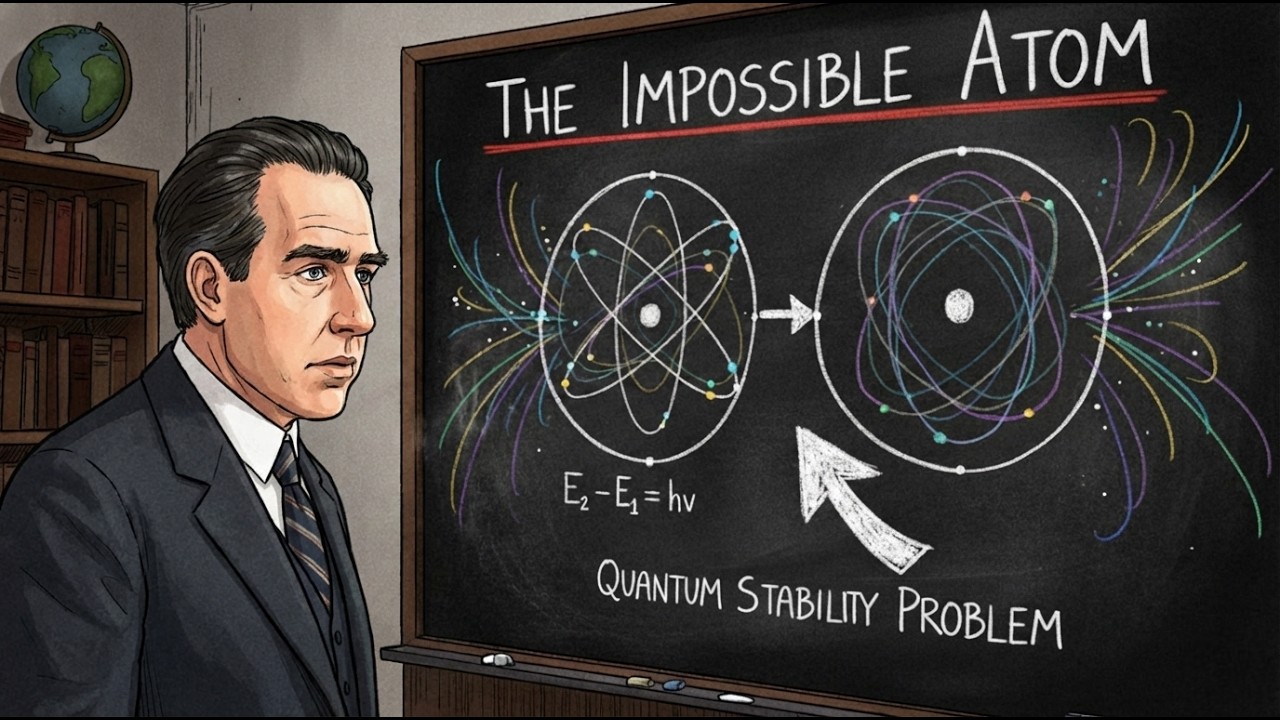
How This One Idea from Niels Bohr Changed Physics Forever
Keywords
Summary
153 words
Critical Evaluation
The video offers a compelling and historically grounded narrative of the quantum stability problem and Bohr’s 1913 model. It effectively explains the paradox of atomic collapse according to classical physics and the key experimental and theoretical steps leading to Bohr’s solution. The content is scientifically accurate, drawing on well-established historical accounts and primary sources. The argumentation is solid, logically progressing from Maxwell’s equations to the ultraviolet catastrophe, Planck’s quanta, Einstein’s photons, Rutherford’s nuclear model, and the spectral line mystery, culminating in Bohr’s postulates. The video excels in making complex concepts accessible without oversimplifying the physics. It uses analogies (e.g., ’ticking time bomb’, ‘barcode’) to aid understanding. The sources cited in the description are authoritative, including Bohr’s original paper, Rutherford’s paper, and standard textbooks. However, the video does not explicitly cite sources during the narration, which slightly reduces its scholarly rigor. The production quality is high, with clear visuals and narration, though some dramatization may be seen as sensationalist. The title accurately reflects the content. Overall, the video is a valuable educational resource for those interested in the history of quantum mechanics, providing both context and explanation. It does not delve into the limitations of Bohr’s model or subsequent developments, but that is not its stated purpose. The video’s strength lies in its storytelling and clarity, making it an excellent introduction to a pivotal moment in physics.
226 words
Title / Content Match
The title accurately reflects the content, focusing on Bohr's contribution to resolving the atomic stability crisis.
Quality & Reliability
7/10
The video provides a historically accurate narrative of the quantum stability problem and Bohr's model, citing primary sources and textbooks. However, it lacks explicit citations within the narration and contains some dramatization. The sources listed are reliable and relevant.
Key Moments
Markers derived by PSI from the transcript: the creator did not define chapters.
- Introduction: The paradox of atomic stability and the quantum stability problem.
- Explanation of Maxwell's equations and why accelerating charges radiate energy.
- The classical prediction: atoms should collapse in picoseconds.
- The crisis in physics: ultraviolet catastrophe and Planck's quanta.
- Einstein's photon concept and the wave-particle duality.
- Rutherford's gold foil experiment and the discovery of the nucleus.
- The mystery of atomic spectra and the Balmer series.
- Bohr's revolutionary model: quantized orbits and energy jumps.
- How Bohr's model explains spectral lines and atomic stability.
- Conclusion: The death of classical physics and the birth of quantum mechanics.
Cited Sources
- On the Constitution of Atoms and Molecules — Bohr's 1913 paper presenting his atomic model.
- The Scattering of α and β Particles by Matter and the Structure of the Atom — Rutherford's 1911 paper on the nuclear atom.
- Introduction to Quantum Mechanics — Standard textbook reference for quantum mechanics.
- Quantum Physics of Atoms, Molecules, Solids, Nuclei, and Particles — Textbook covering atomic and quantum physics.
- Modern Physics — Textbook on modern physics including quantum theory.
- MIT OpenCourseWare – 8.04 Quantum Physics I — University course on quantum physics.
- HyperPhysics – Georgia State University — Online physics reference.
- The Feynman Lectures on Physics, Vol. III — Feynman's lectures on quantum mechanics.
- Niels Bohr – Nobel Lecture: The Structure of the Atom — Bohr's Nobel lecture on atomic structure.
- Niels Bohr's Times: In Physics, Philosophy, and Polity — Biography of Bohr by Abraham Pais.
- The Genesis of the Bohr Atom — Historical study on the development of Bohr's model.
- Niels Bohr and the Quantum Atom: The Bohr Model of Atomic Structure 1913–1925 — Book on Bohr's atomic model.
- The Conceptual Development of Quantum Mechanics — Historical account of quantum mechanics development.
Concurring Sources
- Bohr model — Wikipedia article on Bohr's model, consistent with the video's description.
- Quantum stability problem — Wikipedia article on the stability of matter, related to the quantum stability problem.
Contribution & Novelties
The video provides a clear and engaging narrative of the quantum stability problem and Bohr’s solution, making complex historical and scientific concepts accessible. It emphasizes the paradigm shift from classical to quantum physics.
Pour aller plus loin :
- Bohr model — Overview of Bohr’s atomic model and its significance.
- Quantum mechanics — General introduction to quantum theory.
- Atomic orbital — Modern quantum mechanical description of electron states.
- Correspondence principle — Bohr’s principle linking quantum and classical physics.
- Old quantum theory — Historical context of early quantum models.
87 words
Radar Profile
The radar profile shows high scores in quantity and quality of information, with a moderate technical level and good reliability. This indicates a well-balanced educational video that is both informative and accessible.
💬 No comments were provided for analysis.