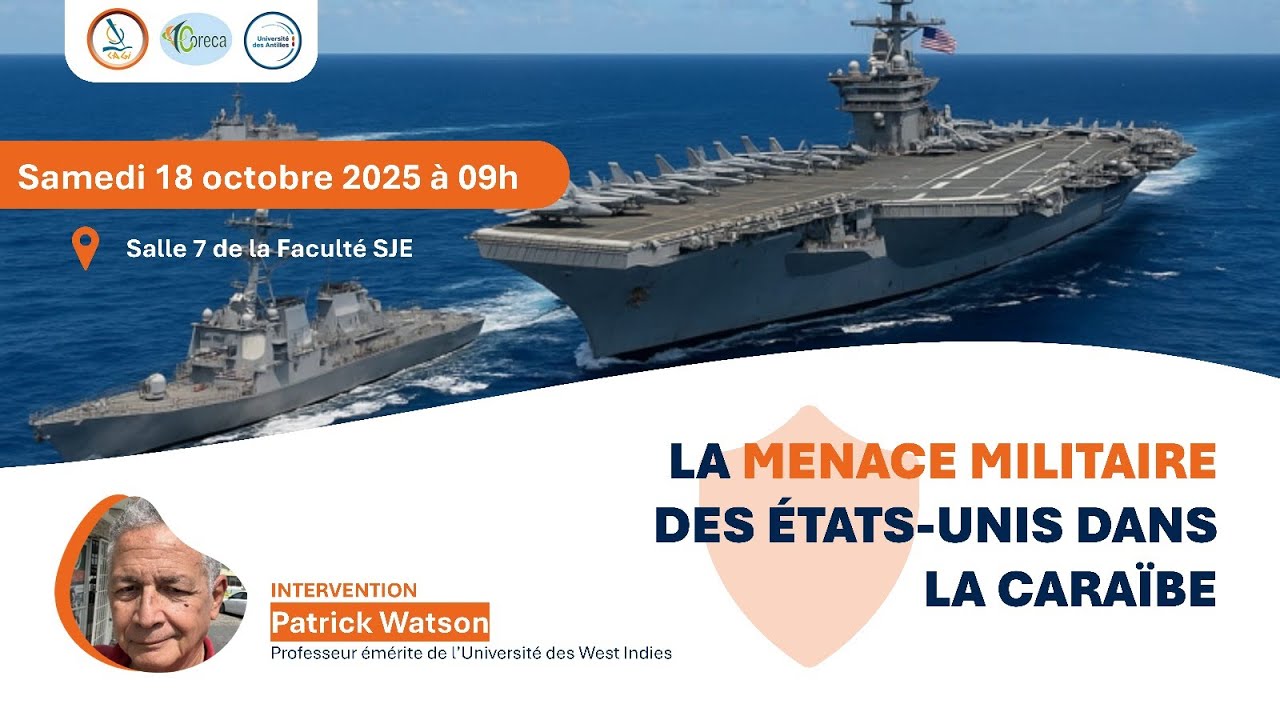
La Menace Militaire des Etats-Unis dans la Caraïbe, Patrick WATSON Professeur Emérite UWI, Trinidad
Keywords
Summary
194 words
Critical Evaluation
Value of the Information & Strength of the Argument
The value of the information lies in the unique perspective of a Caribbean academic on a current geopolitical issue, providing insights into regional reactions and the role of Trinidad. The argumentation is coherent but relies heavily on personal interpretation and anecdotal evidence rather than systematic analysis. Watson makes a plausible case that the US military actions are aimed at regime change, but he does not provide concrete evidence beyond citing US statements and the lack of survivors from the attacks. He also highlights the controversial stance of Trinidad’s government, which is a valuable point for understanding regional dynamics. However, the presentation lacks depth in exploring alternative explanations and does not engage with counterarguments, which weakens its overall persuasiveness.
Scientific Rigor, Source Quality, Title Accuracy
The scientific rigor is moderate: the speaker is an expert in economics, not specifically in military or political science, but his academic background lends some credibility. He does not cite specific sources during the talk, relying on general knowledge and current events. The title accurately reflects the content, which is a focused analysis of the US military threat in the Caribbean. The adequacy between title and content is good, as the talk directly addresses the topic. However, the lack of citations and reliance on personal opinion reduce the overall scientific quality. The presentation would benefit from referencing official documents or reports to support its claims.
238 words
Title / Content Match
The title accurately reflects the content, which focuses on the US military threat in the Caribbean as analyzed by Professor Watson.
Quality & Reliability
6/10
The speaker is an emeritus professor of economics with relevant expertise, but the presentation is largely an opinion piece with limited verifiable data and no citations. The claims are plausible but not rigorously sourced.
Key Moments
Markers derived by PSI from the transcript: the creator did not define chapters.
- Introduction of Patrick Watson by Fred Reno, highlighting his academic background.
- Watson begins his talk, discussing the history of US-Venezuela relations and the election of Hugo Chavez.
- Watson mentions the US naval fleet in the Caribbean and argues it is not just about drug trafficking.
- He criticizes Trinidad's government for offering its territory as a base, calling it a dangerous move.
- Discussion of the sinking of boats and the lack of survivors, questioning the official justification.
- Watson mentions the Nobel Peace Prize awarded to María Corina Machado and her call for foreign intervention.
- He concludes by expressing personal fear of becoming a victim of war, comparing to the Cuban Missile Crisis.
- Q&A session begins; Watson answers a question about resistance in the Caribbean.
Cited Sources
- No specific sources cited in the video — The speaker did not cite specific sources during the talk.
Concurring Sources
- No concordant sources provided — No external sources were cited in the video.
Dissenting Sources
- No discordant sources provided — No external sources were cited in the video.
Contribution & Novelties
The talk provides a Caribbean perspective on the US military presence, highlighting the role of Trinidad and Tobago and the reactions of other nations. It offers a critical analysis of the official justification and suggests underlying motives of regime change. The speaker’s personal experience and regional knowledge add value.
Pour aller plus loin :
- Venezuela–Guyana relations — Background on the territorial dispute.
- United States–Venezuela relations — Historical context of US-Venezuela tensions.
- Bay of Pigs Invasion — Historical reference used by the speaker.
82 words
Radar Profile
The radar profile shows moderate scores across all dimensions, with slightly higher scores in quantity of information and lower in technical level. This indicates a presentation that is informative but not deeply technical or rigorously sourced.
💬 No comments were provided for analysis.