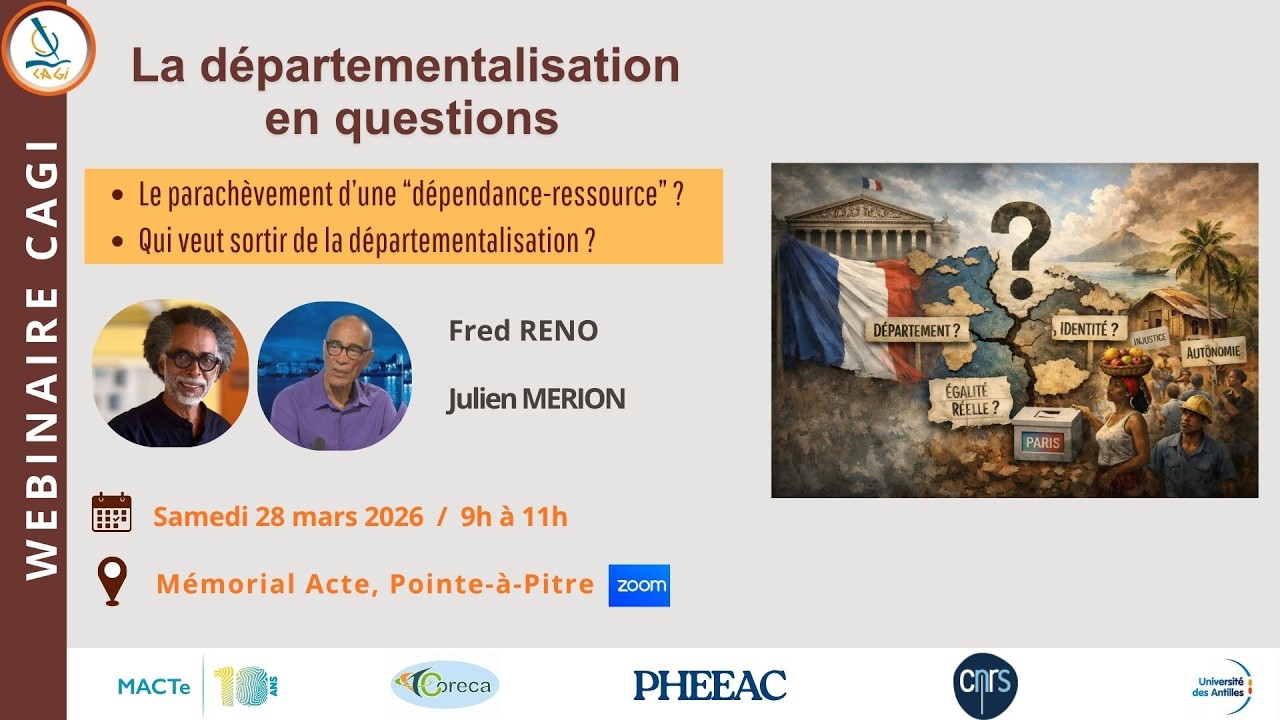
Première partie: Les interventions de Fred RENO et Julien MERION
Keywords
Summary
208 words
Critical Evaluation
Value of the Information & Strength of the Argument
The value of the information is high, as the speakers provide a nuanced historical and political analysis of departmentalization in the French overseas territories, particularly Guadeloupe. They offer original concepts like ‘dependency-resource’ and ‘departmentalization of identity,’ supported by specific examples and citations. The argumentation is solid, with clear logical progression and use of historical evidence. However, the presentations are largely based on the speakers’ interpretations and may not cover all perspectives, but they are well-structured and persuasive.
Scientific Rigor, Source Quality, Title Accuracy
The scientific rigor is good: the speakers reference specific laws, dates, and documents, such as the 1946 law, the 1958 colloquium, and the work of Aimé Césaire and Michel Girot. They also mention a thesis by Mael Avenner. The sources are credible within the context of academic discourse. The title accurately reflects the content, and the video is well-organized. No comments were provided, so no analysis of public reception is included.
163 words
Title / Content Match
The title accurately reflects the content, which focuses on the two presentations by Fred Reno and Julien Mérion on the topic of departmentalization.
Quality & Reliability
8/10
The video is a recorded academic conference with two expert speakers (Fred Reno and Julien Mérion) who provide detailed historical and political analysis. They cite specific dates, laws, and sources, and the discussion is structured and rigorous. However, the video is a single event with no external verification or peer review, and some claims are based on the speakers' interpretations.
Key Moments
Markers derived by PSI from the transcript: the creator did not define chapters.
- Introduction by the moderator, welcoming attendees and introducing the topic of departmentalization.
- Fred Reno begins his presentation, outlining the paradoxes of departmentalization.
- Fred Reno discusses the historical origins of departmentalization, dating back to 1794.
- Fred Reno explains the concept of 'dependency-resource' and its reciprocal nature.
- Fred Reno analyzes the cultural and identity dimensions of departmentalization, citing examples like the flag and music.
- Julien Mérion begins his presentation on who wants to leave departmentalization.
- Julien Mérion discusses the two approaches to leaving departmentalization: managerial and rupture.
- Conclusion: the persistence of dependency and the lack of change since 1956.
Cited Sources
- Thèse de Mael Avenner: Décolonisation et changement social aux Antilles françaises — Fred Reno recommends this thesis for further reading on the topic.
- Michel Girot, 2005 — Cited by Fred Reno on the persistence of dependency.
- Aimé Césaire, Discours sur le colonialisme — Referenced for his critique of assimilation.
Concurring Sources
- Wikipedia: Departmentalization — Provides general background on the concept.
Dissenting Sources
- No discordant sources found — The video does not present conflicting sources; it is a single academic presentation.
Contribution & Novelties
The video offers a fresh perspective on departmentalization by framing it as a ‘dependency-resource’ relationship, emphasizing the reciprocal nature of dependence. It also highlights the depoliticization of cultural identity in Guadeloupe, which is a novel observation. The discussion of the two approaches to leaving departmentalization (managerial vs. rupture) provides a clear analytical framework.
Pour aller plus loin :
- Départementalisation — Wikipedia article on departmentalization in French overseas territories.
- Aimé Césaire — Overview of the writer and politician who played a key role in the 1946 law.
- French overseas territories — General information on France’s overseas territories.
96 words
Radar Profile
The radar profile shows high scores in information quantity, quality, technical level, and reliability, indicating a well-researched and informative presentation. The balance suggests a comprehensive analysis suitable for an academic audience.