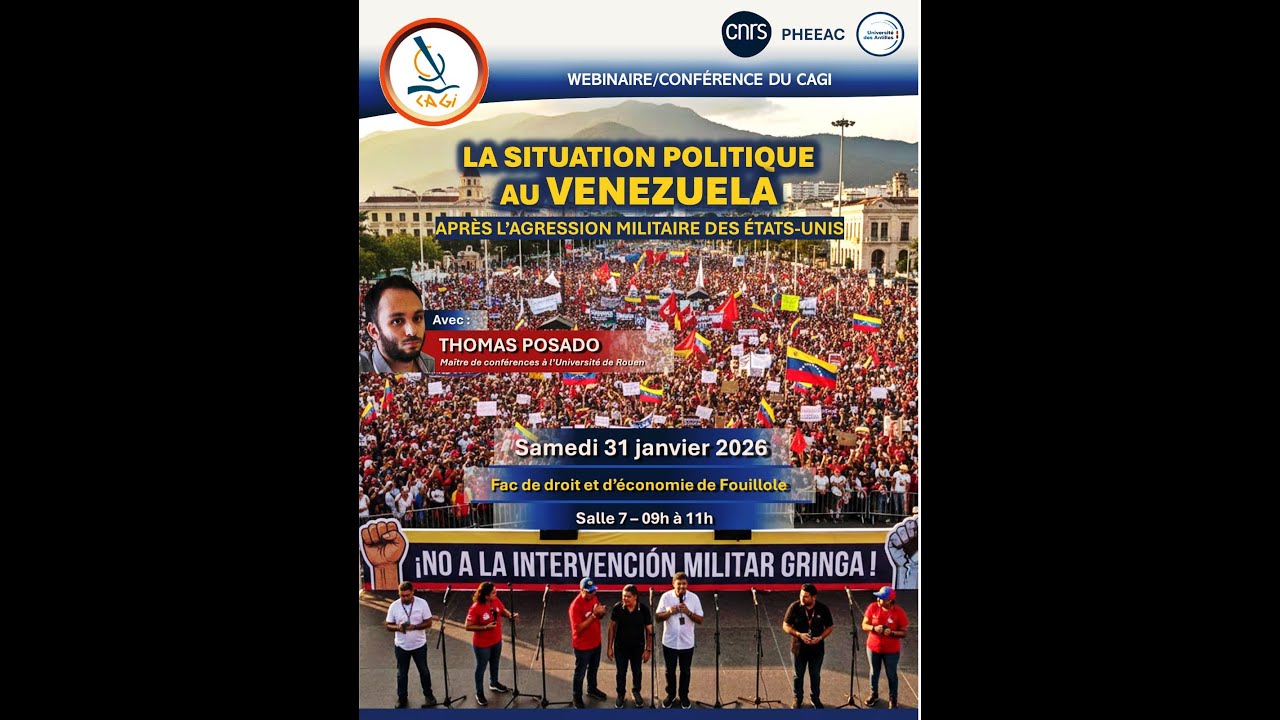
La situation politique au Venezuela par Thomas POSADO, Maître de conférences
Keywords
Summary
162 words
Critical Evaluation
Value of the Information & Strength of the Argument
The value of the information is high: Posado provides a well-informed, nuanced analysis that goes beyond simple condemnation of US intervention. He offers historical context, economic data, and political insights that are not commonly found in mainstream media. His argumentation is solid, based on his academic expertise and specific examples (e.g., the release of Juan Orlando Hernández, the role of fentanyl). He also acknowledges the authoritarian nature of Maduro’s regime, avoiding a one-sided narrative. However, some claims are interpretative and lack direct evidence, such as the assertion that US intervention is solely about oil, though he supports it with circumstantial evidence.
Scientific Rigor, Source Quality, Title Accuracy
The speaker demonstrates scientific rigor by referencing his own book and academic background. He cites specific events and documents, such as the US National Security Doctrine and the new Venezuelan hydrocarbon law. However, he does not provide direct citations or URLs during the talk, relying on his expertise. The title accurately reflects the content, and the discussion is well-structured. The Q&A segment adds depth, addressing criticisms and clarifying positions. Overall, the sources are credible but not formally cited in the video.
197 words
Title / Content Match
The title accurately reflects the content: a detailed analysis of the political situation in Venezuela by an academic expert.
Quality & Reliability
8/10
The speaker is a recognized academic (maître de conférences) specializing in Venezuela, with a recent book on the topic. The analysis is nuanced, acknowledging both US interventionism and Maduro's authoritarianism. However, the talk is an opinion/expert analysis rather than a peer-reviewed study, and some claims (e.g., US motivations) are interpretative.
Key Moments
Markers derived by PSI from the transcript: the creator did not define chapters.
- Introduction of Thomas Posado and his background.
- Discussion on Bolívar and Chávez's legacy.
- Analysis of the revolutionary period and its decline.
- Explanation of the US military intervention and its motivations.
- Debunking the narcotrafficking pretext.
- Discussion on the new hydrocarbon law and oil interests.
- Q&A session: critique of binary framing and Maduro's authoritarianism.
- Posado acknowledges Maduro's authoritarian practices while condemning US intervention.
- Discussion on US policy in Latin America and China's role.
- Speculation on US military bases in French territories and Caribbean.
Cited Sources
- Venezuela: de la révolution à l'effondrement — Mentioned as the speaker's recent book, providing the basis for his analysis.
Concurring Sources
- Venezuela: de la révolution à l'effondrement — The speaker's own book, which aligns with his analysis.
Dissenting Sources
- US State Department statements on Venezuela — Official US narratives may contradict the speaker's claims about motivations and the nature of the intervention.
Contribution & Novelties
This talk provides a unique academic perspective on the recent US intervention in Venezuela, combining historical context with current events. It offers a nuanced view that criticizes both US imperialism and Maduro’s authoritarianism, which is rare in mainstream discourse. The speaker’s expertise adds depth to the analysis, particularly regarding the role of oil and the drug trafficking pretext.
Pour aller plus loin :
- Doctrine Monroe — Historical context for US interventionism in Latin America.
- Bolivarian Revolution — Overview of the political movement initiated by Chávez.
- Venezuelan economic crisis — Background on the economic collapse and its causes.
97 words
Radar Profile
The radar profile shows high scores in quantity and quality of information, with a moderate technical level. This indicates a well-informed, accessible talk suitable for a general audience interested in geopolitics.
💬 Sur les 0 commentaires analysés, aucune tendance n'est disponible.