CLEAR/CURES Seminar: Dr. Allen J. Wilcox (Nat'l Institute for Env Health Sciences) Oct 9, 2025
Keywords
Summary
186 words
Critical Evaluation
Value of the Information & Strength of the Argument
The talk provides a compelling critique of the use of SGA as a proxy for FGR, supported by empirical data from ROC analyses and multiple epidemiological studies. The argument is well-structured, logically sound, and clearly presented. The speaker effectively demonstrates the limitations of current definitions and the need for a paradigm shift. The value of the information is high, as it challenges a widely used practice and offers a path forward.
Scientific Rigor, Source Quality, Title Accuracy
The presentation is based on a published paper and references several studies, including a latent class analysis by Jennifer Hutchinson. The speaker is a leading expert in reproductive epidemiology, and his arguments are grounded in solid methodology. The title accurately reflects the content. The talk is scientifically rigorous, and the sources cited are credible. The adequacy between title and content is excellent.
148 words
Title / Content Match
The title accurately reflects the seminar content, which is a presentation by Dr. Allen J. Wilcox on the study of fetal growth restriction.
Quality & Reliability
9/10
The speaker is a highly respected epidemiologist with extensive experience and publications. The talk is based on a published paper and presents a well-reasoned argument with supporting data. The presentation is clear and acknowledges limitations.
Key Moments
Markers derived by PSI from the transcript: the creator did not define chapters.
- Introduction of Dr. Allen J. Wilcox by Stephen.
- Dr. Wilcox begins his talk, explaining the importance of the topic and the challenge of defining fetal growth restriction.
- Discussion of the use of SGA as a surrogate marker and its advantages.
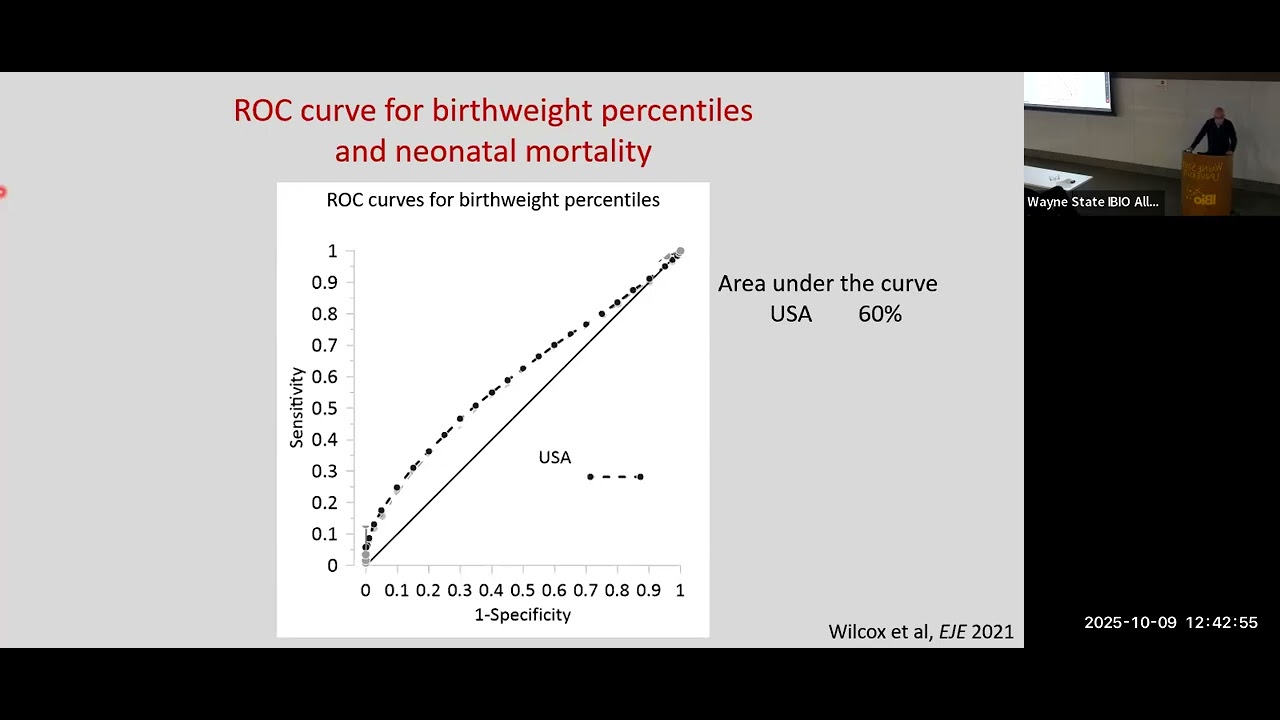
- Presentation of ROC analysis results showing poor predictive value of birth weight percentiles for neonatal mortality.
- Comparison with gestational age as a predictor, which has an AUC of 88%.
- Explanation of the conceptual distinction between SGA and FGR, using a Venn diagram.
- Discussion of false conclusions about prevalence and mortality risk when using SGA.
- Presentation of latent class analysis study by Jennifer Hutchinson, showing FGR prevalence of ~1% in term births.
- Comparison of birth weight distribution in FGR vs. unaffected, showing a shift of 1.6 SD.
- Discussion of converging evidence from multiple studies on FGR prevalence and high relative risk.
- Call for clinical markers and collaborative research to better define FGR.
- Q&A session begins.
Cited Sources
- On the Study of Fetal Growth Restriction, Time to Abandon SGA — The paper on which this talk is based, published by Dr. Wilcox.
- Predicting adverse perinatal outcomes by various customized and population-based standards for fetal growth — Study from Roberto Romero's group, cited in the talk, showing poor predictive value of fetal size standards.
Concurring Sources
- Fetal growth restriction: current knowledge — General review supporting the challenges in defining FGR.
Dissenting Sources
- Small for gestational age and risk of long-term adverse outcomes — Some studies may still support the use of SGA as a useful marker for adverse outcomes, though they may not address the distinction from FGR.
Contribution & Novelties
This talk provides a critical reevaluation of the use of SGA as a surrogate for fetal growth restriction, offering a clear argument for abandoning this practice. It synthesizes evidence from multiple studies to show that FGR is a rare but severe condition with a distinct pathophysiology. The speaker proposes a shift towards defining FGR using clinical markers independent of size, and highlights the need for collaborative research to develop such markers.
Pour aller plus loin :
- Fetal growth restriction - Wikipedia — Provides an overview of FGR, its causes, and clinical significance.
- Small for gestational age - Wikipedia — Explains the definition and implications of SGA.
- Latent class analysis - Wikipedia — Describes the statistical method used in the Hutchinson study.
121 words
Radar Profile
The radar profile shows high scores in quality of information and reliability, reflecting the speaker's expertise and the well-supported argument. The quantity of information is also high, but the technical level is moderate, making it accessible to a broad scientific audience.
💬 No comments were provided for analysis.