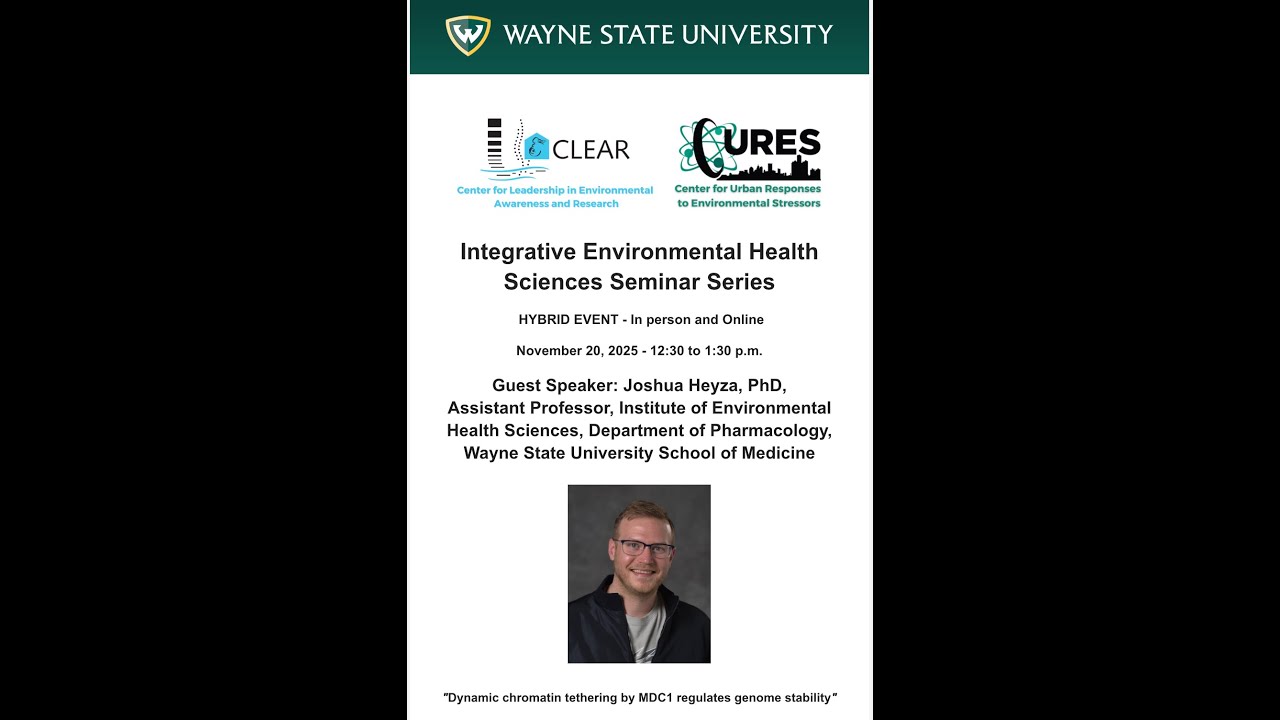
CLEAR/CURES Research Seminar: Dr. Joshua Heyza (Wayne State U) - November 20, 2025
Keywords
Summary
171 words
Critical Evaluation
Value of the Information & Strength of the Argument
The seminar provides significant value by presenting novel insights into the dynamic regulation of MDC1, a key DNA repair protein. The use of endogenous tagging and single-molecule microscopy offers a physiologically relevant approach, overcoming limitations of overexpression and endpoint assays. The argumentation is solid, supported by rigorous experimental evidence: deletion mutants, phospho-mimetic and phospho-dead mutants, in vitro kinase assays, and phospho-specific antibodies. The speaker clearly explains the rationale and interprets results, building a compelling case for the PST domain’s role in chromatin tethering and its regulation by phosphorylation. The research addresses fundamental questions in DNA repair and has implications for understanding genome stability and disease.
Scientific Rigor, Source Quality, Title Accuracy
The scientific rigor is high, with detailed methodology and clear presentation of data. The speaker cites his own published work and mentions using resources like PhosphoSitePlus. The title accurately reflects the seminar’s content. The description provides an abstract and speaker bio, but no external sources are listed. The talk is based on original research, presumably peer-reviewed, given the speaker’s track record. The adequacy between title and content is excellent.
189 words
Title / Content Match
The title accurately reflects the content: a research seminar by Dr. Joshua Heyza on DNA repair mechanisms.
Quality & Reliability
9/10
The seminar presents original research from a peer-reviewed study, with detailed methodology (CRISPR tagging, single-molecule microscopy) and clear data. The speaker is an established researcher with NIH funding. The content is highly technical and specific, indicating high reliability.
Key Moments
Markers derived by PSI from the transcript: the creator did not define chapters.
- Introduction by Dr. Graeme Parker and speaker introduction
- Overview of lab's research focus and techniques
- Introduction to DNA double-strand breaks and repair pathways
- Challenges in studying DNA repair proteins and use of CRISPR tagging
- Discovery of MDC1 constitutive chromatin binding via PST domain
- Regulation of PST binding by CDK1 phosphorylation during mitosis
- Role of MDC1 in tethering DNA breaks during mitosis and conclusions
Cited Sources
- PhosphoSitePlus — Used to identify post-translational modifications on MDC1 PST domain
Concurring Sources
- PhosphoSitePlus — Database confirming phosphorylation sites on MDC1
Contribution & Novelties
The seminar presents original findings on the PST repeat domain of MDC1 as a multivalent nucleosome-binding domain with tunable affinity, regulated by CDK1 phosphorylation during mitosis. This provides a mechanistic basis for MDC1’s dynamic chromatin interactions and its role in homologous recombination and genome stability. The use of endogenous tagging and single-molecule microscopy offers a powerful approach to study DNA repair in living cells.
Pour aller plus loin :
- Homologous recombination — Key pathway for high-fidelity DSB repair.
- MDC1 — Overview of MDC1 protein and its functions.
- Single-molecule microscopy — Technique used to visualize individual molecules in living cells.
99 words
Radar Profile
The radar profile shows very high scores in all dimensions, indicating a technically deep, reliable, and information-rich seminar. The lowest score is in quantity of information, but still high, reflecting the focused nature of a research talk.