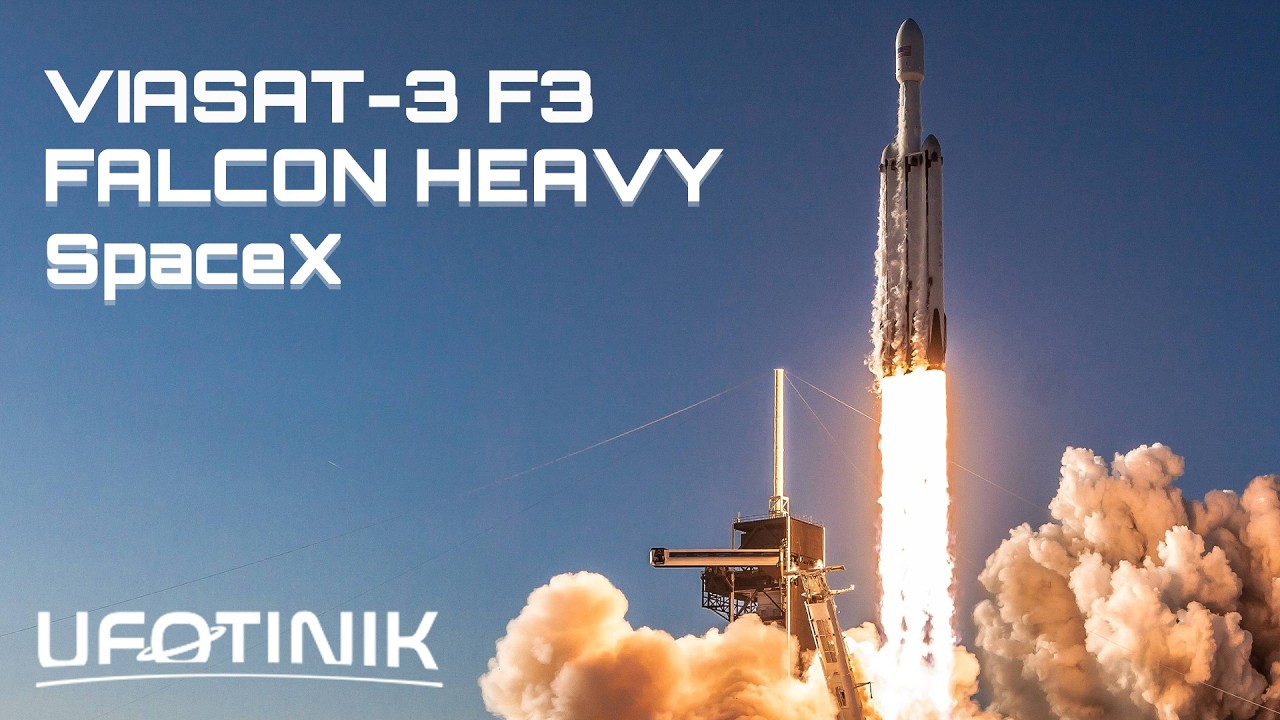
🔴 EN DIRECT LANCEMENT SPACEX FALCON HEAVY ViaSat-3 F3 (Lancement spatial FR )
Keywords
Summary
191 words
Critical Evaluation
The video offers a rich, real-time narrative of a significant space launch, blending technical details with corporate history. The host demonstrates deep knowledge of the space industry, particularly regarding Viasat’s acquisition strategy and the evolution of satellite communications. The information on Viasat’s history is presented with specific dates, company names, and financial figures, which adds credibility. However, the lack of direct citations to primary sources means that some claims cannot be independently verified. The discussion of geostationary versus low Earth orbit satellites is accurate and well-explained, providing valuable context for viewers. The host’s commentary on SpaceX’s business model is insightful, though it reflects a personal perspective. The live format introduces some digressions and informal language, but this does not detract from the overall informational value. The video successfully achieves its goal of providing live coverage and educational content. The title accurately reflects the content, and the inclusion of historical background enhances understanding. The main weakness is the absence of formal references, which limits its use as a scholarly source. Nevertheless, for a general audience interested in space exploration, this video is a valuable resource.
184 words
Title / Content Match
The title accurately reflects the live launch coverage of the Falcon Heavy carrying ViaSat-3 F3, though the content also includes extensive background on Viasat's history.
Quality & Reliability
7/10
The stream provides a detailed historical account of Viasat's corporate acquisitions and technical context for the Falcon Heavy launch, but relies on unverified claims and lacks direct citations to primary sources. The host's expertise is evident, yet the information is presented in a conversational, non-peer-reviewed manner.
Key Moments
Markers derived by PSI from the transcript: the creator did not define chapters.
- Introduction and welcome, launch details: time, location, weather.
- History of Viasat: founding in 1986, early funding, and IPO.
- Acquisitions in 2001: Scientific Atlanta, Comsat Laboratories, US Monolithics, and partnerships.
- Comparison of geostationary vs. low Earth orbit satellites, and SpaceX's business model.
- More acquisitions and contracts, including defense contracts.
- Discussion of Falcon Heavy and booster recovery plans.
- Countdown updates and weather checks.
- Launch sequence and liftoff.
- Booster separation and landing of side boosters.
- Confirmation of successful launch and congratulations.
Cited Sources
- UFOTINIK Launch Calendar — Referenced for upcoming launches.
- Starlink Program Overview — Mentioned for more information on Starlink.
Concurring Sources
- SpaceX Falcon Heavy Launch of ViaSat-3 F3 — Official SpaceX mission page confirming launch details and objectives.
Dissenting Sources
- ViaSat-3 F3 Launch Delayed Due to Weather
External References
Contribution & Novelties
The video provides a unique real-time perspective on a Falcon Heavy launch, enriched with a detailed corporate history of Viasat that is not commonly covered in mainstream media. It offers insights into the business strategies of satellite operators and the evolution of satellite internet, contrasting geostationary and low Earth orbit systems. The host’s analysis of SpaceX’s economic model adds depth to the understanding of the commercial space industry.
Pour aller plus loin :
- ViaSat-3 satellite — Wikipedia article on the ViaSat-3 satellite series, providing technical specifications and mission details.
- Falcon Heavy — Wikipedia article on the Falcon Heavy rocket, including its design and flight history.
- Geostationary orbit — Wikipedia article explaining the concept and applications of geostationary orbits.
- Starlink — Wikipedia article on SpaceX’s satellite internet constellation, relevant to the discussion of LEO systems.
134 words
Radar Profile
The radar profile shows high scores in quantity of information and reliability, reflecting the detailed historical data and accurate launch coverage. The technical level is moderate, suitable for a general audience, while the overall quality is strong, making this a valuable resource for space enthusiasts.
💬 Sur les 0 commentaires analysés, aucune tendance n'est disponible.