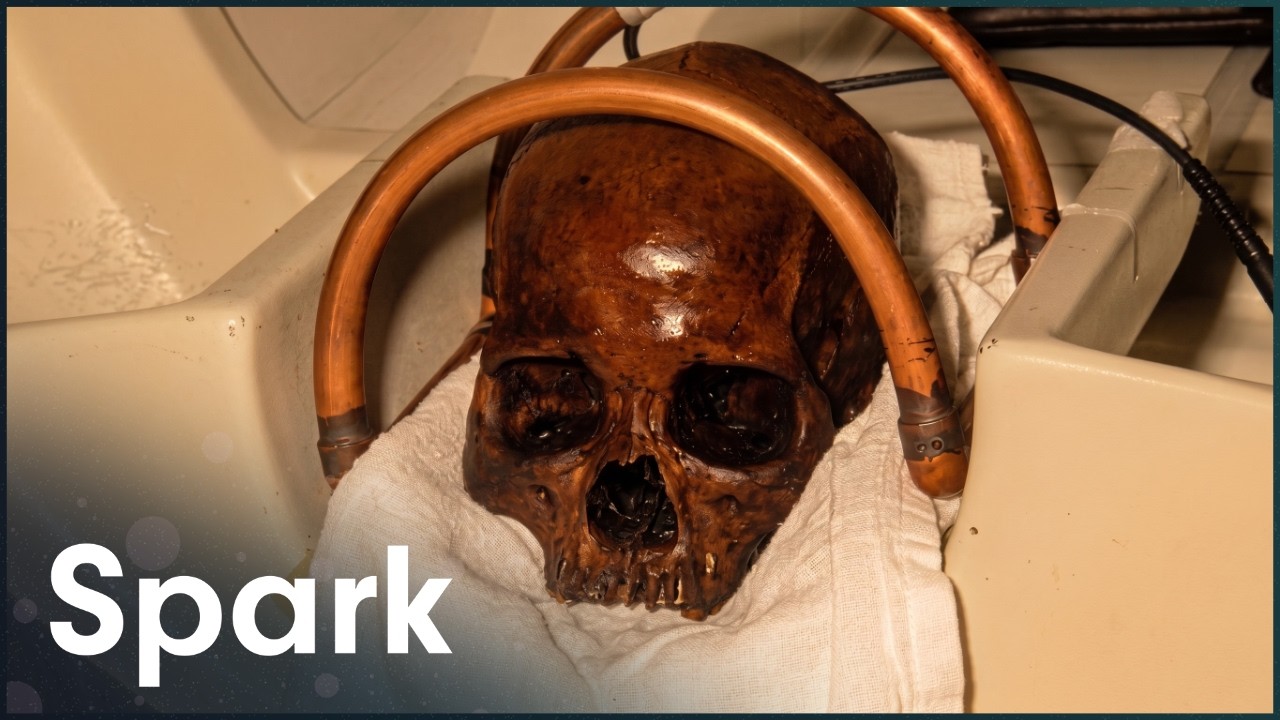
After 8,000 Years... There's Still A Brain Inside This Skull
Keywords
Summary
166 words
Critical Evaluation
The documentary provides a compelling and informative account of the Windover Bog archaeological site, presenting a wealth of scientific detail in an accessible manner. The strength of the content lies in its integration of multiple scientific disciplines—archaeology, genetics, forensics, and isotope analysis—to reconstruct the lives of these ancient people. The interviews with experts, such as Glen Doran and Bill Houseworth, lend credibility and firsthand insight. The explanation of the preservation process is clear and scientifically accurate, emphasizing the role of peat’s anaerobic and non-acidic conditions. The DNA recovery is presented as a groundbreaking achievement, and the caution regarding contamination is appropriately highlighted. The isotope analysis is well-explained, providing a logical method to determine the nomadic lifestyle of the population. The documentary also addresses the broader implications, such as the cognitive equivalence of ancient and modern humans, which is supported by current scientific consensus. However, there are some limitations. The narrative occasionally leans into dramatization, particularly with the ‘homicide’ angle, which may oversimplify the forensic evidence. The documentary does not provide specific citations or references for the claims made, which would enhance its scientific rigor. Additionally, the focus on the ‘oldest DNA’ may be outdated, as subsequent discoveries have pushed back the timeline. Despite these minor issues, the documentary is a valuable educational resource, effectively communicating complex scientific concepts to a general audience. The adéquation between title and content is strong, as the preserved brain is a central element. Overall, the documentary is well-researched and engaging, though it could benefit from more explicit source referencing.
254 words
Title / Content Match
The title is engaging and accurately reflects the central discovery of preserved brains in ancient skulls.
Quality & Reliability
8/10
The documentary presents a well-documented archaeological case with expert interviews and references to scientific techniques (radiocarbon dating, DNA analysis, isotope analysis). However, some dramatization and lack of detailed citations reduce the score slightly.
Key Moments
Markers derived by PSI from the transcript: the creator did not define chapters.
- Discovery of the first skull by construction worker Steve Vander Jack.
- Archaeologist Glen Doran is called to the site and begins excavation.
- Radiocarbon dating reveals the remains are over 7,000 years old.
- Engineering operation to drain the bog and uncover the full burial ground.
- Discovery of brains inside skulls, confirmed by MRI.
- DNA extraction and analysis, confirming Native American ancestry.
- Isotope analysis reveals the nomadic lifestyle of the Windover people.
- Discussion of burial practices and the significance of the site.
- Forensic evidence suggesting a possible homicide among the remains.
Cited Sources
- Windover Archaeological Site — Background information on the site and its significance.
- Ancient DNA Analysis — Explanation of techniques used to recover DNA from ancient remains.
- Radiocarbon Dating — Method used to date the remains.
Concurring Sources
- Windover Archaeological Site — Corroborates the existence and significance of the site.
- Ancient DNA Analysis — Supports the feasibility of recovering DNA from ancient remains.
Contribution & Novelties
The documentary provides a detailed account of the Windover Bog discovery, highlighting the exceptional preservation of brains and DNA, which offers unique insights into prehistoric Native American populations. It demonstrates the application of modern forensic and genetic techniques to ancient remains, contributing to our understanding of human evolution and migration.
Pour aller plus loin :
- Ancient DNA and Human Evolution — Relevant for understanding the genetic analysis of ancient populations.
- Isotope Analysis in Archaeology — Explains the method used to determine diet and mobility.
- Peatland Preservation — Discusses how peat bogs preserve organic materials.
94 words
Radar Profile
The radar profile shows high scores in information quantity, quality, and reliability, with a slightly lower technical level, indicating a well-balanced documentary that is both informative and accessible.
💬 Sur les 0 commentaires analysés, aucune tendance n'est disponible.