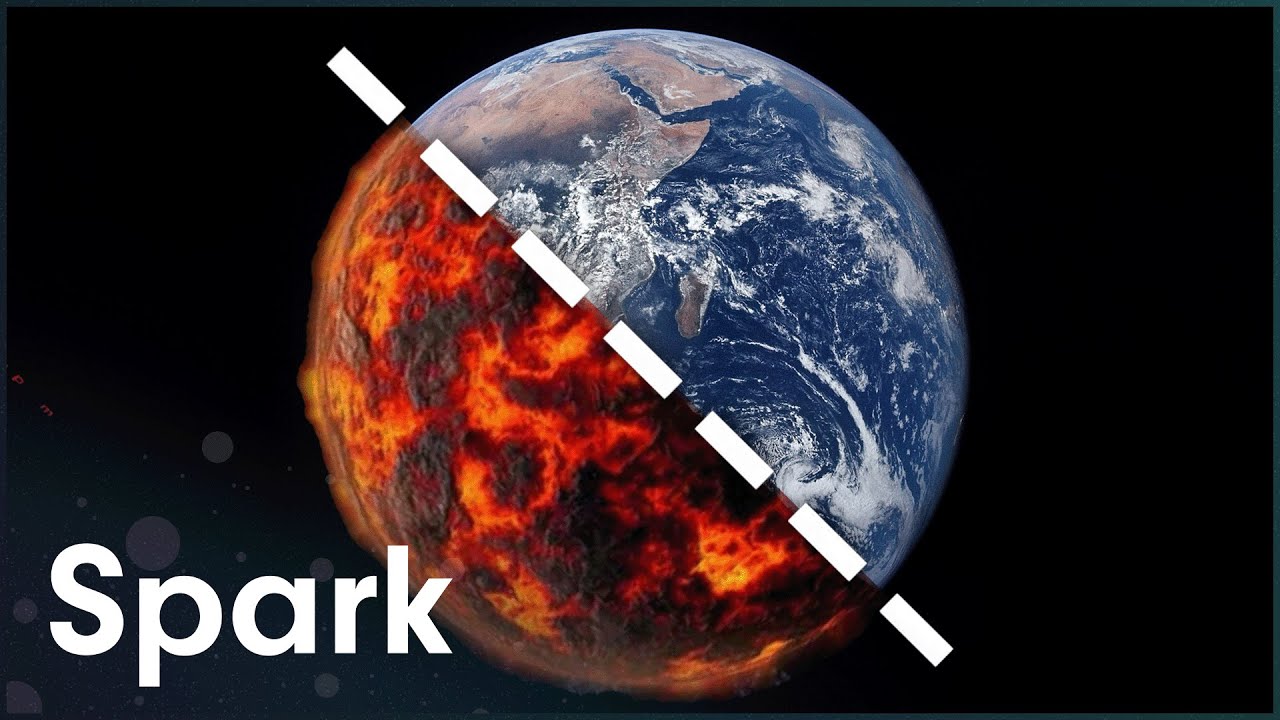
The 4.5 Billion-Year Transformation Of Planet Earth
Keywords
Summary
174 words
Critical Evaluation
The documentary provides a comprehensive and engaging overview of Earth’s formation and evolution, suitable for a general audience. It effectively combines expert interviews, visualizations, and simple demonstrations to explain complex processes. The scientific content is largely accurate and reflects current understanding, though some simplifications are inevitable given the scope. For instance, the process of planetesimal formation via electrostatic charging is presented as a key mechanism, but recent research also emphasizes gravitational instabilities and other processes. The giant impact hypothesis for the Moon’s origin is presented as the leading theory, which is correct, but alternative hypotheses are not mentioned. The documentary also touches on the importance of the magnetic field and plate tectonics, but does not delve into the details of how these processes interact. The sources cited are not explicitly referenced within the film, but the experts interviewed are credible scientists from reputable institutions. The production quality is high, with stunning visuals and a compelling narrative. However, the documentary could have benefited from more explicit citations and a discussion of ongoing debates. Overall, it is a valuable educational resource that inspires curiosity about Earth’s history.
185 words
Title / Content Match
The title accurately reflects the content, which traces Earth's history from its formation to present day.
Quality & Reliability
8/10
The documentary presents established scientific theories (solar nebula, planetesimal accretion, giant impact hypothesis, dynamo theory) with expert interviews and demonstrations. It is generally accurate, though simplified for a general audience. No major errors detected, but some processes are oversimplified.
Key Moments
Markers derived by PSI from the transcript: the creator did not define chapters.
- Introduction to the question of Earth's formation and the mystery of its habitability.
- Explanation of molecular clouds and the birth of the solar system from a collapsing cloud.
- Demonstration of angular momentum conservation using a spinning carousel.
- Discussion of the International Space Station experiment showing electrostatic clumping of particles.
- Description of the formation of planetesimals and the growth of planets through collisions.
- Introduction of the solar wind threat and the role of the magnetic field in protecting Earth.
- Demonstration of magnetic field generation using iron filings and a coil.
- Discussion of the giant impact hypothesis for the Moon's formation.
- Explanation of how water was delivered to Earth via asteroids and comets.
- Overview of the development of an oxygen-rich atmosphere and the emergence of life.
Cited Sources
- History Hit — Mentioned as a subscription service for historical documentaries, not directly related to the scientific content.
Concurring Sources
- NASA Solar System Exploration — NASA's official resource on planetary science, supporting the general narrative of solar system formation.
Dissenting Sources
- Alternative theories for Moon formation — The documentary presents the giant impact hypothesis as the only theory, but there are alternative hypotheses such as the capture theory and fission theory, which are not mentioned.
Contribution & Novelties
The documentary synthesizes current scientific knowledge into a coherent narrative, making complex processes accessible. It emphasizes the interconnectedness of Earth’s systems and the delicate balance that allows life to thrive.
Pour aller plus loin :
- Solar Nebula — Overview of the solar nebula hypothesis.
- Giant Impact Hypothesis — Detailed explanation of the leading theory for the Moon’s formation.
- Earth’s Magnetic Field — Information on the geomagnetic field and its role in protecting the atmosphere.
74 words
Radar Profile
The radar profile shows high scores in information quantity and quality, with a moderate technical level. This indicates a well-balanced documentary that is informative and reliable, but not overly technical, making it suitable for a broad audience.