Virtual Alumni Event with Dr. Stephanie Morain - 4/28/2026
Keywords
Summary
244 words
Critical Evaluation
Value of the Information & Strength of the Argument
The talk provides valuable insights into the ethical complexities of pragmatic clinical trials, a topic of growing importance in evidence-based medicine. Morain’s argumentation is well-structured, using concrete examples to illustrate abstract ethical concepts. She effectively highlights the tension between the need for real-world evidence and the traditional protections for research subjects. Her discussion of the minimal risk standard is particularly valuable, as she clearly explains the two competing interpretations and their practical implications. She also introduces a novel framework for evaluating the ‘rights and welfare’ criterion, which is often vague. The talk is persuasive in arguing that current regulatory frameworks may be ill-suited for PCTs, and she calls for more nuanced approaches. However, the argumentation is primarily from her own perspective, and she does not deeply engage with counterarguments or alternative viewpoints, which limits the comprehensiveness of the analysis.
Scientific Rigor, Source Quality, Title Accuracy
Morain demonstrates strong scientific rigor by referencing specific trials (e.g., the laryngoscope trial, PREP-IT, Kaiser vaccine trial) and regulatory documents (e.g., the Belmont Report, OHRP guidance). She also mentions her own published work, such as a JAMA special communication, which adds credibility. However, she does not provide detailed citations for all claims, and some references are only mentioned in passing. The title accurately reflects the content, as it is a virtual alumni event with a discussion on research ethics. The talk is well-organized and stays on topic, with no significant digressions. The presence of a personal anecdote about her daughter’s condition is relevant and humanizes the need for CER, but it is not a source of scientific evidence.
272 words
Title / Content Match
The title accurately reflects the content: a virtual alumni event featuring Dr. Stephanie Morain discussing contemporary challenges in research ethics.
Quality & Reliability
8/10
The speaker is a recognized expert in research ethics, with a PhD and endowed professorship. The talk is based on her own research and published work, and she references specific trials and regulatory frameworks. However, it is a single expert's perspective, not a systematic review, and some claims are not fully referenced in the video.
Key Moments
Markers derived by PSI from the transcript: the creator did not define chapters.
- Introduction by Travis Rieder, welcoming attendees and introducing Dr. Stephanie Morain.
- Dr. Morain begins her talk, outlining her background and the focus on pragmatic clinical trials.
- Presentation of three example trials: laryngoscope, PREP-IT, and influenza vaccine trials.
- Discussion of key attributes of pragmatic clinical trials, including embedded research and lack of consent.
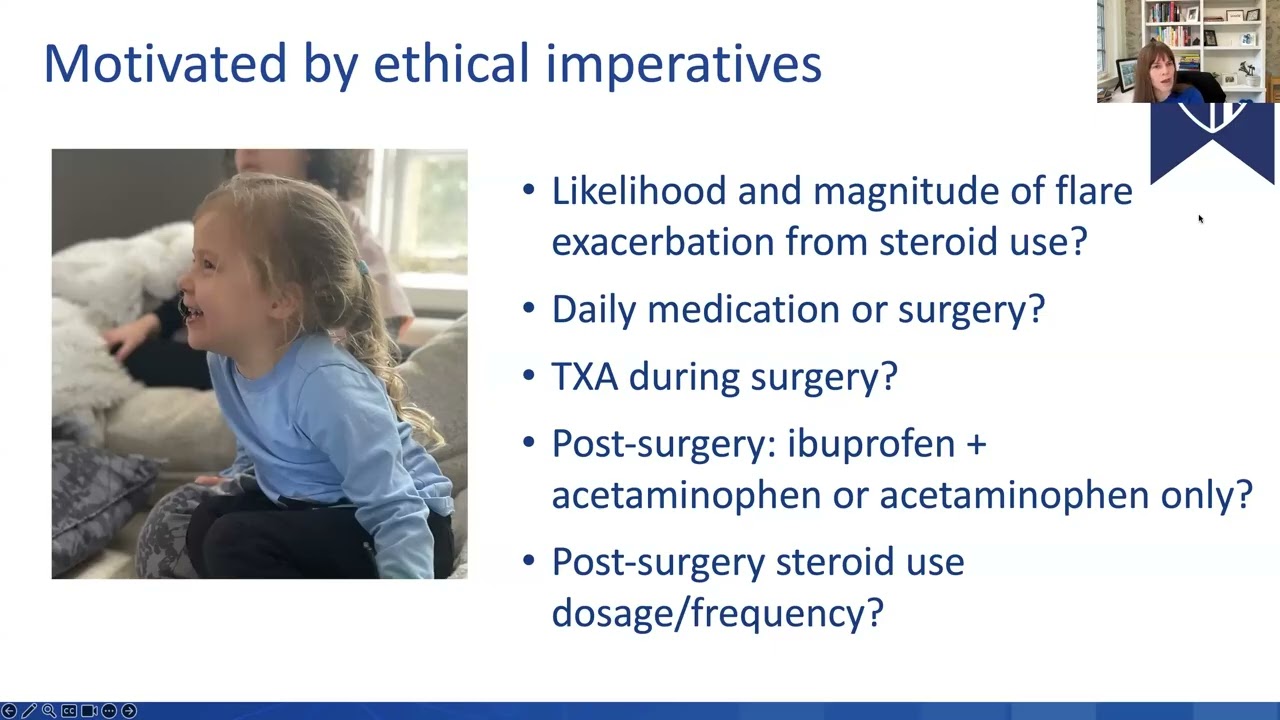
- Ethical motivations for PCTs, illustrated by personal anecdote about her daughter's PFAPA condition.
- Introduction of ethical and regulatory challenges, focusing on informed consent and minimal risk.
- Deep dive into minimal risk standard, contrasting incremental risk and OHRP's perspective.
- Discussion of the 'rights and welfare' criterion and proposal for assessing meaningful patient decisions.
- Examples of decisions where patient input is or is not meaningful, such as laryngoscope vs. surgery.
- Conclusion and Q&A session, addressing additional challenges like data monitoring and equity.
Cited Sources
- Belmont Report — Referenced as foundational to research ethics, distinguishing research from practice.
- OHRP Draft Guidance on SUPPORT Study — Discussed in relation to minimal risk determination for standard-of-care interventions.
- JAMA Special Communication on Incremental Risk — Morain and colleagues proposed the incremental risk standard for pragmatic trials.
Concurring Sources
- Belmont Report — Aligns with the talk's emphasis on distinguishing research from practice.
- OHRP Draft Guidance on SUPPORT Study — Discussed as a contrasting view on minimal risk, which the talk critiques.
Dissenting Sources
- OHRP Draft Guidance on SUPPORT Study — OHRP's position that risks of standard-of-care interventions should be considered research risks when randomization changes treatment, which conflicts with the incremental risk standard.
Contribution & Novelties
The talk provides a comprehensive overview of ethical challenges in pragmatic clinical trials, synthesizing existing literature and offering a novel framework for assessing the ‘rights and welfare’ criterion in consent waivers. It highlights the practical implications of different minimal risk interpretations and calls for more nuanced regulatory guidance. The personal anecdote about her daughter’s condition adds a compelling human dimension to the need for comparative effectiveness research.
Pour aller plus loin :
- Pragmatic Clinical Trials — Overview of pragmatic trials and their characteristics.
- Common Rule — Federal regulations for human subjects research, including criteria for consent waivers.
- Comparative Effectiveness Research — Definition and importance of CER in healthcare decisions.
109 words
Radar Profile
The radar profile shows high scores in all dimensions, indicating a well-rounded and reliable presentation. The talk is rich in information, technically sound, and credible, with a strong ethical argumentation. The only slight weakness is the lack of detailed citations for some claims, but overall it is a high-quality expert discussion.