Three Models for Public Input in a Public Health Emergency by Justin Bernstein, PhD
Keywords
Summary
144 words
Critical Evaluation
Value of the Information & Strength of the Argument
The talk provides a valuable conceptual framework for understanding public input in emergencies, distinguishing between three models and evaluating their strengths and weaknesses. Bernstein’s argumentation is rigorous, systematically presenting the rationale for each model and then critiquing them with real-world examples and references to academic literature. He effectively uses the COVID-19 pandemic to illustrate the practical challenges of implementing deliberative processes, such as time sensitivity and public trust issues. The proposal of the Informal Consultation Model is innovative and well-argued, though it remains somewhat underdeveloped compared to the critique of the other models.
Scientific Rigor, Source Quality, Title Accuracy
Bernstein demonstrates scientific rigor by grounding his arguments in established theories of deliberative democracy and citing relevant scholars such as Jamie Webb, Aron Fun, Miko Varto, and Alexander Guerrero. He also references empirical studies, such as the Oregon Citizens Assembly and research on public trust during emergencies. The title accurately reflects the content, which is a focused analysis of three models for public input. The talk is well-structured and the arguments are logically coherent, though it is primarily an opinion piece rather than a systematic review.
194 words
Title / Content Match
The title accurately reflects the content, which presents and critiques three models for public input in public health emergencies.
Quality & Reliability
8/10
The talk is a well-structured philosophical analysis grounded in real-world examples and references to academic literature. The speaker is a PhD and presents arguments systematically, though it is an opinion piece rather than an empirical study.
Key Moments
Markers derived by PSI from the transcript: the creator did not define chapters.
- Introduction to the talk and the question of public input in public health emergencies.
- Discussion of the Technocratic Model and its limitations.
- Introduction of the Formal Deliberative Model and mini-publics.
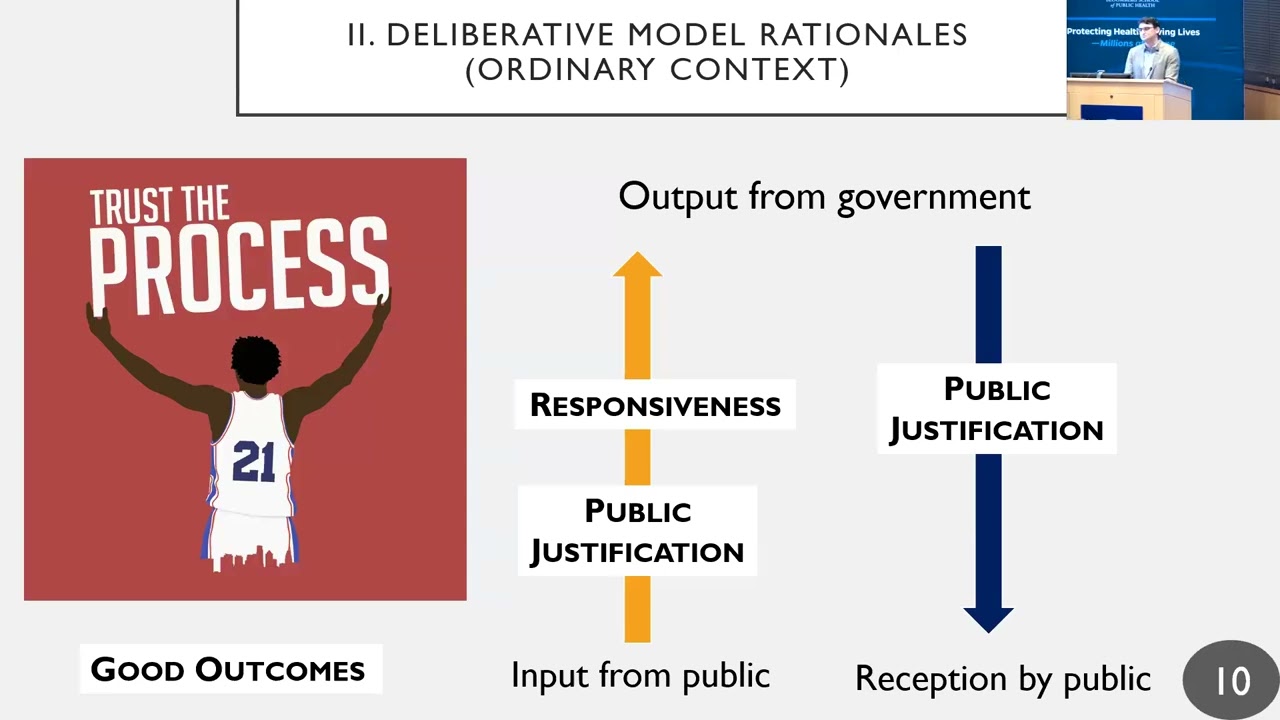
- Rationales for mini-publics: good outcomes, responsiveness, and public justification.
- Examples of mini-publics during COVID-19, including the Oregon Citizens Assembly.
- Critique of mini-publics in emergencies: time constraints, incomplete information, and public distrust.
- Proposal of the Informal Consultation Model and concluding remarks.
Cited Sources
- Jamie Webb quotation on expert analysis and value questions — Cited in the talk to argue that expert analysis cannot resolve value trade-offs.
- Aron Fun on citizen juries and deliberative polls — Quoted to support the use of mini-publics in emergencies.
- Miko Varto on deliberative mini-publics — Quoted to argue for the potential of mini-publics in crises.
- Alexander Guerrero on descriptive representativeness — Cited to support the responsiveness rationale for mini-publics.
- Oregon Citizens Assembly — Mentioned as an example of a mini-public during COVID-19.
Concurring Sources
- Deliberative democracy — Supports the theoretical background of the Formal Deliberative Model.
- Mini-publics — Provides general information on mini-publics.
Contribution & Novelties
The talk contributes a novel framework for understanding public input in emergencies by proposing the Informal Consultation Model as a middle ground between technocratic and formal deliberative approaches. It synthesizes existing literature and applies it to the specific context of public health emergencies, highlighting practical constraints often overlooked. The emphasis on second-order responsiveness and the role of community leaders adds depth to the discussion.
Pour aller plus loin :
- Deliberative democracy — Foundational concept for the talk.
- Mini-publics — Directly relevant to the Formal Deliberative Model.
- Citizens’ assembly — Example of a mini-public.
- COVID-19 pandemic — Context for the discussion.
100 words
Radar Profile
The radar profile shows high scores in quality of information and reliability, with moderate scores in quantity and technical level. This reflects a well-argued but specialized talk that may not be accessible to all audiences.