Ethical and Social Dimensions of Implanted Brain-Computer Interface Research
Keywords
Summary
168 words
Critical Evaluation
Value of the Information & Strength of the Argument
The talk provides valuable insights into the ethical challenges of iBCIs, drawing on real-world cases and current policy debates. Wexler’s argumentation is balanced, presenting multiple perspectives on issues like neural data privacy. She supports her points with references to specific companies, studies, and legislative actions, enhancing the credibility of her claims. However, some arguments could be more deeply developed, and the talk is more of an overview than a deep dive into any single issue.
84 words
Title / Content Match
The title accurately reflects the content, which focuses on ethical and social dimensions of implanted brain-computer interface research.
Quality & Reliability
8/10
Presentation by a recognized expert in neuroethics, based on published literature and current policy debates. The talk is well-structured, cites specific cases and sources, and acknowledges open questions. However, it is an opinion/expert talk rather than a systematic review, and some claims (e.g., investment figures) are not fully sourced in the video.
Key Moments
Markers derived by PSI from the transcript: the creator did not define chapters.
- Introduction to the talk and overview of iBCI landscape.
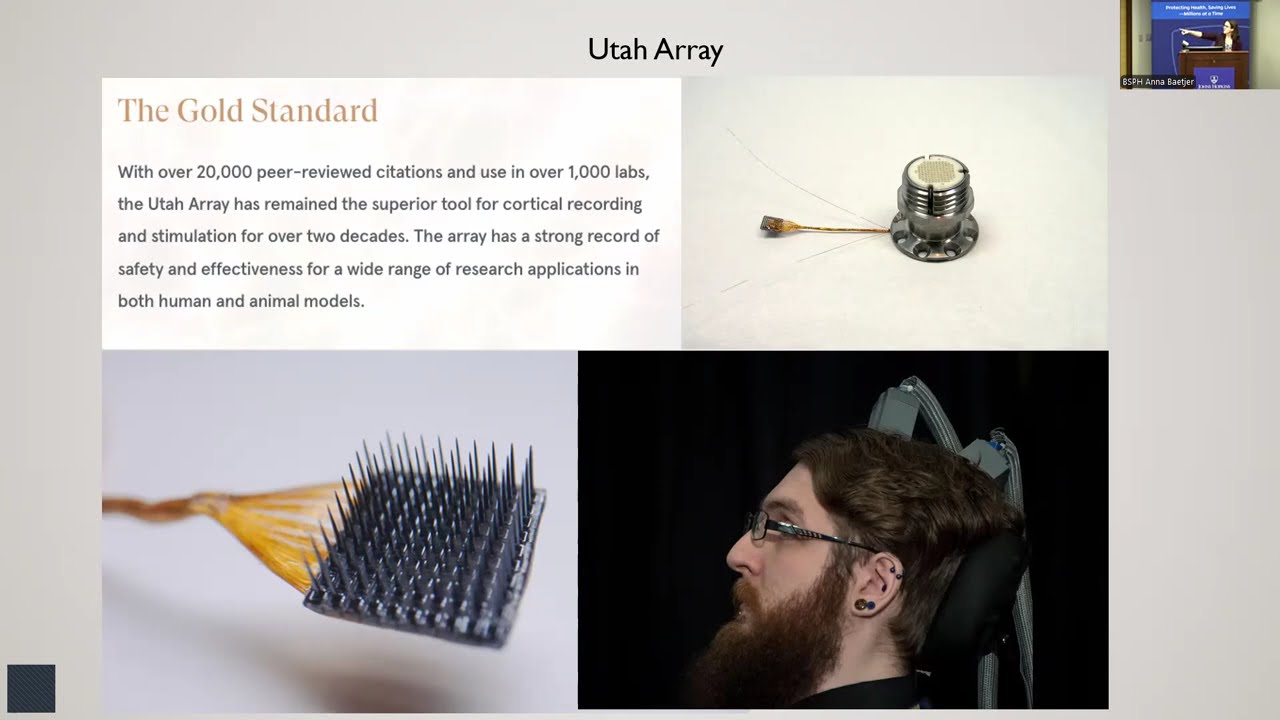
- Discussion of hardware innovations and companies like Neuralink and Synchron.
- Introduction to ethical issues, starting with device abandonment.
- Case studies of device abandonment (ATI, Second Sight).
- Discussion of post-trial responsibilities and policy gaps.
- Neural data privacy: debate on uniqueness and legal protections.
- State laws and Neurorights Foundation efforts.
- Consumer neurotechnology and broader implications.
- Conclusion and call for further research and policy.
Cited Sources
- Nature article on device abandonment — Referenced in the talk as a publication profiling individuals affected by device abandonment.
- UNESCO Recommendations on Ethics of Neurotechnology — Mentioned as taking a broad approach to neural data privacy.
- Neurorights Foundation — Discussed as an organization advocating for new laws to protect neural data.
- Second Sight Medical Products — Case study of a company that discontinued support for its retinal implants.
Concurring Sources
- Neurorights Foundation — Aligned with the talk's emphasis on the need for new laws to protect neural data.
- UNESCO Recommendations on Ethics of Neurotechnology — Supports the broader approach to neural data privacy mentioned in the talk.
Dissenting Sources
- American Medical Association resolution on neural data — The AMA's narrow definition of neural data contrasts with the broader approach advocated by UNESCO and discussed in the talk.
Contribution & Novelties
The talk provides a comprehensive overview of current ethical issues in iBCI research, synthesizing recent developments and debates. It highlights the pressing issue of device abandonment and the lack of infrastructure for long-term support, which is a relatively underexplored topic. The discussion on neural data privacy is timely, given recent legislative actions. The talk also emphasizes the need for interdisciplinary collaboration and policy development.
Pour aller plus loin :
- Neuroethics Society — Official society for neuroethics, relevant for further reading.
- Brain Initiative — NIH initiative funding neuroscience research, including iBCIs.
- The Battle for Your Brain by Nita Farahany — Book discussing legal and ethical implications of neurotechnology.
107 words
Radar Profile
The radar profile shows high scores in quality and reliability, reflecting the expert's credibility and use of sources. The quantity of information is also high, but the technical level is moderate, making it accessible to a general audience. The overall balance indicates a well-rounded presentation suitable for those interested in neuroethics.
💬 No comments were provided for analysis.