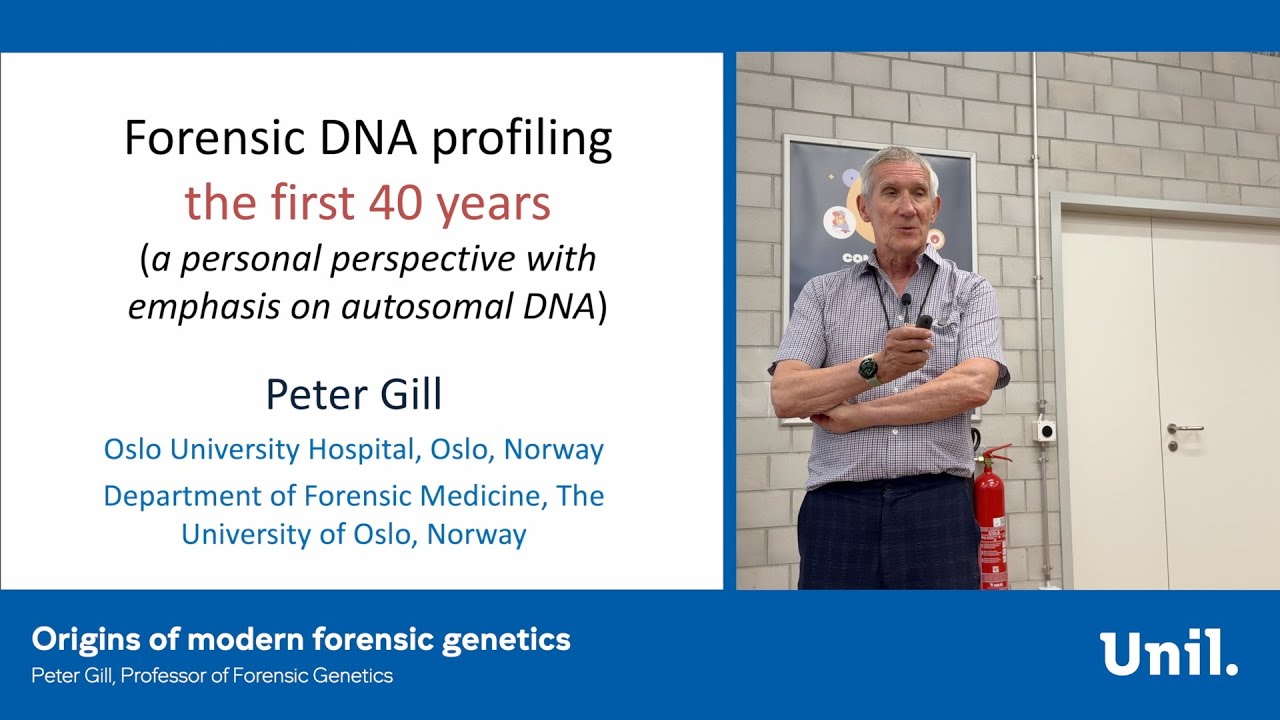
Origins of modern forensic genetics - Conférence publique de l'Ecole des sciences criminelles
Keywords
Summary
212 words
Critical Evaluation
Peter Gill’s presentation is a masterclass in the history of forensic genetics, delivered by a scientist who was directly involved in many of the key developments. The talk is meticulously structured, tracing the evolution from protein markers to modern STR-based profiling. Gill’s firsthand account lends immense credibility, as he provides specific details about the challenges and breakthroughs. The scientific rigor is evident in his emphasis on validation and the importance of demonstrating that techniques are fit for purpose. He candidly discusses the limitations of early methods and the labor-intensive nature of the work, which adds depth to the narrative. The sources cited, including Jeffreys’ 1985 paper and the 1986 Narborough case, are well-known and verifiable. The talk also highlights the ethical and practical considerations of mass screening and the establishment of DNA databases. The only minor criticism is that the presentation assumes some familiarity with molecular biology, but this does not detract from its value. Overall, this is an excellent resource for anyone interested in the origins of forensic DNA analysis, offering both historical context and technical insight.
178 words
Title / Content Match
The title accurately reflects the content, which traces the origins and evolution of forensic genetics.
Quality & Reliability
9/10
Presentation by a leading expert in forensic genetics, with detailed historical account and references to key publications. High reliability due to direct involvement in the developments described.
Key Moments
Markers derived by PSI from the transcript: the creator did not define chapters.
- Introduction to pre-DNA methods: protein markers and their limitations.
- Alec Jeffreys' 1985 paper on hypervariable minisatellites and initial collaboration.
- First proof-of-principle: DNA profiling on various forensic samples.
- Development of differential extraction for separating sperm and vaginal cells.
- The Narborough murders case: first use of DNA to exonerate a suspect.
- Mass screening of 5,000 men and the identification of Colin Pitchfork.
- Transition to single-locus probes and the role of PCR.
- Advent of STRs and their application to degraded samples, including Romanov remains.
- First operational multiplex in 1993 and use in Waco disaster victim identification.
- Launch of the UK National DNA Database in 1995 and its evolution.
Cited Sources
- Hypervariable 'minisatellite' regions in human DNA — Jeffreys' 1985 paper that introduced DNA fingerprinting.
- Forensic application of DNA 'fingerprints' — First demonstration of DNA profiling on forensic samples.
- The Narborough murders case — First use of DNA profiling in a criminal investigation.
Concurring Sources
- A brief history of the formation of DNA databases in forensic science — Supports the historical account of DNA database development.
Contribution & Novelties
This talk provides a unique insider perspective on the origins of forensic genetics, detailing the technical challenges and breakthroughs that shaped the field. It highlights the importance of validation and the evolution from labor-intensive methods to modern high-throughput systems.
Pour aller plus loin :
- Short tandem repeat — Key molecular marker used in modern forensic DNA profiling.
- Polymerase chain reaction — Technique that enabled amplification of DNA, crucial for STR analysis.
- National DNA database — Concept sparked by the Pitchfork case, now used worldwide.
84 words
Radar Profile
The radar profile shows high scores across all dimensions, with particular strength in information quality and reliability, reflecting the expert's authoritative account. The slightly lower score in technical level indicates that the content is accessible to a broad audience while still providing depth.
💬 Sur les 0 commentaires analysés, aucune tendance n'est disponible.