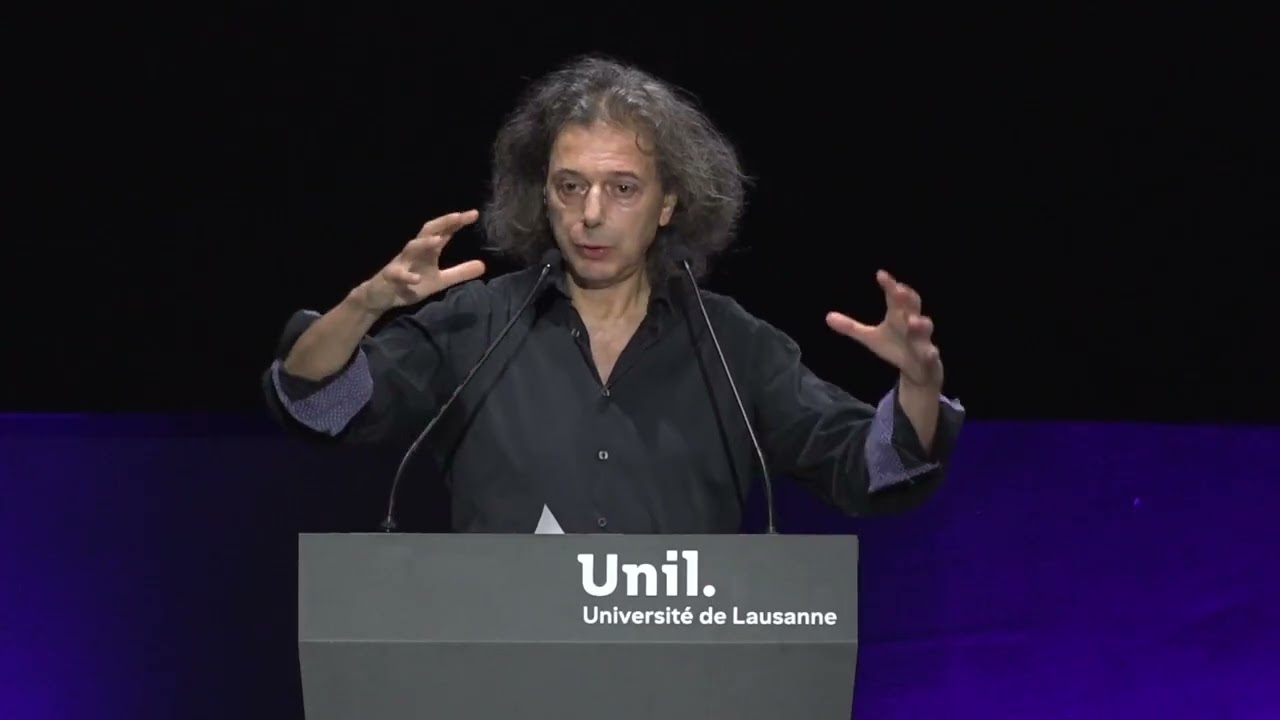
L'IA générative est-elle en train de détruire la pensée humaine? | Éric Sadin
Keywords
Summary
169 words
Critical Evaluation
Éric Sadin’s lecture offers a compelling and articulate critique of generative AI, grounded in his philosophical framework and previous works. His argument is well-structured, moving from a clear distinction between two types of AI to a detailed analysis of the consequences on language, image, and work. Sadin’s strength lies in his ability to synthesize complex ideas and present them in an accessible yet profound manner. He effectively highlights the risks of delegating intellectual and creative tasks to machines, emphasizing the loss of human agency and the potential for cultural homogenization.
However, the lecture is primarily an opinion piece, and Sadin does not provide empirical evidence or engage with counterarguments in depth. While he references his own books, he does not cite external studies or data to support his claims, which may limit the scientific rigor of his argument. For instance, his assertion that generative AI is ‘indefendable de part en part’ is a strong normative claim that could benefit from a more nuanced discussion of potential benefits or mitigations.
The discussion with Mathias Humbert, a professor of information systems, adds a technical perspective, but the dialogue is brief and does not delve deeply into the technical aspects of AI. Sadin’s rhetorical style, while engaging, sometimes borders on the apocalyptic, which may alienate listeners who are more optimistic about AI’s potential.
Overall, the lecture is valuable for its philosophical insights and its call to reflect on the societal implications of AI. It is particularly relevant for audiences interested in the ethical and human dimensions of technology. However, those seeking a balanced, evidence-based analysis may find it lacking in empirical support and counterpoints.
271 words
Title / Content Match
The title accurately reflects the central question addressed in the talk, which focuses on the potential harms of generative AI to human thought and creativity.
Quality & Reliability
8/10
The speaker is a recognized philosopher and author of several books on technology critique. The talk is well-structured, referencing his own published work and providing a coherent argument. However, it is primarily an opinion-based lecture with limited empirical data or citations to external studies.
Key Moments
Markers derived by PSI from the transcript: the creator did not define chapters.
- Introduction and thanks to organizers.
- Sadin introduces the topic and mentions the 'white-collar apocalypse'.
- He distinguishes between cognitive/organizational AI and generative AI.
- Discussion on the 'intellectual and creative turn' of AI.
- Sadin explains the probabilistic correlation principle behind generative AI.
- He argues that generative AI is 'reproductive' rather than 'generative'.
- First major consequence: impact on language and individual expression.
- Second consequence: impact on representation and images.
- Third consequence: impact on work and cognitive professions.
- Broader societal consequences: emotional dependence, environmental impact.
- Call for collective awareness and resistance.
Cited Sources
- Le Désert de nous-mêmes. Le tournant intellectuel et créatif de l’intelligence artificielle — Sadin's latest book, published in 2025, which this lecture extends.
- L'intelligence artificielle, l'enjeu du siècle: anatomie d'un anti-humanisme radical — Sadin's 2018 book where he defined cognitive/organizational AI.
Concurring Sources
- The Age of Surveillance Capitalism — Shoshana Zuboff's work on the exploitation of personal data, which aligns with Sadin's concerns about AI's impact on autonomy.
- Weapons of Math Destruction — Cathy O'Neil's critique of algorithmic decision-making, supporting Sadin's warnings about AI's societal risks.
Dissenting Sources
Contribution & Novelties
This lecture provides a philosophical critique of generative AI, emphasizing the delegation of human intellectual and creative faculties to machines. Sadin’s distinction between cognitive/organizational AI and the ‘intellectual and creative turn’ offers a useful framework for understanding the unique risks of generative AI. He argues that generative AI is fundamentally reproductive, not generative, and warns of the erosion of human judgment and autonomy.
Pour aller plus loin :
- The Turing Test — A foundational concept in AI philosophy, relevant to discussions of machine intelligence.
- The Chinese Room argument — John Searle’s thought experiment challenging the notion of machine understanding.
- Technological Determinism — A theory that technology shapes society, relevant to Sadin’s critique of AI’s societal impact.
116 words
Radar Profile
The radar profile shows high scores in quality of information and global reliability, reflecting Sadin's expertise and coherent argumentation. However, the quantity of information is moderate, and the technical level is relatively low, indicating a focus on philosophical rather than technical aspects.
💬 The comments are predominantly positive, with many viewers expressing admiration for Sadin's ideas and the lecture's depth. A few critical voices question his approach, but overall the reception is enthusiastic.