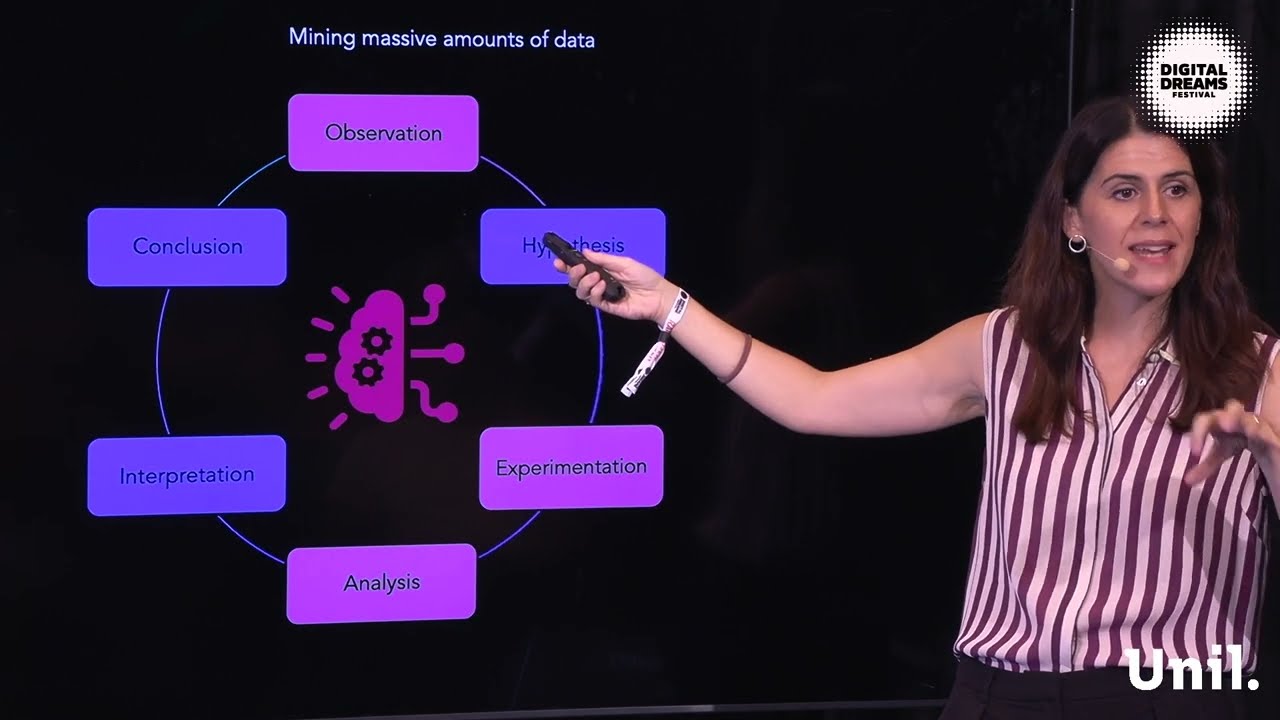
Keeping Science Human in the Age of AI
Keywords
Summary
139 words
Critical Evaluation
The talk provides a compelling and accessible overview of the intersection of AI and biomedical research, grounded in the speaker’s direct experience. The speaker effectively communicates complex concepts, such as tumor heterogeneity and AI models, using analogies and visual aids. The argumentation is solid, emphasizing the potential of AI to accelerate discovery while cautioning against losing the human element. The scientific rigor is high, as the speaker references Nobel Prize-winning work (AlphaFold, neural networks) and her own published research. However, the talk is more of an expert opinion than a systematic review, and it lacks detailed citations or data to support some claims. The sources cited are primarily general references to AI models and technologies, not specific papers. The adéquation between title and content is strong, as the talk directly addresses the theme of keeping science human. The presentation is well-structured, moving from personal background to specific examples and future implications. The speaker’s credibility is enhanced by her position at a renowned institution and her active research. The talk would benefit from more concrete examples of how AI has improved patient outcomes and a deeper discussion of ethical frameworks. Overall, it is a valuable and thought-provoking talk for a broad audience, though it may not offer new technical insights for experts.
211 words
Title / Content Match
The title accurately reflects the content, which discusses the integration of AI in biomedical research while emphasizing the importance of human creativity, intuition, and ethics.
Quality & Reliability
8/10
The speaker is a professor and bioinformatician at CHUV and UNIL, with a strong background in computational biology and AI. The talk is based on her personal research experience and references recent Nobel Prizes and established AI models like AlphaFold. However, it is a general talk without detailed citations or peer-reviewed references, and some claims are simplified for a broad audience.
Key Moments
Markers derived by PSI from the transcript: the creator did not define chapters.
- Introduction and welcome by the host.
- Speaker introduces herself and her background.
- Explanation of AI in biomedicine: combining data and models.
- Discussion of tumor heterogeneity and precision oncology.
- Overview of new technologies: single-cell profiling and AI models.
- Examples of AI breakthroughs: AlphaFold and AI pathology.
- Speaker's group research: generating virtual experiments.
- Challenges of drug resistance and immunotherapy.
- The importance of keeping science human: creativity, intuition, ethics.
- Conclusion and call for balanced AI integration.
Cited Sources
- AlphaFold — Mentioned as a Nobel Prize-winning AI model for protein structure prediction.
- Nobel Prize in Chemistry 2024 — Referenced for AlphaFold and de novo protein design.
- Nobel Prize in Physics 2024 — Referenced for neural networks.
- Cryo-EM — Mentioned as a technology for visualizing molecular structures, awarded to Jacques Dubochet.
Concurring Sources
- AlphaFold — Supports the claim that AI can predict protein structures.
- Nobel Prize in Chemistry 2024 — Confirms the recognition of AI in protein science.
Contribution & Novelties
The talk provides a personal perspective on integrating AI into biomedical research while emphasizing the human elements of creativity, intuition, and ethics. It highlights recent AI breakthroughs and their potential to transform cancer research and clinical practice.
Pour aller plus loin :
- AlphaFold — The AI system for protein structure prediction, central to the talk.
- Precision oncology — The approach of tailoring treatment to individual tumor characteristics.
- Foundation models in biology — A review of large AI models applied to biological data.
- Ethics of AI in healthcare — WHO guidance on the ethics and governance of AI in health.
99 words
Radar Profile
The radar profile shows high scores in quality of information and reliability, reflecting the speaker's expertise and the use of established AI models. The quantity of information is moderate, as the talk is more conceptual than detailed. The technical level is moderate, making it accessible to a broad audience.