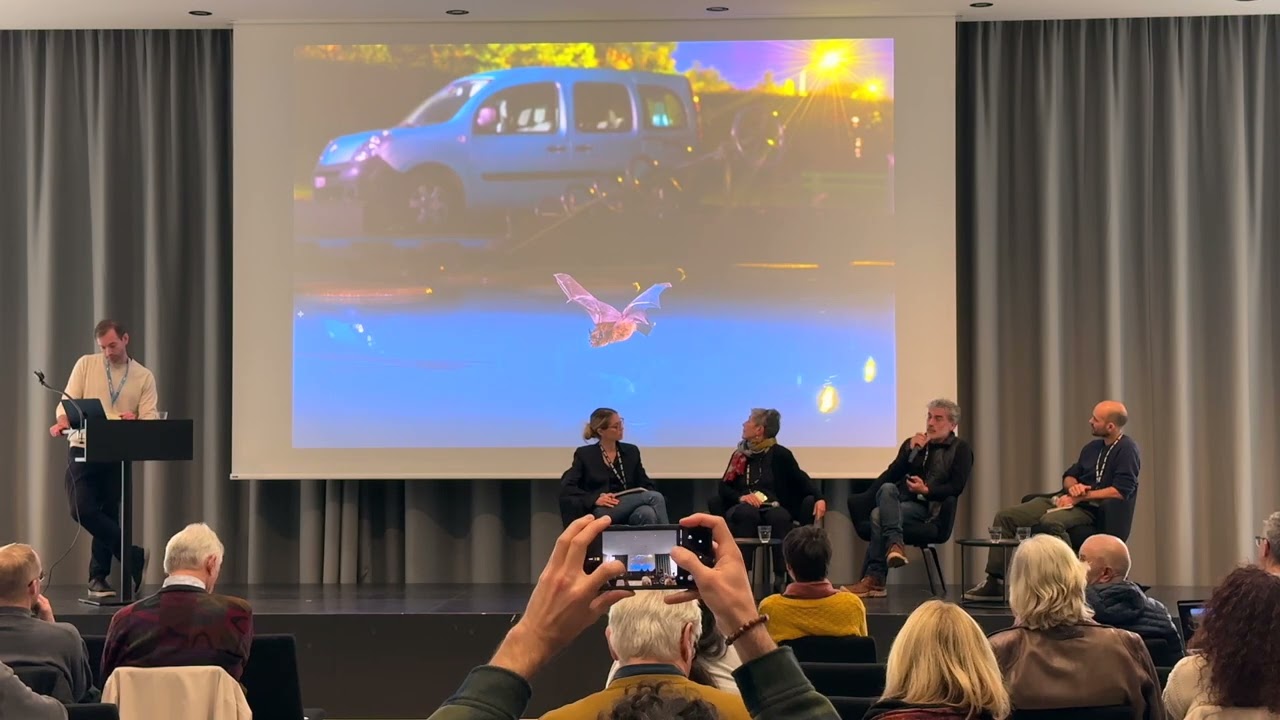
ECOTOPIALES 2025 - Territoires sensibles : explorer le vivant via la créativité environnementale
Keywords
Summary
156 words
Critical Evaluation
The roundtable offers a valuable interdisciplinary dialogue between art and science, focusing on urban wildlife and environmental creativity. Laurent Geslin’s photographic work provides concrete examples of animals adapting to urban environments, which serves as a compelling entry point for discussing broader ecological and philosophical questions. The discussion is grounded in real observations and experiences, lending authenticity to the conversation. However, the scientific rigor is limited: there are no formal citations or references to specific studies, and the arguments are largely anecdotal. The researchers contribute theoretical perspectives, but the conversation remains at an introductory level, suitable for a general audience. The strength of the discussion lies in its ability to bridge artistic practice and scientific inquiry, highlighting the importance of imagination and narrative in environmental engagement. The moderation by Damien De Lor effectively guides the conversation, ensuring that both artistic and scientific viewpoints are explored. The title accurately reflects the content, and the roundtable successfully meets its goal of exploring the living through environmental creativity. The main weakness is the lack of depth in scientific analysis, but as a public-facing event, it serves its purpose of raising awareness and fostering reflection. Overall, the content is informative and thought-provoking, though not highly technical or rigorously scientific.
204 words
Title / Content Match
The title accurately reflects the content: a roundtable on sensitive territories and exploring life through environmental creativity.
Quality & Reliability
7/10
The roundtable features two academic researchers (Nathalie Blanc, CNRS; Nathalie Dietschy, UNIL) and a photographer (Laurent Geslin), providing a mix of scientific and artistic perspectives. The discussion is exploratory and interdisciplinary, with no formal citations or peer-reviewed references. The content is credible but not rigorously scientific.
Key Moments
Markers derived by PSI from the transcript: the creator did not define chapters.
- Introduction and welcome to the roundtable
- Laurent Geslin begins presenting his work on urban foxes in London
- Discussion on animals in cities and their adaptation
- Presentation of photographs of urban wildlife in Paris and Orleans
- Anecdote about a bear encounter in Romania
- Reflections on the relationship between art and science
- Discussion on the concept of 'sensitive territories'
- Audience questions and interaction
- Concluding remarks and thanks
Contribution & Novelties
The roundtable provides an original perspective on urban wildlife through the lens of artistic creativity, emphasizing the importance of imagination and narrative in environmental awareness. It bridges the gap between scientific knowledge and aesthetic experience, offering a holistic approach to understanding our relationship with the living world.
Pour aller plus loin :
- Environmental humanities — Relevant for understanding the interdisciplinary field that combines environmental studies with humanities.
- Urban ecology — Provides scientific background on the study of ecosystems in urban areas.
- Biophilia hypothesis — Relevant to the discussion of human connection with nature.
93 words
Radar Profile
The radar profile shows a balanced distribution across the four dimensions, with slightly higher scores in quality of information and reliability, reflecting the credible but non-technical nature of the discussion. The quantity of information is moderate, and the technical level is low, indicating an accessible yet informative content.