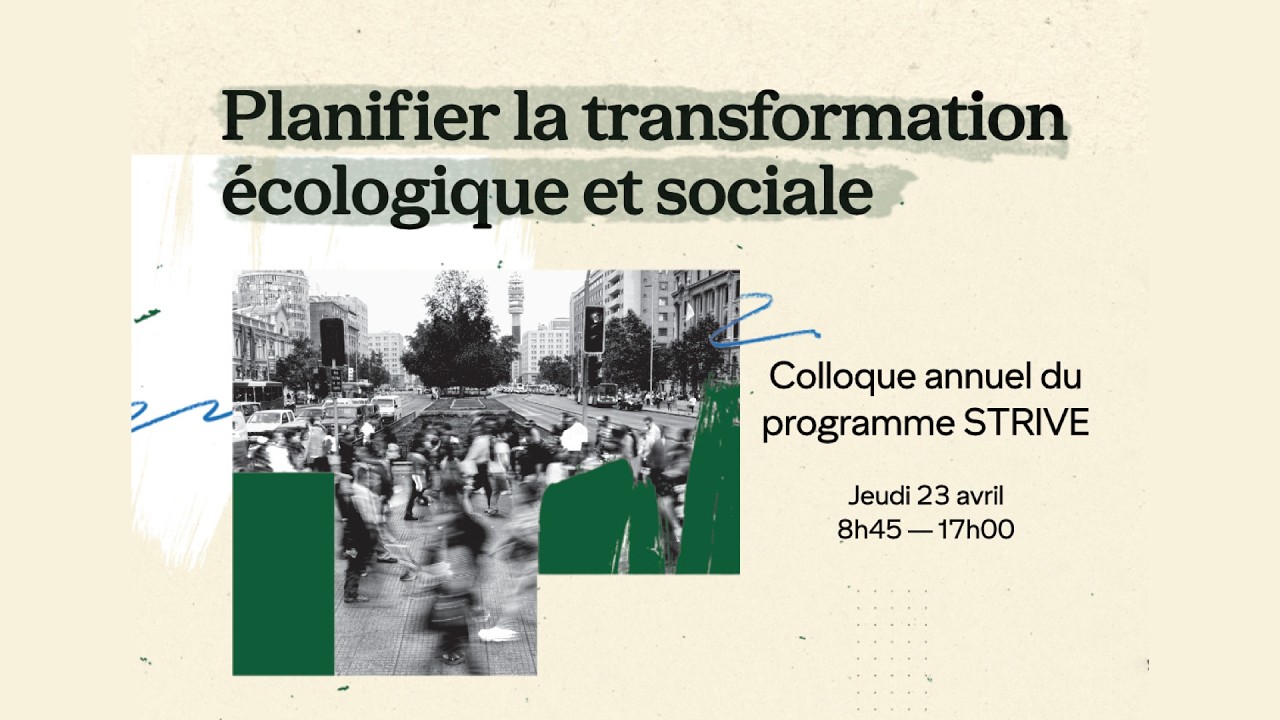
Colloque STRIVE 2026 : Planifier la transformation écologique et sociale
Keywords
Summary
141 words
Critical Evaluation
The conference provides a rich, interdisciplinary exploration of planning for ecological and social transformation. The presentations are grounded in current research and policy experiences, offering a balanced view of the challenges and opportunities. The inclusion of speakers from different countries (France, Switzerland, Canada) and disciplines (economics, law, political science) enriches the discussion. The quality of information is high, with speakers citing relevant literature and data. The argumentation is generally solid, though some presentations are more descriptive than analytical. The sources cited are credible, including academic publications and government reports. The title accurately reflects the content, and the conference is well-structured. However, the video is long (6.5 hours) and may require significant time investment. The technical quality is good, with clear audio and slides. The conference does not include a Q&A session, which limits interactive engagement. Overall, the conference is a valuable resource for researchers, policymakers, and students interested in sustainability transitions. The main strength is its interdisciplinary approach, which highlights the complexity of planning and the need for collaborative solutions. The main weakness is the lack of critical discussion on the feasibility of planning in democratic contexts. The conference could benefit from more concrete case studies and comparative analyses. Despite these minor limitations, the conference offers a comprehensive overview of current thinking on planning for sustainability.
216 words
Title / Content Match
The title accurately reflects the content, which is a full-day conference on planning ecological and social transformation.
Quality & Reliability
8/10
The conference features academic speakers from recognized institutions, presenting research and policy experiences. The content is interdisciplinary and grounded in current sustainability debates. However, as a conference recording, it lacks peer review and some presentations may be preliminary.
Key Moments
Markers derived by PSI from the transcript: the creator did not define chapters.
- Welcome and introduction to the STRIVE program by Augustin Fragnière and Dunia Brunner.
- Presentation of the project 'How to plan ecological and social transformation? Scenarios and public policies' by Julia Steinberger, Véronique Boillet, Eric Jondeau, and Martino Maggetti.
- Natacha Gondran discusses territorialization of planetary boundaries in France: challenges, methods, and issues.
- Mathilde Viennot presents the design and implementation of ecological planning in France, from the High Commission for Strategy and Planning.
- Orlane Moynat, Timothée Parrique, and Jean-André Davy-Guidicelli present an application of the Doughnut model to Switzerland.
- Simon Tremblay-Pepin discusses post-capitalist models, needs, and limits in the context of planning.
- Benedetta Akot presents on planning and governance of the European Green Deal: designing and implementing eco-social policies.
Cited Sources
- STRIVE program — Mentioned as the research program organizing the conference.
- Doughnut Economics — Referenced as a model for sustainable development.
- Planetary boundaries — Referenced in the context of territorialization.
Concurring Sources
- IPCC Reports — Consistent with the urgency of ecological transformation.
- Raworth's Doughnut Economics — Aligns with the Doughnut model discussed.
Dissenting Sources
- Critiques of planning — Some scholars argue that top-down planning may be inefficient or undemocratic, a perspective not deeply explored in the conference.
Contribution & Novelties
The conference provides a comprehensive overview of current research and policy on planning for ecological and social transformation. It highlights the challenges of territorializing global limits and the need for democratic governance. The presentations offer both theoretical frameworks and practical examples from France and Switzerland. The event fosters interdisciplinary dialogue, which is crucial for addressing complex sustainability issues.
Pour aller plus loin :
- Doughnut Economics Action Lab — Provides tools and case studies for applying the Doughnut model.
- Planetary Boundaries Research — Original research on planetary boundaries.
- European Green Deal — Official EU policy framework.
95 words
Radar Profile
The radar profile shows high scores in quantity and quality of information, reflecting the comprehensive and expert content. The technical level is moderate, indicating accessibility to a broad audience. Overall reliability is high due to the academic setting and credible speakers.