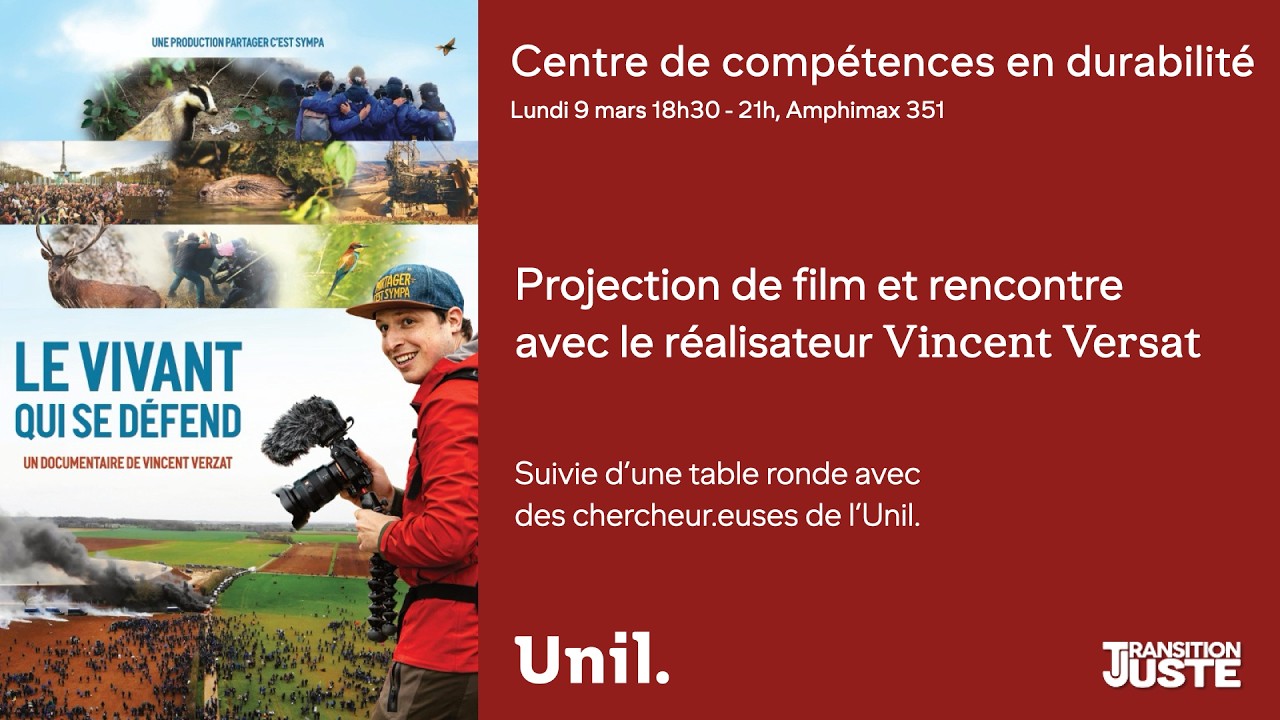
Le Vivant qui se défend, réalisation Vincent Verzat. Film et table ronde académique à l’Unil
Keywords
Summary
128 words
Critical Evaluation
The roundtable discussion offers a rich, multidisciplinary analysis of environmental activism and nature preservation, grounded in the documentary’s narrative. The panelists bring diverse expertise: Gabriel Cotte, a biologist and hydrologist, provides scientific context on Swiss ecosystems and local struggles; Clémence De, a legal scholar, explains the legal framework and risks of civil disobedience; Damien de Lorme, a philosopher, explores ethical dimensions; and Timothé Paric, an economist, discusses degrowth. The discussion is well-moderated and maintains a high level of intellectual rigor. The film itself is used as a springboard for deeper analysis, and the panelists effectively connect its themes to concrete Swiss examples, such as the Bois de Ballens and the Mormont ZAD. The arguments are well-supported by academic knowledge and practical experience. However, the discussion is somewhat limited by time constraints, and some topics are only briefly touched upon. The sources cited are primarily the film and the university’s sustainability center, which are credible but not exhaustive. Overall, the video provides valuable insights into environmental activism and the role of academia in addressing ecological crises. The title accurately reflects the content, and the production quality is high. The main strength is the diversity of perspectives, which enriches the discussion. A minor weakness is that the debate could have been more structured to allow deeper exploration of each topic. Nevertheless, it is a commendable effort to bridge documentary filmmaking and academic discourse.
231 words
Title / Content Match
The title accurately reflects the content: a film screening followed by an academic roundtable discussion. The title mentions the film and the academic setting, which matches the video.
Quality & Reliability
8/10
The video is an academic roundtable discussion featuring researchers from the University of Lausanne, providing expert perspectives on environmental issues. The discussion is grounded in scientific and legal expertise, and the film itself is a documentary by a recognized journalist. The content is well-structured and credible, though it is primarily a debate rather than a peer-reviewed presentation.
Key Moments
Markers derived by PSI from the transcript: the creator did not define chapters.
- Introduction of the roundtable and panelists.
- Vincent Verzat explains the personal and strategic motivations behind the film.
- Gabriel Cotte discusses Swiss parallels, focusing on the Bois de Ballens forest and the fight against a gravel pit.
- Clémence De analyzes legal aspects of environmental activism and civil disobedience in Switzerland.
- Damien de Lorme offers philosophical reflections on ecological ethics and the relationship with nature.
- Timothé Paric discusses economic perspectives, including degrowth and post-growth approaches.
- Q&A session with the audience, addressing questions on local engagement and systemic change.
- Concluding remarks and calls to action for the audience.
Cited Sources
- Centre de compétences en durabilité de l'UNIL — Mentioned as the organizing body of the event.
- Le Vivant qui se défend (film) — The documentary film discussed in the roundtable.
Concurring Sources
- Centre de compétences en durabilité de l'UNIL — The center promotes sustainability research and education, aligning with the film's themes.
Contribution & Novelties
The video provides a unique interdisciplinary discussion on environmental activism, bridging documentary filmmaking and academic research. It offers insights into Swiss environmental conflicts, legal challenges, and philosophical and economic perspectives on sustainability. The roundtable format allows for a nuanced exploration of the film’s themes, highlighting the importance of local engagement and systemic change.
Pour aller plus loin :
- Décroissance — Economic concept discussed by Timothé Paric.
- Désobéissance civile — Legal and ethical concept analyzed by Clémence De.
- Biodiversité — Central theme of the film and discussion.
86 words
Radar Profile
The radar profile shows high scores in information quantity and quality, reflecting the rich multidisciplinary content. The technical level is moderate, suitable for a general academic audience. The reliability is high due to the expertise of the panelists. Overall, the video is a well-rounded resource for understanding environmental activism from multiple perspectives.