Sous influence: comment l’emprise transforme nos pensées? | Élisabeth Feytit (Méta de Choc)
Keywords
Summary
123 words
Critical Evaluation
The conference provides a compelling and accessible overview of the psychological mechanisms underlying mental manipulation and cultic influence. Feytit’s expertise is evident in her detailed case study of the MISA movement and her ability to connect individual experiences to broader psychological principles. The strength of the talk lies in its vivid narrative and the emphasis on the gradual, often invisible nature of indoctrination, which challenges the common misconception that victims are weak or unintelligent. The inclusion of a dialogue with John Antonakis adds an academic perspective, though the discussion remains largely at a descriptive level rather than offering rigorous empirical evidence. The talk is well-structured, moving from a specific case to general principles, and it effectively highlights the role of cognitive biases and metacognition. However, the reliance on anecdotal evidence and the lack of systematic research citations limit the scientific rigor. The speaker’s authority is based on her professional experience rather than peer-reviewed studies, which is appropriate for a public lecture but not for a formal scientific analysis. The content is highly relevant and raises important questions about vulnerability and prevention, but it could benefit from more concrete data and references to psychological research. Overall, the talk is informative and thought-provoking, but it should be viewed as an expert opinion rather than a comprehensive scientific review.
216 words
Title / Content Match
The title accurately reflects the content, which explores how mental influence and manipulation can transform thoughts, using the case of a spiritual leader.
Quality & Reliability
8/10
The speaker is a recognized documentarist and podcaster specializing in mental manipulation, and the talk is hosted by the University of Lausanne with a dialogue with a professor. The content is based on documented cases and psychological mechanisms, but relies heavily on anecdotal evidence and personal expertise rather than systematic research.
Key Moments
Markers derived by PSI from the transcript: the creator did not define chapters.
- Introduction to metacognition and the topic of indoctrination.
- Story of Vera and her arrival at the meeting point.
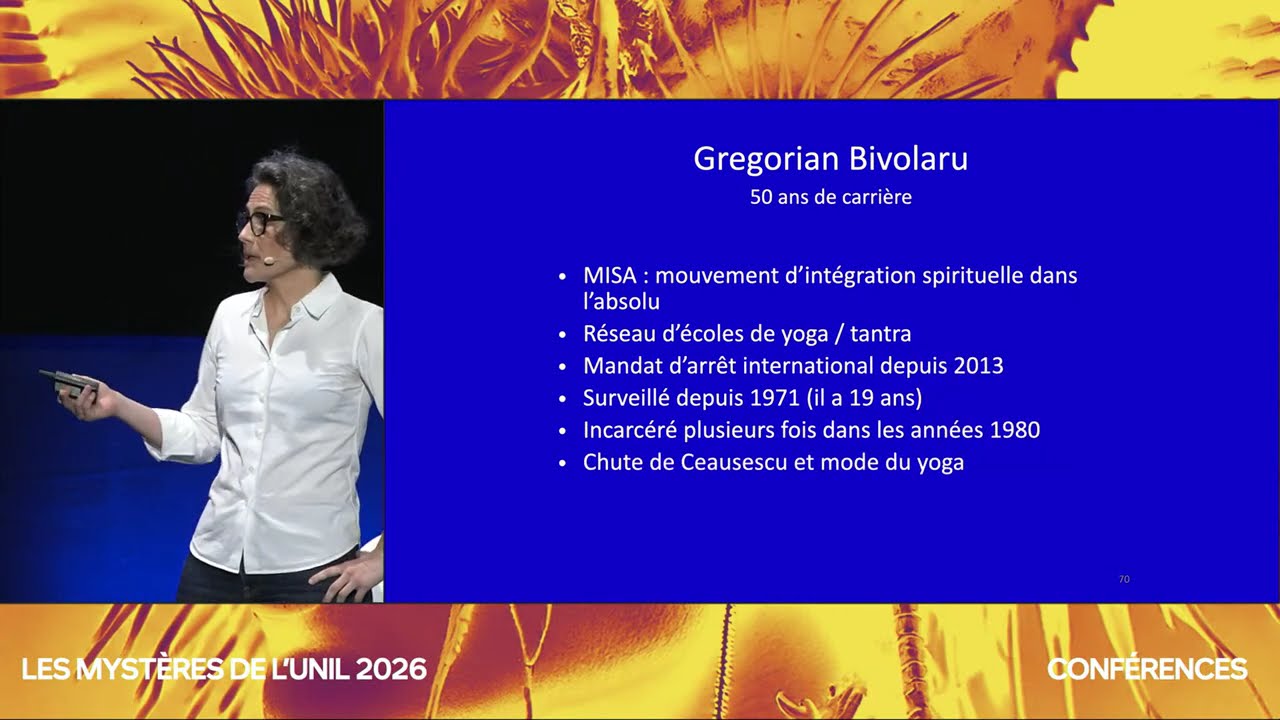
- Introduction of Gregorian Bivolarou and the MISA movement.
- Discussion of the product of appeal in various cultic movements.
- Exploration of motivations for joining such movements.
- Psychological vulnerabilities and personality traits that may facilitate influence.
- Dialogue with John Antonakis on leadership and charisma.
- Q&A session with the audience.
Cited Sources
- Méta de Choc (podcast) — The speaker's own podcast, which explores metacognition and critical thinking.
Concurring Sources
- International Cultic Studies Association (ICSA) — Research and resources on cultic groups and psychological manipulation.
Dissenting Sources
Contribution & Novelties
The talk offers a detailed case study of the MISA movement and synthesizes psychological mechanisms of influence in an accessible way. It emphasizes the gradual nature of indoctrination and the role of metacognition in resisting manipulation.
Pour aller plus loin :
- Cult Awareness Network — Provides resources on cultic groups and exit counseling.
- B. F. Skinner’s operant conditioning — Relevant to understanding behavioral control techniques.
- Cognitive dissonance theory — Explains how individuals rationalize contradictory beliefs.
75 words
Radar Profile
The radar profile shows high scores in information quality and reliability, but moderate in technical level and quantity, indicating a balanced but not deeply technical presentation.
💬 No comments were provided for analysis.