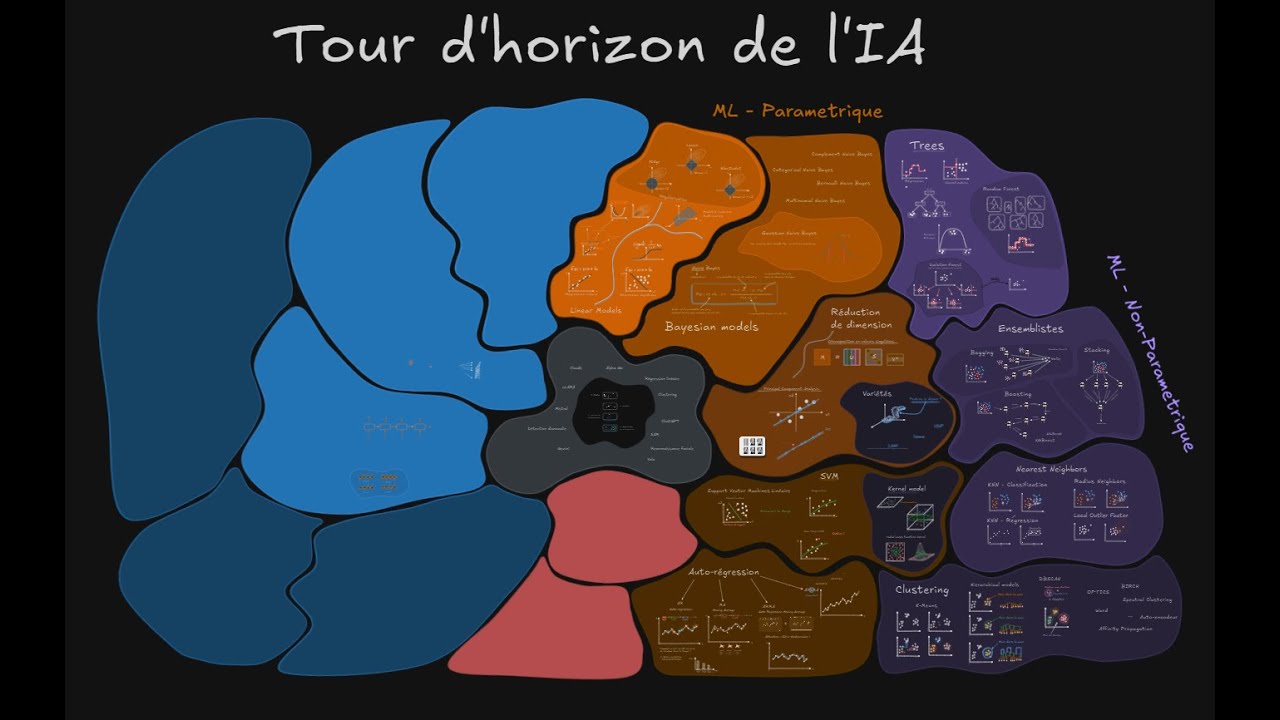
La carte de l'IA | Partie 1
Keywords
Summary
158 words
Critical Evaluation
Value of the Information & Strength of the Argument
The video provides a valuable high-level overview of AI models, effectively structuring the complex landscape into clear families. The argumentation is solid, as the presenter explains the underlying principles (data, model, performance measure, optimization) and connects them to specific algorithms. He uses intuitive examples and visualizations to illustrate concepts like linear regression, decision trees, and naive Bayes. The presentation is engaging and pedagogical, making it accessible to a broad audience. However, the depth is limited; it does not delve into mathematical derivations or provide detailed comparisons, but it serves as an excellent starting point for learners.
Scientific Rigor, Source Quality, Title Accuracy
The scientific rigor is adequate for an introductory overview. The presenter accurately describes fundamental concepts and mentions historical figures like Carl Friedrich Gauss and Claude Shannon. However, no specific sources are cited within the video, and the description only provides links to the creator’s own resources (website, GitHub, etc.). The title accurately reflects the content, as it is indeed a ‘map’ of AI models. The video does not claim to present original research but rather to synthesize existing knowledge. Overall, the content is reliable for educational purposes, though viewers seeking in-depth citations may need to consult additional resources.
209 words
Title / Content Match
The title accurately reflects the content: a comprehensive map of AI models, presented in a structured and visual way.
Quality & Reliability
8/10
The video provides a clear and structured overview of AI models, with accurate explanations of fundamental concepts. The presenter is an experienced data scientist, and the content is well-illustrated. However, it is a high-level overview without deep technical details or citations, so a perfect score is not warranted.
Key Moments
Markers derived by PSI from the transcript: the creator did not define chapters.
- Introduction and welcome back to YouTube after a long absence.
- Explanation of the four fundamental pillars of machine learning: data, model, performance measure, and optimization.
- Introduction to the map of AI and the first family: linear models.
- Detailed explanation of linear regression and the method of least squares.
- Discussion of gradient descent and its role in optimization.
- Introduction to regularized linear models (Ridge, Lasso, Elastic Net) and their purpose.
- Transition to tree-based models: decision trees and their orthogonal decision boundaries.
- Explanation of entropy and information theory in the context of decision trees.
- Overview of random forests and isolation forests as extensions of tree-based models.
- Introduction to Bayesian models, starting with naive Bayes and its independence assumption.
Cited Sources
- Machine Learnia GitHub — Mentioned as a resource for code and materials.
- Machine Learnia Website — Mentioned as the main website for courses and information.
- Free Book: Apprendre le Machine Learning en une semaine — Mentioned as a free resource for learning machine learning.
- Machine Learnia Formations — Mentioned as a link to sign up for the creator's training program.
Concurring Sources
- Machine Learnia GitHub — Provides code and resources that align with the video's content.
Contribution & Novelties
The video provides a clear and structured overview of AI models, organizing them into families and explaining their underlying principles. It is particularly useful for beginners to understand the landscape of AI without getting lost in technical details. The presenter’s pedagogical approach and visualizations make complex concepts accessible.
Pour aller plus loin :
- Linear regression — Foundational concept for linear models.
- Gradient descent — Key optimization algorithm used in training many models.
- Decision tree learning — Core idea behind tree-based models.
- Naive Bayes classifier — Simple yet effective probabilistic classifier.
90 words
Radar Profile
The radar profile shows high scores in quantity and quality of information, with a moderate technical level. This indicates a well-structured educational video that balances depth and accessibility, making it suitable for a broad audience.
💬 Très positif. Sur les 30 commentaires analysés, les spectateurs expriment une grande gratitude et admiration pour la clarté pédagogique et le retour de la chaîne, avec de nombreux témoignages de suivi depuis 2019-2021.