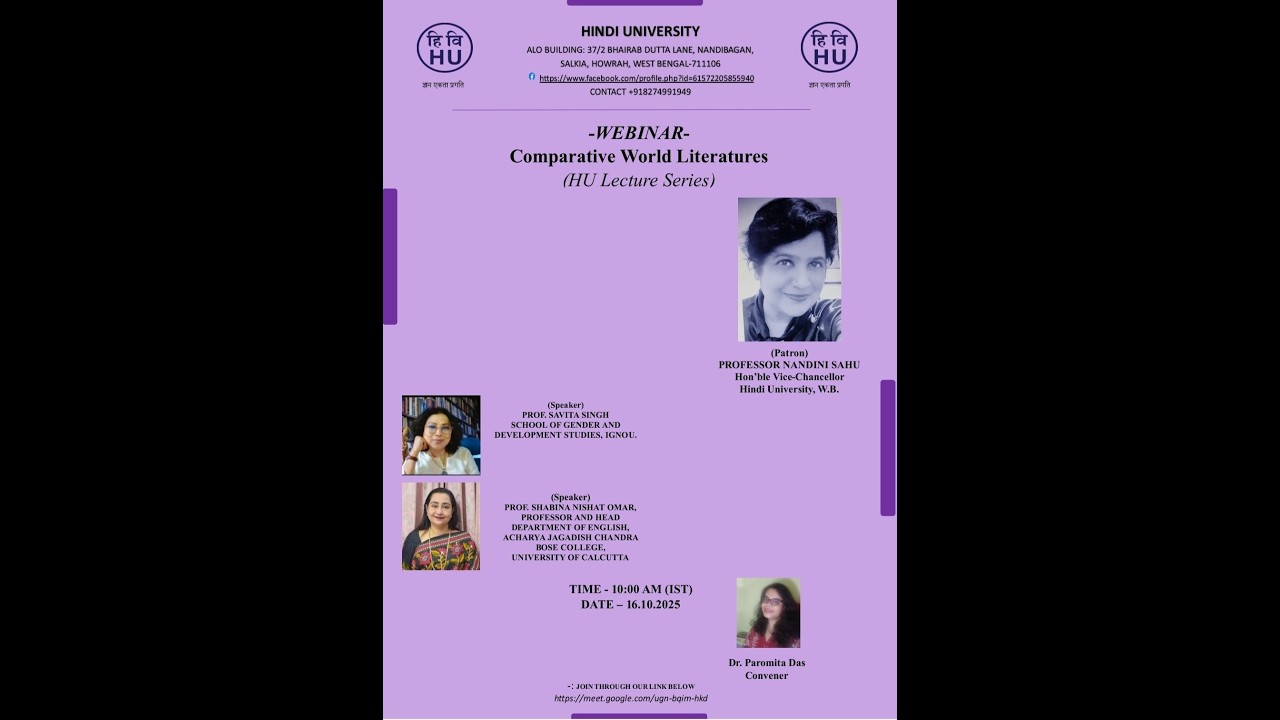
LECTURE 27: COMPARATIVE WORLD LITERATURES SERIES.
Keywords
Summary
159 words
Critical Evaluation
Value of the Information & Strength of the Argument
The lecture provides valuable insights into the works of László Krasznahorkai from a feminist perspective, offering a unique interpretation that connects his themes to feminist critiques of patriarchy and moral collapse. The argumentation is theoretically grounded, drawing on feminist epistemology, standpoint theory, and existential philosophy. However, the lecture is largely subjective and lacks empirical evidence or systematic analysis. The speaker’s personal reflections and theoretical framework are compelling but may not be accessible to a general audience. The argumentation is coherent but relies heavily on the speaker’s authority rather than on verifiable sources.
Scientific Rigor, Source Quality, Title Accuracy
The lecture demonstrates a high level of academic rigor in its theoretical framework, but it lacks explicit citations of sources. The speaker references literary works and theorists (e.g., Aristotle, Descartes, Marx, Herbert Marcuse, Susan Sontag) but does not provide specific references or URLs. The title accurately reflects the content, as it is a lecture in a series on comparative world literatures. The content is consistent with the title, focusing on comparative literature and its relevance to contemporary issues. However, the lack of verifiable sources and the subjective nature of the analysis reduce the overall scientific rigor.
203 words
Title / Content Match
The title accurately reflects the content as it is a lecture in a series on comparative world literatures.
Quality & Reliability
6/10
The lecture is an expert opinion by established academics, but it lacks verifiable sources and rigorous citations. The content is subjective and interpretive, with no empirical data or peer-reviewed references.
Key Moments
Markers derived by PSI from the transcript: the creator did not define chapters.
- Introduction and welcome by the host, Paramita, and Vice Chancellor Nandini Sahu.
- Nandini Sahu introduces the speakers and discusses the importance of comparative literature.
- Professor Savita Singh begins her lecture on László Krasznahorkai from a feminist perspective.
- Singh discusses the ontological basis of comparative literature and the self-other relationship.
- Singh analyzes Krasznahorkai's 'Satan Tango' and its depiction of moral collapse.
- Singh explores 'The Melancholy of Resistance' and its symbolic use of the whale.
- Singh connects Krasznahorkai's themes to feminist critiques of patriarchy and moral unlivability.
- Singh concludes her lecture, emphasizing the need for inclusive dialogues in literature.
- Introduction of the second speaker, Professor Shabina Nishat Omar, but her lecture is not included in the transcript.
Contribution & Novelties
The lecture offers a novel feminist interpretation of László Krasznahorkai’s works, linking his themes of moral collapse and existential crisis to feminist critiques of patriarchy. It highlights the importance of comparative literature in fostering inclusive dialogues and understanding the self through the other. The speaker’s theoretical framework, drawing on feminist epistemology and standpoint theory, provides a fresh perspective on contemporary global crises.
Pour aller plus loin :
- László Krasznahorkai - Wikipedia — Overview of the author’s life and works.
- Feminist Standpoint Theory - Internet Encyclopedia of Philosophy — Explanation of the theoretical framework used in the lecture.
- Blue Humanities - Wikipedia — Introduction to the concept mentioned by the second speaker.
111 words
Radar Profile
The radar profile shows moderate scores across all dimensions, with a slightly higher level of technical depth and information quantity, but lower reliability due to lack of citations. This suggests a lecture that is intellectually stimulating but not rigorously sourced.