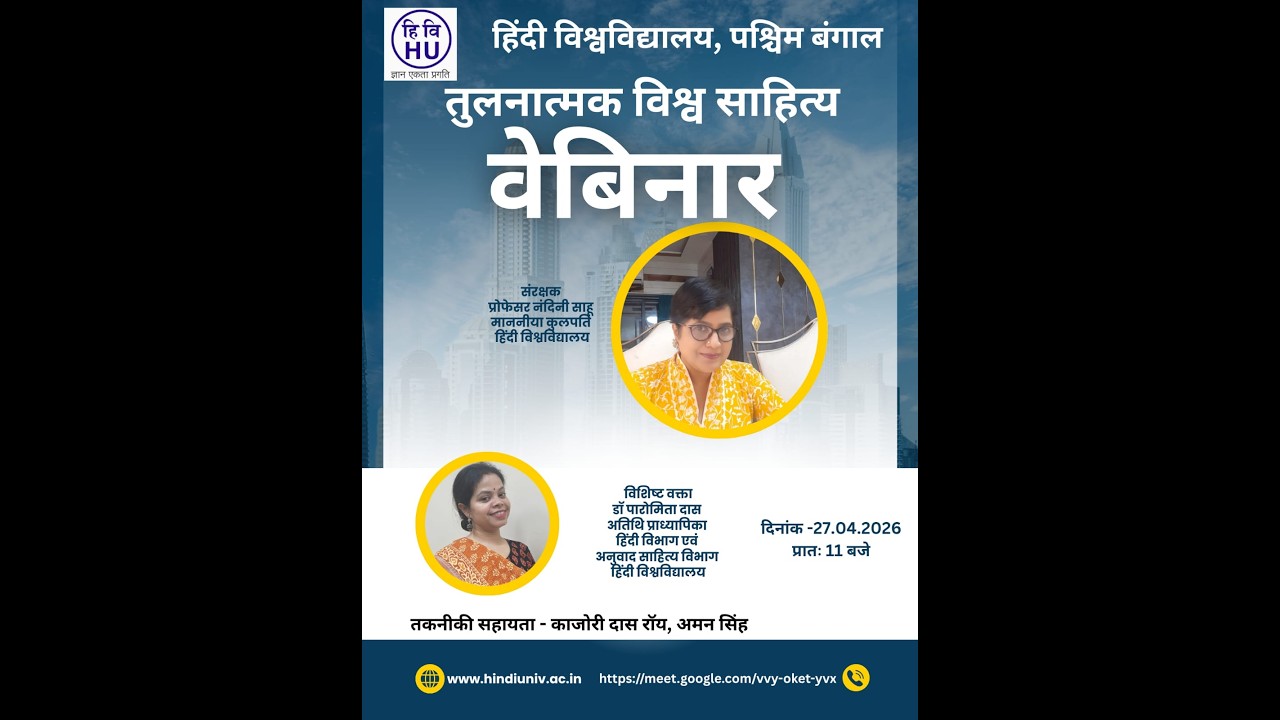
LECTURE: 38- COMPARATIVE WORLD LITERATURES SERIES.
Keywords
Summary
140 words
Critical Evaluation
Value of the Information & Strength of the Argument
The lecture provides a comprehensive historical overview of Hindi journalism, highlighting its significance in Bengal and its global expansion. The argumentation is primarily descriptive, presenting a linear narrative of key publications and their contributions. While the speaker mentions theoretical concepts like the colonial public sphere and cultural nationalism, these are not deeply explored or critically applied. The value lies in the compilation of historical facts and the emphasis on the role of Hindi journalism in shaping cultural identity and nationalist movements. However, the lack of critical analysis and engagement with scholarly debates limits its scholarly value.
Scientific Rigor, Source Quality, Title Accuracy
The lecture relies on historical facts and mentions several newspapers and figures, but does not provide specific citations or references. The sources are not verifiable from the video alone. The title is broad and does not accurately reflect the specific focus on Hindi journalism in Bengal, though it is part of a series on comparative world literatures. The content is presented as a lecture, and the speaker’s expertise is not established beyond her role as guest faculty. The lack of citations and critical engagement reduces the scientific rigor.
199 words
Title / Content Match
The title is generic and does not reflect the specific focus on Hindi journalism in Bengal, but it is part of a series on comparative world literatures.
Quality & Reliability
6/10
The lecture provides a historical overview of Hindi journalism in Bengal and its global spread, but lacks citations and critical analysis. It is more descriptive than analytical, with limited engagement with theoretical frameworks mentioned in the introduction.
Key Moments
Markers derived by PSI from the transcript: the creator did not define chapters.
- Introduction and overview of the lecture's themes.
- Discussion of the first Hindi newspaper, Udant Martand, and its significance.
- Mention of Bangadoot and its multilingual approach.
- Overview of 19th-century Hindi newspapers and their role in social reform.
- Discussion of Gandhi's journalism and its impact.
- Spread of Hindi journalism among the diaspora.
- Post-independence institutionalization and technological advancements.
- Conclusion and global presence of Hindi journalism.
Contribution & Novelties
The lecture offers a broad historical survey of Hindi journalism, particularly its origins in Bengal and its global spread, which may be useful for students new to the topic. However, it does not present new research or original insights. The speaker touches on theoretical frameworks but does not apply them in depth.
Pour aller plus loin :
- Hindi journalism — Overview of the history and development of Hindi journalism.
- Udant Martand — Details on the first Hindi newspaper.
- Subaltern Studies — Theoretical framework relevant to the lecture’s themes.
- Postcolonialism — Context for understanding the colonial public sphere.
97 words
Radar Profile
The radar profile shows moderate scores across all dimensions, with quantity of information being the highest, indicating a lecture that provides a substantial amount of historical data but lacks depth in critical analysis and technical rigor.