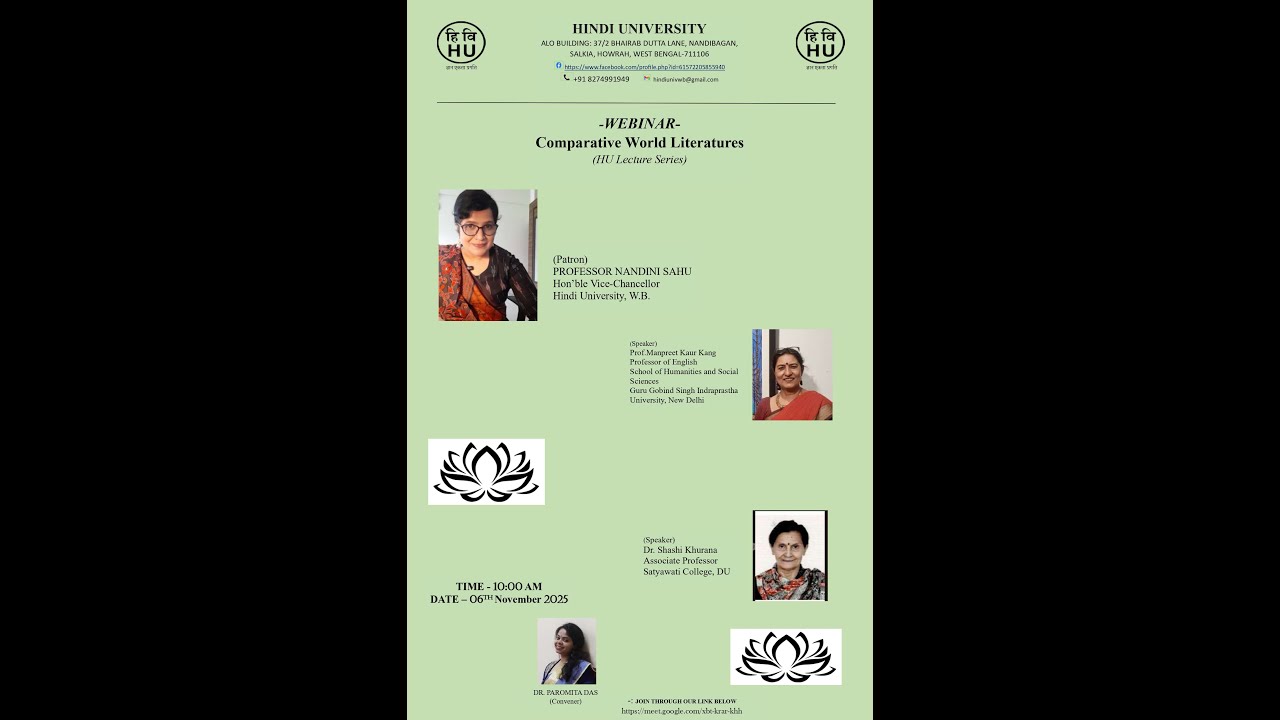
LECTURE 31: Hindi University, West Bengal Special Lecture Series
Keywords
Summary
194 words
Critical Evaluation
Value of the Information & Strength of the Argument
The lecture offers valuable insights into the theme of hunger as portrayed in two canonical texts, ‘Jane Eyre’ and ‘Nectar in a Sieve’. Dr. Khurana’s close reading of specific passages effectively illustrates the emotional and physical impact of hunger, and her comparison across British and Indian literature highlights universal human experiences while also acknowledging cultural specificities. The argumentation is largely based on textual evidence and personal interpretation, which is appropriate for a literary analysis. However, the lecture lacks a broader theoretical framework or engagement with existing scholarship on comparative literature, which limits its academic depth. The discussion is descriptive rather than analytical, and the potential for a more systematic comparison is not fully realized. Nonetheless, the lecture successfully demonstrates the value of thematic reading in comparative literature.
Scientific Rigor, Source Quality, Title Accuracy
The lecture demonstrates a reasonable level of scientific rigor in its close reading of primary texts, but it does not cite any secondary sources or scholarly references. The speakers rely on their own expertise and textual analysis, which is acceptable for a lecture but limits the verifiability of claims. The title accurately reflects the content, as the session is indeed a special lecture on comparative world literatures. The technical quality of the recording is moderate, with some interruptions and a video message that could not be played, which slightly detracts from the overall presentation. No comments were provided for analysis.
242 words
Title / Content Match
The title accurately reflects the content: a special lecture series by Hindi University, West Bengal, focusing on comparative world literatures.
Quality & Reliability
6/10
The lecture is an academic webinar featuring established scholars. The content is based on close reading of literary texts and personal academic experience, but lacks explicit citations or references to external sources. The technical quality is moderate, with some interruptions and a video message that could not be played.
Key Moments
Markers derived by PSI from the transcript: the creator did not define chapters.
- Introduction and welcome by the host, introducing the chairperson and speakers.
- Technical issues with playing the video message from Professor Nandini Sahu.
- Introduction of Dr. Shashi Khurana, the first speaker.
- Dr. Khurana begins her lecture on the theme of hunger in world literature, focusing on Jane Eyre.
- Reading and analysis of passages from Jane Eyre depicting hunger and poverty.
- Transition to Kamala Markandaya's 'Nectar in a Sieve' and discussion of hunger in the context of industrialization and colonialism.
- Reading and analysis of passages from 'Nectar in a Sieve' depicting starvation and malnutrition.
- Concluding remarks and brief Q&A session.
Cited Sources
- Jane Eyre — Primary text discussed in the lecture, by Charlotte Brontë.
- Nectar in a Sieve — Primary text discussed in the lecture, by Kamala Markandaya.
Concurring Sources
- Jane Eyre — Primary text discussed, consistent with the theme of hunger.
- Nectar in a Sieve — Primary text discussed, consistent with the theme of hunger.
Contribution & Novelties
The lecture offers a focused thematic analysis of hunger in two literary works from different cultural contexts, demonstrating the potential of comparative literature to highlight universal human experiences. However, it does not introduce new theoretical perspectives or original research. The discussion is primarily descriptive, and the comparative aspect is underdeveloped.
Pour aller plus loin :
- Comparative Literature — Overview of the field and its methodologies.
- World Literature — Concept and debates surrounding world literature.
- Hunger in Literature — Exploration of hunger as a literary theme.
85 words
Radar Profile
The radar profile shows moderate scores across all dimensions, with slightly higher scores in information quantity and quality, reflecting the lecture's substantive content but limited technical depth and source rigor. The low technical score indicates a lack of advanced theoretical or methodological sophistication.