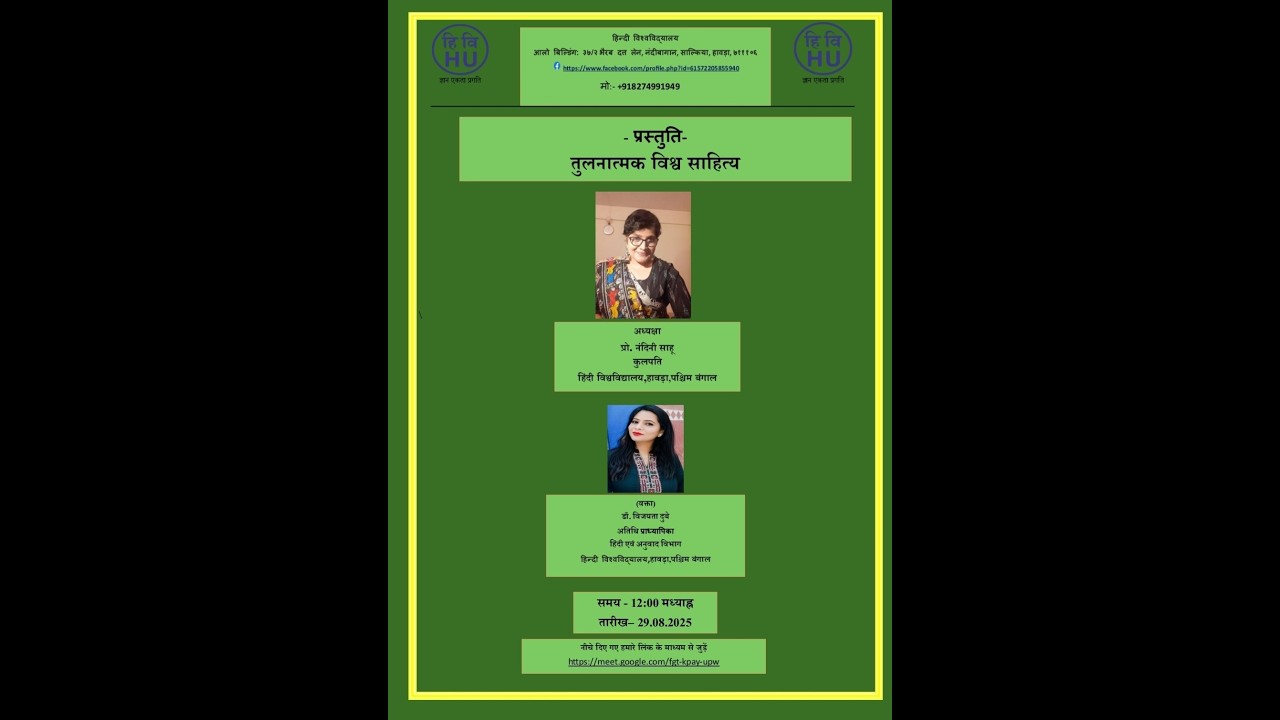
LECTURE 24: Hindi University, West Bengal Special Lecture Series
Keywords
Summary
149 words
Critical Evaluation
Value of the Information & Strength of the Argument
The lecture provides a broad overview of comparative world literature, tracing its historical development and emphasizing its importance in a globalized world. The argumentation is coherent, moving from the need for comparative study to its benefits and challenges. However, the value is limited by a lack of deep analysis or concrete examples; the presentation is more of an introduction than a critical examination. The speakers advocate for a pluralistic approach, but the argumentation relies on generalities and well-known references rather than novel insights.
Scientific Rigor, Source Quality, Title Accuracy
The lecture demonstrates moderate scientific rigor. It references several scholars and works (e.g., Goethe, Tagore, Edward Said, Gayatri Spivak) and mentions historical developments, but does not provide specific citations or sources. The title accurately reflects the content, as it is indeed a lecture in a series on comparative world literature. The presentation is structured and informative, but lacks the depth expected of a rigorous academic analysis.
164 words
Title / Content Match
The title accurately reflects the content: a special lecture in a series on comparative world literature at Hindi University.
Quality & Reliability
7/10
The lecture is an academic presentation by two professors, providing a structured overview of comparative world literature, its history, and significance. It references several scholars and works, but lacks detailed citations or verifiable sources. The content is largely descriptive and programmatic, with limited critical depth.
Key Moments
Markers derived by PSI from the transcript: the creator did not define chapters.
- Introduction by Prof. Nandini Sahu, Vice Chancellor, outlining the lecture series and its objectives.
- Discussion on the shift from Eurocentrism to plurality in comparative world literature.
- Emphasis on translation as an epistemic bridge and the power of translators.
- Dr. Vijayata Dubey begins her talk on the state and direction of comparative world literature.
- Historical overview: origins in 19th-century Europe, key scholars, and the establishment of comparative literature as a discipline.
- Discussion on the significance of comparative world literature for global understanding and peace.
- Relationship between Hindi literature and world literature, including mutual influences.
- Contribution of comparative literature to the development of Hindi literature.
- Challenges and solutions for comparative world literature.
- Conclusion and closing remarks.
Cited Sources
- Hindi University Journal of Interdisciplinary Studies — Mentioned as a forthcoming journal focusing on comparative literature.
- Translation as a Power by Nandini Sahu — Referenced by Prof. Sahu as her research publication on translation.
Concurring Sources
- Comparative Literature (Wikipedia) — Provides background on the discipline, its origins, and key scholars.
- World Literature (Wikipedia) — Discusses the concept of world literature and its evolution.
Contribution & Novelties
The lecture presents a programmatic vision for comparative world literature from an Indian perspective, emphasizing the inclusion of vernacular and tribal literatures. It advocates for a decolonized approach and highlights the role of translation in fostering epistemic justice. While not groundbreaking, it contributes to the ongoing discourse on world literature by centering Indian languages and traditions.
Pour aller plus loin :
- Comparative Literature (Wikipedia) — Overview of the discipline and its history.
- World Literature (Wikipedia) — Concept and debates around world literature.
- Translation Studies (Wikipedia) — Academic field related to translation theory and practice.
94 words
Radar Profile
The radar profile shows moderate scores across all dimensions, indicating a balanced but not exceptional lecture. The highest score is in quantity of information, reflecting the broad coverage, while technical depth and reliability are moderate, consistent with a general overview rather than a specialized analysis.
💬 No comments were provided for analysis.