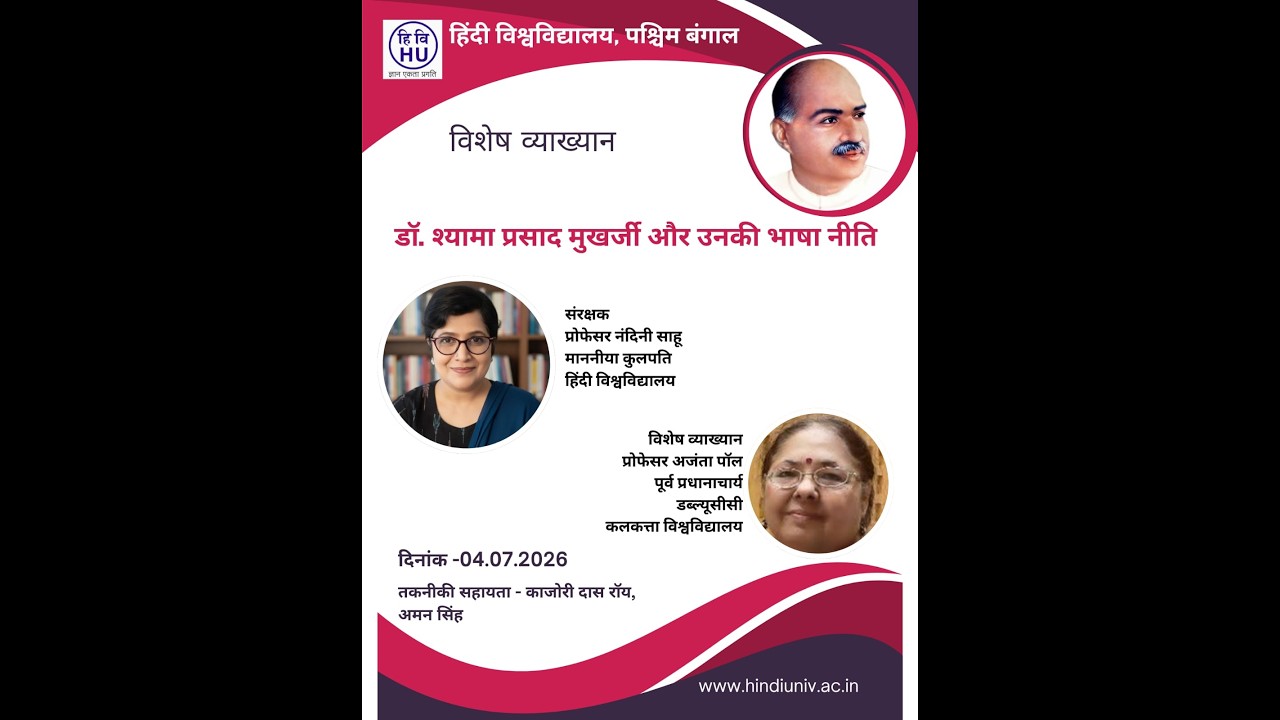
HINDI UNIVERSITY Special Lecture on Dr. Syama Prasad Mookerjee
Keywords
Summary
187 words
Critical Evaluation
Value of the Information & Strength of the Argument
The lecture provides valuable insights into Dr. Syama Prasad Mookerjee’s language policy, drawing on primary sources such as Constituent Assembly debates. The argumentation is coherent and well-structured, presenting Mookerjee’s views as a balanced approach between national unity and linguistic diversity. However, the lecture is largely descriptive and lacks critical analysis or engagement with counterarguments. The speaker’s expertise lends credibility, but the argumentation could be strengthened by addressing potential criticisms of Mookerjee’s positions.
Scientific Rigor, Source Quality, Title Accuracy
The lecture demonstrates scientific rigor by quoting directly from the Constituent Assembly debates, providing a primary source. The quality of sources is good, but the lecture does not cite secondary literature or scholarly analyses. The title accurately reflects the content, as the lecture is indeed about Dr. Mookerjee’s language policy. No comments were provided for analysis.
143 words
Title / Content Match
The title accurately reflects the content, which is a special lecture on Dr. Syama Prasad Mookerjee's language policy.
Quality & Reliability
7/10
The lecture is delivered by an academic expert, Prof. Ajanta Paul, and includes direct quotations from Constituent Assembly debates, indicating scholarly rigor. However, it is an opinion piece with limited critical analysis and no citations of secondary sources.
Key Moments
Markers derived by PSI from the transcript: the creator did not define chapters.
- Introduction by Vice Chancellor Prof. Nandini Sahu, welcoming attendees and introducing the lecture series on Dr. Syama Prasad Mookerjee.
- Prof. Sahu highlights Mookerjee's contributions to education and his role in protecting Bengali interests during partition.
- Prof. Ajanta Paul begins her lecture, providing a biographical sketch of Dr. Mookerjee.
- Discussion of the language debate in the Constituent Assembly, including the positions of Hindi supporters and regional representatives.
- Explanation of the Munshi-Ayyangar formula and the adoption of Hindi as official language with English as associate for 15 years.
- Quotation from Dr. Mookerjee's speech in the Constituent Assembly, emphasizing unity in diversity and the importance of Sanskrit.
- Further quotations from Mookerjee's speech, defending Bengali and other regional languages.
- Conclusion summarizing Mookerjee's balanced language policy and his legacy.
Cited Sources
- Constituent Assembly of India Debates (Proceedings) - Volume IX — Quoted extensively by Prof. Paul to illustrate Dr. Mookerjee's views on language policy.
Concurring Sources
- Constituent Assembly of India Debates (Proceedings) - Volume IX — Primary source quoted in the lecture, supporting the arguments presented.
Contribution & Novelties
The lecture offers a focused examination of Dr. Syama Prasad Mookerjee’s language policy, drawing on primary sources from the Constituent Assembly debates. It highlights his advocacy for linguistic pluralism and his balanced approach to national unity. The lecture is a tribute to Mookerjee’s vision, which remains relevant in contemporary debates on language policy in India.
Pour aller plus loin :
- Munshi-Ayyangar formula — Provides context on the constitutional compromise.
- Official Languages Act, 1963 — Relevant to the ongoing language debate.
- Syama Prasad Mukherjee — Biographical background.
86 words
Radar Profile
The radar profile shows high scores in information quantity, quality, and reliability, with a moderate technical level. This indicates a well-informed lecture that is accessible to a general audience, though it may lack depth for specialists.