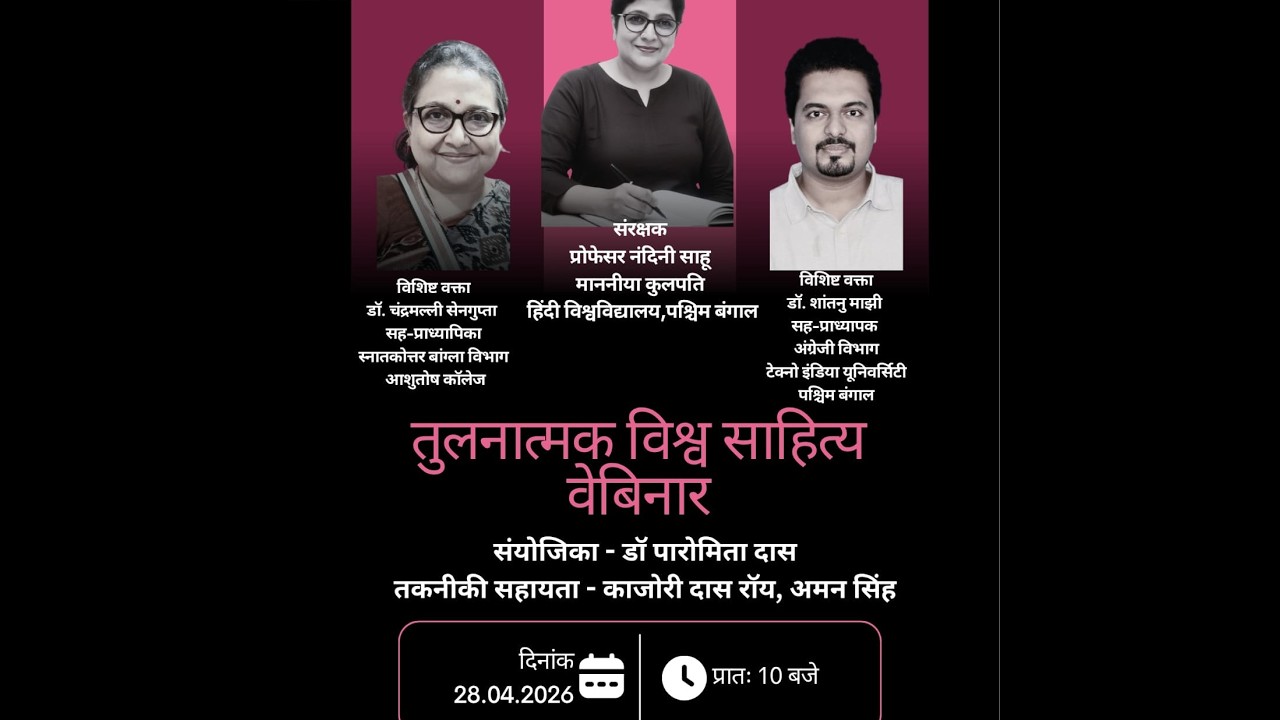
LECTURE: 39- COMPARATIVE WORLD LITERATURES SERIES
Keywords
Summary
119 words
Critical Evaluation
Value of the Information & Strength of the Argument
The value of the information lies in its scholarly perspective on decolonizing English studies, offering concrete pedagogical frameworks like ‘undisciplining’ and ’transimperialism.’ The argumentation is coherent and well-structured, drawing on established theorists (Goethe, Damrosch, Moretti) and recent initiatives. However, the discussion is largely theoretical and lacks empirical evidence or case studies. The speakers’ arguments are persuasive but rely on academic authority rather than data.
Scientific Rigor, Source Quality, Title Accuracy
The lecture demonstrates scientific rigor through references to academic works and initiatives, such as the ‘Undisciplining Victorian Studies’ essay and the ‘Undisciplining the Victorian Classroom’ project. However, specific sources are not formally cited, and the discussion is based on expert opinion. The title accurately reflects the content, which is a lecture in a series on comparative world literatures. The webinar is well-organized, with clear introductions and a structured format.
148 words
Title / Content Match
The title accurately reflects the content, which is a lecture in a series on comparative world literatures.
Quality & Reliability
7/10
The lecture features established academics discussing comparative world literature, decolonization, and pedagogy. The content is scholarly and references known theorists and initiatives, but lacks formal citations or peer-reviewed sources. The discussion is largely theoretical and opinion-based, with limited empirical evidence.
Key Moments
Markers derived by PSI from the transcript: the creator did not define chapters.
- Introduction by Dr. Paramita, welcoming participants and introducing the webinar.
- Inaugural address by Prof. Nandini Sahu, discussing the importance of the lecture series and introducing the speakers.
- Introduction of Dr. Shantanu Maji by Dr. Paramita, highlighting his academic background.
- Dr. Maji begins his lecture on 'From Colony to Classroom: English Studies in India', discussing world literature and comparativism.
- Dr. Maji discusses the 'undisciplining' approach and transimperialism in Victorian studies.
- Dr. Maji talks about the colonial origins of English syllabi and the need for decolonization.
- Dr. Maji concludes his lecture, and Dr. Chandramalli Sengupta is introduced.
- Dr. Sengupta begins her lecture on female priests in African and Indian novels (not transcribed).
- Q&A session and closing remarks.
Cited Sources
- Undisciplining Victorian Studies — Referenced by Dr. Maji as a foundational essay for the 'undisciplining' approach.
- Undisciplining the Victorian Classroom — International initiative mentioned by Dr. Maji as a pedagogical framework.
- David Damrosch's work on world literature — Mentioned as a contemporary theorist in world literature.
- Franco Moretti's work on world literature — Mentioned as a contemporary theorist in world literature.
Concurring Sources
- Undisciplining Victorian Studies — Referenced by Dr. Maji as a foundational essay for the 'undisciplining' approach.
- Undisciplining the Victorian Classroom — International initiative mentioned by Dr. Maji as a pedagogical framework.
Contribution & Novelties
The webinar contributes to the discourse on decolonizing English studies by proposing concrete pedagogical frameworks like ‘undisciplining’ and ’transimperialism.’ It emphasizes the need to read English literature within a global, comparative context, particularly from the perspective of the global south. The lecture series itself is an initiative to foster interdisciplinary dialogue.
Pour aller plus loin :
- World literature — Overview of the concept and its evolution.
- Postcolonial literature — Relevant to decolonization discussions.
- Comparative literature — Foundation of the lecture series.
81 words
Radar Profile
The radar profile shows high scores in information quantity and quality, with moderate technical level and reliability. This indicates a content-rich lecture with solid academic grounding, but with limited empirical evidence and formal citations.
💬 No comments were provided for analysis.